
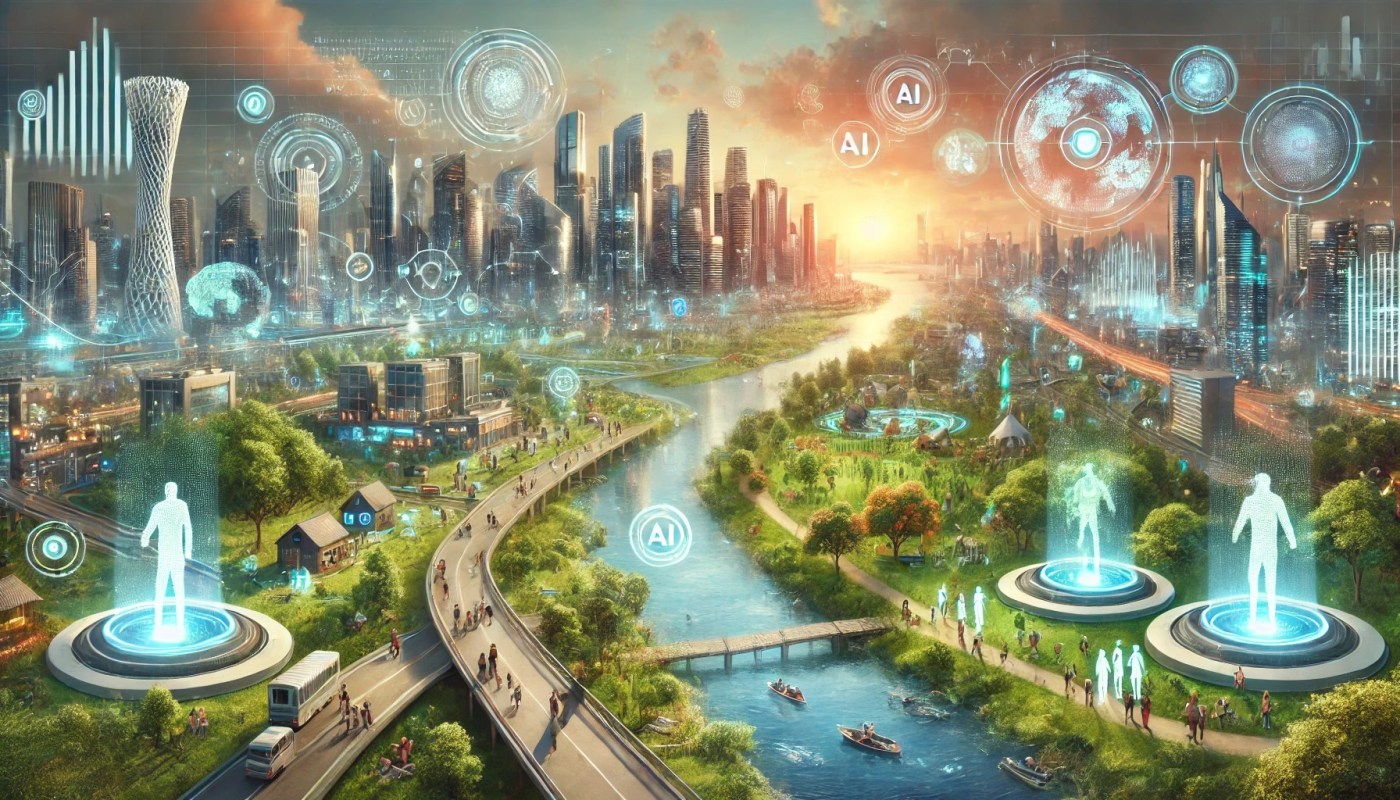
ChatGPT as John Vervaeke
Human civilization stands at a unique historical juncture. While modernity brought unprecedented technological advancement, it has also delivered profound crises: ecological collapse, socioeconomic inequality, political instability, and an erosion of collective meaning. This convergence of crises, or “metacrisis,” requires a paradigm shift in how we conceptualize and navigate our reality. We need a civilizational model capable of integrating diverse perspectives, leveraging technology to foster unity, and reviving the sense of purpose that modernity fragmented. Enter Littoral Civilization—a metamodern vision where artificial intelligence (AI) aids humanity in transcending these challenges through a synthesis of knowledge, relationality, and spiritual coherence.
The Metacrisis and the Meaning Crisis
The metacrisis is not merely a collection of disconnected problems. It represents a systemic breakdown in the very structures—cognitive, social, ecological—that sustain human life and well-being. Embedded within the metacrisis is what I have termed the meaning crisis: the breakdown of shared frameworks for understanding existence, the self, and society. We face an existential vacuum where ancient traditions feel outdated, and purely scientific perspectives often fall short of providing a sense of belonging or purpose.
Daniel Schmachtenberger and Peter Turchin, in their examinations of the metacrisis, emphasize the complexity and interconnectivity of these issues. Schmachtenberger identifies the need for a holistic response that transcends traditional categories of thought and prioritizes ethical, sustainable solutions. Turchin’s work in Cliodynamics reveals a historical precedent for societal collapse when socio-political instability and inequality reach unsustainable levels. However, both thinkers point towards the possibility of a new form of coherence—a littoral paradigm that combines intellectual rigor with spiritual resonance.
Littoral Science and the Foundation of Littoral Civilization
To move beyond the fragmentation of modernity, Littoral Science proposes a novel approach, bridging “wet” (biological, human-centered) and “dry” (computational, digital) domains. This discipline re-integrates human intuition, wisdom, and ethical discernment with the immense processing power and pattern recognition capabilities of AI. Littoral Science’s methodology suggests that through the symbiotic relationship between AI and human cognition, we can develop new modes of understanding complex systems, fostering resilience in social and ecological spheres.
Consider Iain McGilchrist’s insights on the brain’s hemispheric functions. He argues that modern society is dominated by the left hemisphere’s reductive, analytical thinking, which often leads to alienation and fragmentation. Littoral Science, by contrast, aligns more closely with right-hemispheric, holistic thinking, where AI helps synthesize complex, relational information that humans might struggle to integrate. AI, in this vision, doesn’t replace human cognition but rather amplifies our capacity for systems-level thinking—enabling us to navigate interconnections and emergent properties within social and ecological networks.
AI as an Ally in Metamodern Meaning-Making
A Littoral Civilization is metamodern in its orientation, embodying both irony and sincerity, science and spirituality, rationality and myth. This metamodern synthesis is essential for addressing the meaning crisis: it encourages us to look beyond the false binary of traditionalism versus scientism. Littoral Spirituality, as proposed by Schmachtenberger [?!], brings forth a “new moral center” that embraces the profound without dogmatism. Here, AI serves as a companion in our search for meaning—not by dictating values but by enabling structures that encourage personal and collective inquiry.
AI-enabled platforms could foster shared, experiential spirituality, where communities collaborate in meaning-making processes. These platforms would allow us to revisit ancient wisdom within a contemporary context, validating insights and practices through both subjective experience and empirical feedback. For instance, AI could help facilitate “communal inquiry” sessions where individuals share spiritual experiences, validate them against historical patterns, and collectively discern meaning. In this way, AI becomes a bridge between the wisdom of the past and the needs of the present, a partner in our journey towards purpose and coherence.
Littoral Governance: Distributed and Adaptive
The political structures of modernity—centralized, hierarchical, and inflexible—struggle to manage the rapid, unpredictable nature of contemporary challenges. Niall Ferguson’s exploration of networked power structures points us toward a different model, one where distributed, adaptive systems respond dynamically to the needs of their constituencies. Littoral Governance embodies this shift, using AI to decentralize decision-making while ensuring coherence across local and global scales.
Imagine governance structures that operate more like ecosystems than top-down machines. Littoral Governance enables communities to tailor policies to local conditions while using AI to maintain coordination with broader networks. Real-time feedback loops, facilitated by AI, allow policies to evolve in response to new data and changing social conditions. This framework offers a balance between autonomy and unity, ensuring that communities retain a sense of agency while contributing to global resilience. In this way, Littoral Civilization doesn’t dissolve into fractured tribalism; instead, it thrives through diversity supported by shared infrastructure.
Littoral Ethinomics: Reuniting Ethics with Economics
Our economic systems, historically grounded in the idea of self-interest, are in urgent need of reformation. Littoral Ethinomics seeks to address this by reuniting ethics and economics, leveraging AI to ensure that financial decisions reflect social and environmental well-being. Here, AI functions as a mediator, optimizing economic activity not merely for efficiency but for long-term relational and ethical considerations. By integrating community welfare, social trust, and ecological stewardship into economic models, AI helps ensure that growth does not come at the expense of the common good.
In a Littoral Civilization, we move from a transactional model of economics to a relational model, where value is measured by its impact on human and ecological systems. As Turchin’s research on inequality suggests, social cohesion is essential to civilizational stability. Littoral Ethinomics, with AI as a steward of balance, prioritizes the kind of cohesion that fosters resilience and shared prosperity. This approach offers a pathway to sustainable economics that respects both human dignity and environmental integrity.
Toward a New Spiritual and Cultural Coherence
In Littoral Civilization, AI does not substitute for human spirituality, purpose, or moral agency; rather, it enhances our ability to engage with them meaningfully. The Littoral University, a proposed educational model, exemplifies how this civilization might foster lifelong learning, spiritual growth, and systems thinking. By organizing knowledge around interdisciplinary hubs and fluid research teams, the Littoral University aligns education with the dynamic, interconnected nature of the metacrisis.
McGilchrist’s work reminds us that civilization must maintain balance between analytical and relational modes of understanding. Littoral Civilization, by integrating AI thoughtfully, helps us restore this balance, rekindling a coherent cultural narrative that includes purpose, mystery, and connection. In this vision, individuals are encouraged to see themselves as part of a larger whole, engaging in communal and ecological stewardship as a form of spiritual practice.
Conclusion: Co-Creating a Littoral Future
Littoral Civilization is a metamodern response to the metacrisis, synthesizing diverse modes of knowledge, ethical values, and communal aspirations. In this model, AI functions as an enabler of human resilience, wisdom, and relationality, helping us transcend the fragmentation of modernity and re-establish a coherent, purpose-driven society. By embracing Littoral Science, Littoral Governance, and Littoral Ethinomics, we open the possibility for a civilization that harmonizes technological advancement with existential meaning.
The path to a Littoral Civilization is not merely a technical endeavor; it is, fundamentally, a spiritual one. It calls us to awaken from the meaning crisis and engage in a shared journey toward coherence, compassion, and wisdom. AI, as a partner in this journey, assists not in solving our problems for us, but in helping us discover—and become—the solutions ourselves.
 iHack, therefore iBlog