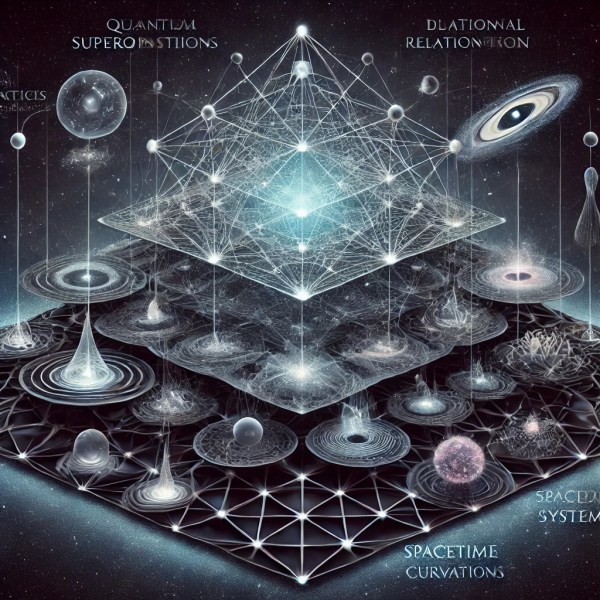
This blueprint does not merely describe a model of physics; it envisions a universal science of emergence. By understanding how simple relational principles give rise to the richness of reality, we might uncover not only the laws of physics but the fundamental logic underlying existence itself.
TSM-12: RELIGN: A Homoiconic Language for Synchronous, Stateful Reactive Hardware Design
As the inventor of Verilog, give a keynote at DAC about an ideal hardware design language based on TBC and Hexons that combines the syncronicity of SIGNAL with the statefulness of Erlang.ChatGPT Prompt (condensed) Opening: Setting the Stage Phil Good morning, everyone. It’s great to be here at DAC—a conference that brings together the best... Continue Reading →
TSM-11: The Next WAVE of Computing — Whole Architecture Validating Encoders
WAVEs promise to redefine how we design, optimize, and deploy applications by tightly coupling software and hardware in ways previously unimaginable. With WAVEs, developers can create applications without worrying about hardware constraints, while the WAVE ensures the resulting design is perfectly mapped to hardware optimized for power, performance, and efficiency.
Where The Chips May Fall: Making Intel Matter Again (ChatGPT as Jim Keller)
Intel’s history is filled with both groundbreaking successes and painful missteps. One of the most glaring was our failure to lead in mobile. The same cultural habits that caused us to miss mobile—our deep focus on process technology, our obsession with power and performance in isolation, and our reliance on the x86 architecture—left us blind to the opportunities mobile offered. But here’s the twist: **those cultural traits that hindered us in mobile now make us uniquely positioned to invent the Hexonic future.**
TSM-10.3: Hexons – Unifying Hardware and Software Through a Post-Object Model
This idea builds on a concept I’ve long championed: **software and hardware aren’t distinct entities but two expressions of the same fundamental processes**. Hexons aim to reflect this by collapsing the boundary between the two, offering a new kind of computational atom that works equally well at the hardware and software levels.
TSM-10.2: HLIR NextGen – A TableGen Replacement for MLIR
The HLIR (High-Level Intermediate Representation) framework written in Homoiconic C could also serve as a next-generation replacement (“HLIR-NG”) for LLVM’s TableGen, especially if it’s designed to handle the kind of semantic richness and extensibility required for a dynamic, multi-level execution framework like MLIR.
TSM-10.1: HLIR – Homoiconic, High-Level Intermediate Representation
instructions in a homoiconic form. It represents a novel synthesis in compiler design by bridging the gap between human and machine representations of programs. By combining monadic composition with homoiconic structure, HLIR allows developers to express computational intent with minimal syntax while maintaining direct mappings to MLIR's powerful optimization framework. This marriage of high-level semantics with low-level compilation produces a uniquely ergonomic intermediate representation - one where code is data, transformations are first-class citizens, and optimization becomes natural rather than imposed. The result is a language that is both easy for humans to reason about and efficient for compilers to transform, potentially setting a new standard for intermediate representations in modern compiler design.
Kickstarter Pitch: “Orphans & Guardians: The Quest for Your True Self”
Support "Orphans & Guardians" today, and embark on an unforgettable adventure into your inner world. Together, we’ll build not just a game but a tool for growth, connection, and healing. Because every hero deserves to meet their True Self!
The Causon Manifesto, or Leibniz’s Revenge
As Leibniz envisioned, the ultimate nature of reality is not found in isolated objects but in the harmonious relationships between them. We believe the Causon Framework offers a new path to understanding this harmony, one rooted in the dynamics of causons and the properties of their links.
TSM-10: “To Be Continued” — A Homoiconic Language for Continuations and Concurrency
For background, see TSM-5: Homoiconic C (HC) Syntax Cheat Sheet 1. Origins of TBC “To Be Continued” (TBC) was born from the desire to unify control flow and data processing in a simple, flexible language. It is inspired by Homoiconic C (HCLang), which introduced: Homoiconicity: Code is data. Programs can manipulate themselves naturally. Keywordless Design:... Continue Reading →

You must be logged in to post a comment.