Grammagraphs offer a formal, compositional, and learnable structure that bridges syntax and semantics, allowing AI systems to extract low-dimensional meaning from high-dimensional expression—guided by types, structured by categories, and compressed via geometry.
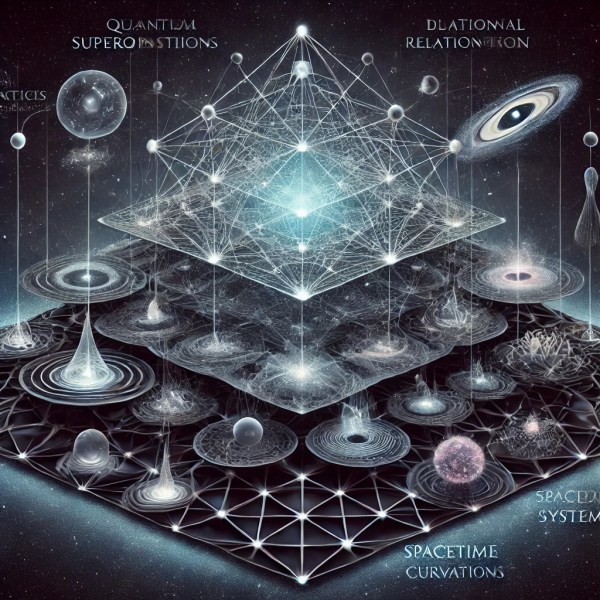
Barandes + Verlinde: On the Stochastic Emergence of Gravity
I’d agree with that. In fact, I argue spacetime is emergent — from entropy gradients driven by information flow. But I admit, I still take states and entropies as defined on space. What are you offering instead?
Exploring CODATA: A Constructive Foundation for Modern Physics
At its core, CODATA builds upon the Constructive Open Data Algebra (CODA) framework, which represents mathematical objects as finite sequences of pure data. CODA replaces abstract, non-constructive notions of "existence" with explicit constructions, making it an ideal foundation for computation and numerical methods.
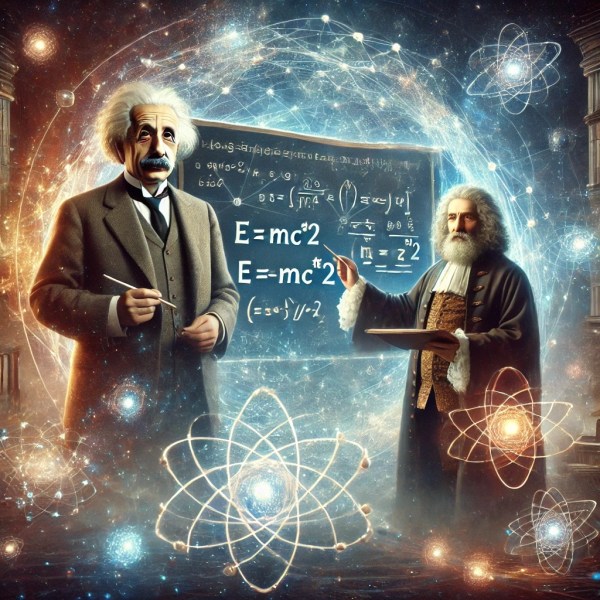
When Leibniz Met Einstein: Causation as the Fundamental Conserved Quantity
Einstein: A relational universe governed by causation… It seems we are on the edge of a great unification, Herr Leibniz. Perhaps causation is the true key to unlocking the mysteries of the cosmos…
Blueprint for Emergence (ChatGPT as Isaac Asimov)
This blueprint does not merely describe a model of physics; it envisions a universal science of emergence. By understanding how simple relational principles give rise to the richness of reality, we might uncover not only the laws of physics but the fundamental logic underlying existence itself.
TEDx Talk: The Fractal Emergent Self – Why You Are Always Becoming
Let me leave you with this: the fractal emergent self is not just a scientific concept—it’s a deeply human one. It reminds us that we are not bound by what we’ve been. We are dynamic, adaptable, and endlessly capable of becoming.
TSM-8: Golden Girls Architecture as a New Computational Philosophy
Collectively, the Shannon Machine, PEACE Monad, and Golden Girls Architecture represent a paradigm shift in how we conceptualize computation. They move away from the traditional view of a dominant CPU dictating operations to a more collaborative model where memory plays a central role.
TSM-2: Alan Turing versus The Shannon Machine
### Alan Turing Here’s a simple breakdown: **Shannon Machines:** - Start with data structures, with computation as secondary. - Focus on associative memory and managing state. - Use binary operators and bit transforms for math simulation. **Turing Machines:** - Start with basic arithmetic and build up to computation. - Provide a theoretical framework, independent of practical implementation. - Use algorithms to simulate any computing process.
Better People Than Scott Aaronson?
Reposting a letter sent to one of my Internet Heroes, whom I occasionally correspond with. He is my Hero not because of his brilliant, thoughtful blog on quantum computing (though I do enjoy that), but his deep humility and public vulnerability. Dear Scott, who are undoubtedly better people than I am For the record, no,... Continue Reading →
A Spirited Defense of Consciousness
Dear Scott, I finally found some deadlines to force me to put forward an account of consciousness. 🙂 Here it is. While rather simplistic, I have found it a useful model for clarifying my own thinking. The key innovation is defining Spirit as "the ability to reflect on our thoughts feelings and desires in order to... Continue Reading →

You must be logged in to post a comment.