Arithmetic that doesn’t terminate is not mathematics. / It’s wishful thinking with symbols…
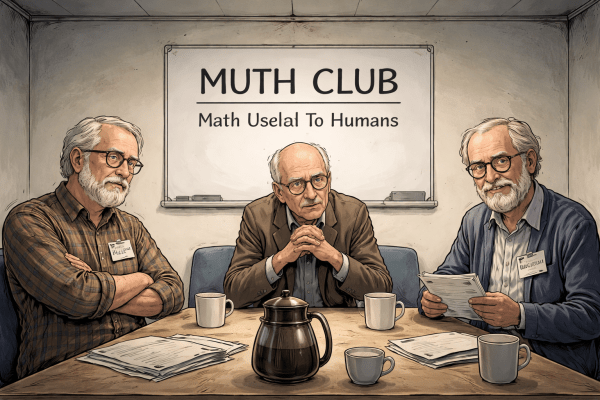
MUTH Club: Math as Engineering, not Science
Arithmetic that doesn’t terminate is not mathematics. / It’s wishful thinking with symbols…

In Laws of Form, I began with the mark: the act of drawing a distinction. / Yet the mark itself presupposes something deeper-- a prior domain in which no geometry is given. / Here I present a successor: The Laws of Formless, a calculus that precedes the making of form…

Here we explore a hypothetical construct, the diaphorum, motivated by a playful challenge from theoretical physicists: can one imagine a structure so basic that geometry, causality, and quantum texture all emerge from it?

Grammagraphs offer a formal, compositional, and learnable structure that bridges syntax and semantics, allowing AI systems to extract low-dimensional meaning from high-dimensional expression—guided by types, structured by categories, and compressed via geometry.

Not trained, Andrej. Learned. As in: the structure is fixed—types, arrows, limits— and the learning fills in the terms. A child writes in crayons over the architect’s blueprint.

came of age in the 1980s, as the C programming language and UNIX operating system were becoming the gold standard for "serious" computing. I was taught that: - Lisp reflects how computers **think** - C reflects how computers **work** - Shell scripts reflect how humans **write** I never questioned this split ....

Mark Burgin: Saul! I just finished reading about Homoiconic C and its concept of “named frames.” It struck me as an interesting middle ground between my named set theory and your pure data foundation. What’s your take on it?
 iHack, therefore iBlog