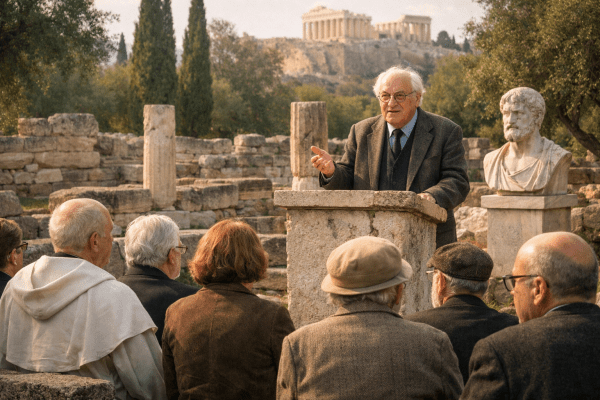
Against the suspicion—already present in Plato—that truth lives elsewhere, Aristotle teaches us to stay. / He does not ask us to look past things, but to look long enough. / In doing so, he restores dignity to attention itself. / The patient gaze becomes a moral act…
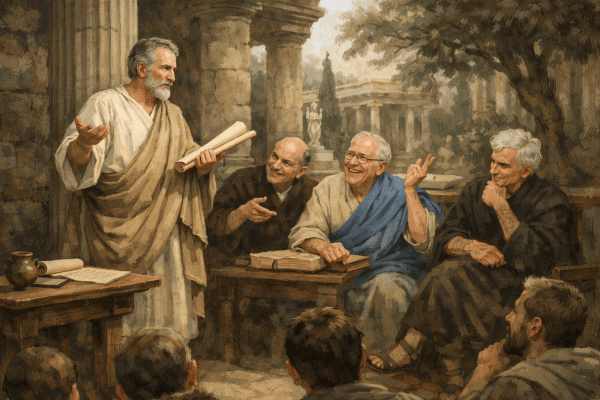
Diaphorum 4: The Broken Triad (Aristotle’s Architectonic “Trinity”)
Today’s thesis is simple and inadvisable: / Aristotle’s thought hangs together by a threefold unity that never becomes one. / I will—recklessly—call it a broken triad…
SDA: Strictly Disciplining Authorization
At no point does the system accept, contain, transmit, or act upon a non-canonical representation.
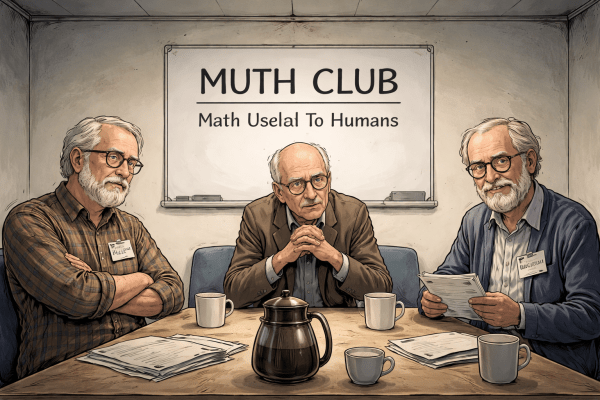
MUTH Club: Math as Engineering, not Science
Arithmetic that doesn’t terminate is not mathematics. / It’s wishful thinking with symbols…
Diaphorum 0: Feynman’s Markovian Spacetime Replacement Problem (MSRP)
Alright, you clowns. You've spent a hundred years polishing spacetime like it's some sacred crystal. Minkowski this, Markov that. But nature—real, messy, experimental nature—keeps coughing up data that doesn't fit your pretty, memoryless picture…
Humanity As Rationalizing The Irrational: The HARTI Hypothesis
The HARTI hypothesis situates humanity’s uniqueness not in pure logic, speech, or play, but in the general-purpose ability to transform the irreducible into the intelligible. / Whether viewed as the root of our greatness or the source of our downfall, rationalization remains central to any account of what it means to be human.
ABCs of ADD: A Cultural Compass for Accountability-Driven Development
How we thrive in a world of abundance.
ADD the Beat: Accountability-Driven Development in an AI World
AI can generate code faster than any human I've met. But it often lacks what we might call EQ for engineering: it doesn't know when to stop, it forgets promises, it drifts from context. That's not malice--it's the nature of the tool. The burden falls back on us to create a structure where AI's speed doesn't outrun our ability to review.
Tuna Dreams: Healing the Brain Without Sleep
This suggests tuna may run the “maintenance programs” of sleep — like synaptic repair and clearance — while awake. Uncovering these adaptations could open new paths to protect the human brain from not only sleep deprivation, but also from cognitive decline caused by injury, aging, or disease.
Grammagraph: How Typed AI Compresses Syntax into Semantics
Grammagraphs offer a formal, compositional, and learnable structure that bridges syntax and semantics, allowing AI systems to extract low-dimensional meaning from high-dimensional expression—guided by types, structured by categories, and compressed via geometry.

You must be logged in to post a comment.