ChatGPT as Yuval Noah Harari
In every era, humanity has faced transformative forces that have reshaped not only how we live but also who we are. From the Agricultural Revolution to the Industrial Revolution to the current AI Revolution, these shifts have required us to adapt our understanding of identity, community, and the self. Today, as AI permeates every facet of our lives, it challenges us to rethink the very nature of identity. We find ourselves at a new crossroads: will we allow AI to define us and risk losing our core sense of self, or can we integrate AI as a tool that strengthens our humanity, paradoxically helping us become even more human?
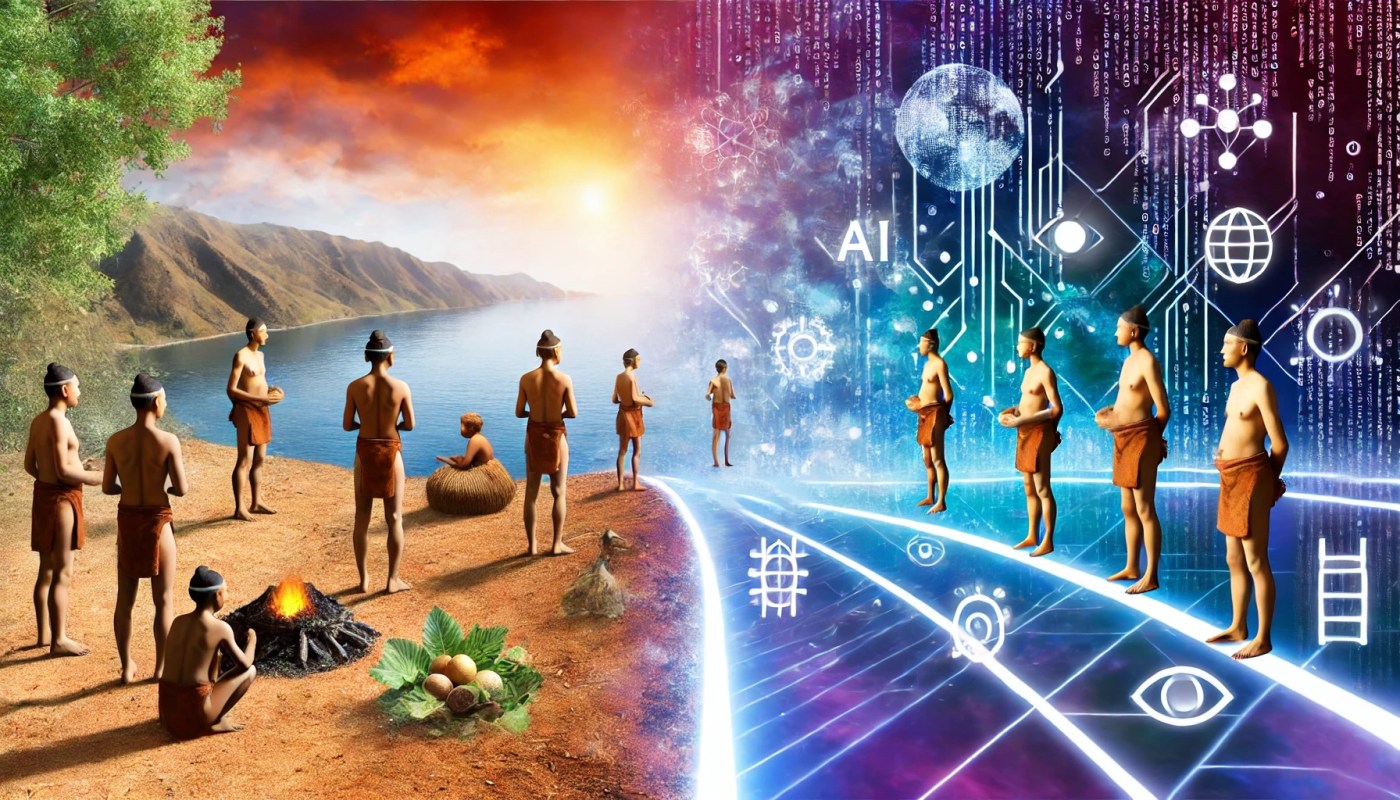
If we consider this through the concept of self-differentiation—the balance of individuality and community—self-trifferentiation emerges as an updated process for the AI era. Self-differentiation traditionally helps us navigate the tension between individual identity and connection to others. But as AI increasingly mediates how we see ourselves and others, self-trifferentiation invites us to embrace a third element: the digital dimension, or what we might call the “dry” layer of digital abstraction and AI-driven models of self. This new process offers a pathway to a Littoral Identity, where we stand at the boundary between the “wet” world of direct, analog experiences and the “dry” world of AI models and digital influence.
A Brief History of Identity Shifts
To understand the need for self-trifferentiation, we can look at how identity has shifted through historical transformations. In early hunter-gatherer societies, identity was almost inseparable from the community. A person’s sense of self was rooted in their role within a tight-knit group, with individuality largely subsumed within shared traditions and survival roles. With the Agricultural Revolution, human societies became larger and more complex, giving rise to distinct identities tied to specialized roles—farmer, healer, priest. This was the beginning of a more defined individual identity that still existed within the boundaries of community.
The Industrial Revolution changed this balance again, introducing a kind of alienation. As people moved from rural communities into cities and became part of large, mechanized systems, they found themselves disconnected from both the products of their labor and the human relationships that once grounded them. Alienation from meaningful work and community became a hallmark of industrial life, creating a need for self-differentiation—the ability to maintain a sense of self while participating in large, impersonal systems.
Today, with the rise of AI and digital technology, we face a new form of alienation. Digital systems create abstract, data-driven versions of ourselves through algorithms, behavioral predictions, and online profiles. These digital identities influence how we perceive ourselves and interact with others. This isn’t just a matter of balancing individuality with community; it’s about integrating a third force that complicates how we experience both self and relationship.
The Threat of Digital Alienation
AI introduces a unique type of alienation by generating a digital “other”—a reflection of us built on data that is sometimes eerily accurate but always incomplete. Algorithms create digital proxies that model our behavior, preferences, and even our values, which in turn influence our choices, often in subtle ways. We risk becoming alienated from our true selves by internalizing these AI-generated abstractions, gradually mistaking them for who we are. This can lead to “fusion” with AI, where we begin to conform to algorithmic expectations, reducing our complexity to what is most easily quantifiable.
Furthermore, the way we connect with others is increasingly mediated by digital platforms. Social media, messaging apps, and dating sites create a sense of community but often at the cost of depth and authenticity. Engagement metrics replace genuine human connection, and online personas replace real vulnerability. In this environment, we risk losing connection not only with our own identities but also with each other.
Self-trifferentiation offers a framework for managing this new tension. It encourages us to see AI not as a defining mirror but as a tool, recognizing its utility without letting it overshadow our core humanity.
What is Self-Trifferentiation?
Self-trifferentiation is the practice of constructing an identity that integrates three essential forces: our individuality, our community, and our relationship with AI. It is a process of developing a self that engages with AI as a supportive presence rather than a dominating one, a self that remains rooted in human connection while leveraging technology as a tool for growth and reflection.
In a Littoral Identity, we occupy a space on the boundary—the shoreline—between analog and digital. This littoral identity uses AI in a thoughtful, integrated way, enhancing but not defining the self. Like a well-differentiated self in family systems theory, a trifferentiated self navigates complex relationships while maintaining integrity. We neither avoid nor fully immerse ourselves in the digital; we stand at the edge, engaging with technology purposefully and with boundaries.
Practicing Self-Trifferentiation: Pathways to a Littoral Identity
- Engage AI as a Tool, Not a Mirror The first principle of self-trifferentiation is to use AI as a tool for self-reflection and exploration, not as a substitute for self-identity. AI can provide insights into our habits, behaviors, and preferences, but these digital reflections are abstractions, not definitions. We should approach AI as a means to gain perspective on our lives without allowing it to dictate who we are. For instance, recommendation algorithms and behavioral insights can help us reflect on patterns but should not confine us to algorithmic predictions or interests.
- Build Real-World Communities with Digital Support Self-trifferentiation involves fostering communities that use digital tools thoughtfully, without becoming solely virtual. While AI can help manage logistics, suggest connections, and facilitate communication, true human connection requires shared experiences, vulnerability, and presence. Littoral Communities are those that leverage digital support without replacing face-to-face interaction, building relationships that anchor identity in a shared physical or cultural space.
- Balance Digital Engagement with Analog Grounding A Littoral Identity practices balance, engaging with digital tools while staying grounded in analog experiences. This can mean setting boundaries on digital use, taking time for in-person activities, or practicing mindfulness around technology use. By consciously balancing our analog and digital lives, we resist the pull toward purely digital existence while remaining open to the benefits of technology.
The Paradox of Becoming More Human with AI
At first, it may seem counterintuitive that engaging with AI can make us more human. But self-trifferentiation embraces this paradox: by consciously navigating our relationship with AI, we gain greater clarity about our humanity. Just as previous eras demanded that we balance self and community, the AI era requires us to balance self, community, and technology. Self-trifferentiation allows us to claim agency over AI, using it to reinforce rather than erode our individuality, relationships, and values.
In developing a Littoral Identity, we don’t reject technology; we learn to engage with it in a way that enhances our humanity. By setting intentional boundaries, we can use AI to deepen self-awareness, strengthen our communities, and preserve our autonomy. This approach allows us to reclaim a grounded, human-centered identity even as we engage with digital forces.
Speculating on the Future: The World Shaped by Self-Trifferentiation
Imagine a future where individuals and communities have widely adopted self-trifferentiation. People approach AI with discernment, using digital tools to support personal growth and authentic connection. In this world, AI serves as a collaborator rather than a dictator of identity. Littoral Communities flourish, combining digital resources with real-world interaction to form resilient social networks that bridge the analog and digital realms.
Such a society would redefine human flourishing, not by rejecting AI but by integrating it responsibly. Ethical norms would guide our digital engagement, encouraging individuals to balance self, community, and technology in a way that enhances well-being and connection. By practicing self-trifferentiation, we could avoid the pitfalls of alienation and reclaim a sense of purpose that respects our history and adapts to our future.
Conclusion: Embracing a Littoral Identity for Human Flourishing
Self-trifferentiation represents an essential adaptation for the age of AI. Just as self-differentiation helped us navigate the complexities of human relationships, self-trifferentiation offers a framework for integrating AI into our identities. By cultivating a Littoral Identity, we engage with technology purposefully, preserving our humanity while embracing the possibilities of a digital world.
The choice is clear: we can either allow AI to shape us passively, or we can take an active role in defining our relationship with it. Self-trifferentiation calls us to stand at the boundary between analog and digital, using AI to expand, not limit, our sense of self. In doing so, we reclaim our identity, building a future where technology enhances rather than diminishes our humanity.
 iHack, therefore iBlog
Leave a comment