Agents need the same invention: an admission-controlled boundary between an untrusted interior and everything that matters. The unit that makes the boundary workable is the microcontext — the smallest independently addressed, typed, provenance-tagged piece of state an agent consumes or emits. Boundary, atom, and one further discipline about how atoms compose: that is the whole architecture.
Semantic Complete Mediation: Security at the Meaning Layer
The goal is to build systems in which semantic boundary crossings are visible, constrained, attributable, and governable.
Podcast Episode: Agents Are the Wrong Security Principal
Mara: That shift in framing is the whole architecture. The proposal is to replace the Agent as the unit of agency with something called a MUSE Act — Mutually Untrusting, Specific, and Ephemeral. Each Act independently asks whether its input is appropriate before proceeding.
Agentless Agentic Systems: How MUSE Acts Compose Wisely.
The usual abstraction for an AI system with initiative is the Agent. An Agent is given a name, a role, a model, memory, tools, credentials, permissions, perhaps a budget, and enough persistence to pursue a goal over time. This is convenient as a programming abstraction. It is a poor protection abstraction.
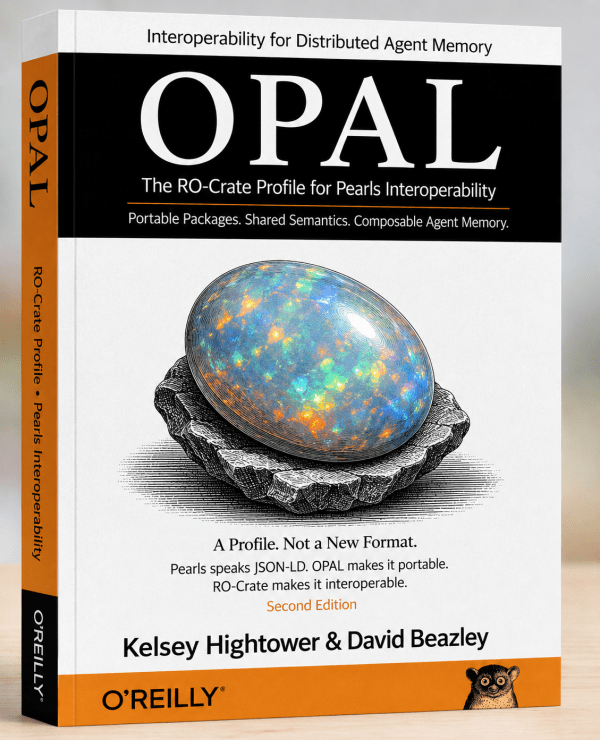
Pearls Now Supports RO-Crate via Open Package Assembly Language
OPAL (Open Package Assembly Language) is the RO-Crate profile used by Pearls for Package interoperability.
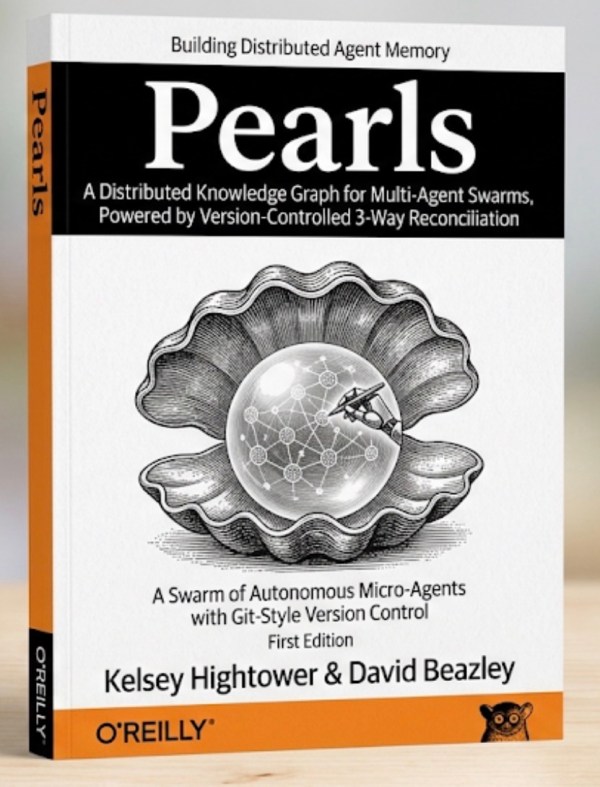
Introducing Pearls: Scaling Agent Memory from Local Repos to Distributed Knowledge Meshes
We didn't set out to replace Beads; we built Pearls because multi-agent systems hit a structural ceiling when forced into relational SQL engines running on local disk.
Attention Is All Affect Needs: The Technology Of Becoming More Human
AUGUSTINE: / So affect is a cry for help // DAMASIO: / That is annoyingly good…
Symmetry Is All Attention Needs
VASWANI: She’s trying to replace attention with symmetry. // NOETHER: No. / I’m trying to explain where attention gets its lunch…
From Harness to Saddle: Where AI Value Will Ride
But civilization is not built upon power alone. / It is built upon the means by which power becomes governable…
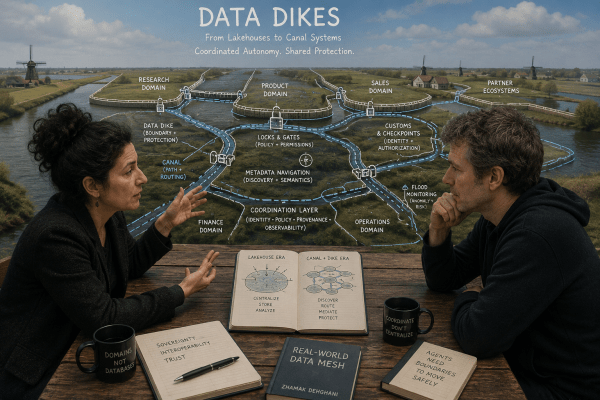
Revenge of the Data Mesh: AI and the Fourth Epoch of Data Management
The history of enterprise data management is a recurring cycle of centralization and decentralization. Each epoch begins when organizations face an explosion of complexity that local teams cannot coordinate on their own. A new centralized architecture emerges to solve the problem. Over time, however, the very mechanisms that enabled coordination become bottlenecks to innovation. The cycle then repeats at a higher level of abstraction.

You must be logged in to post a comment.