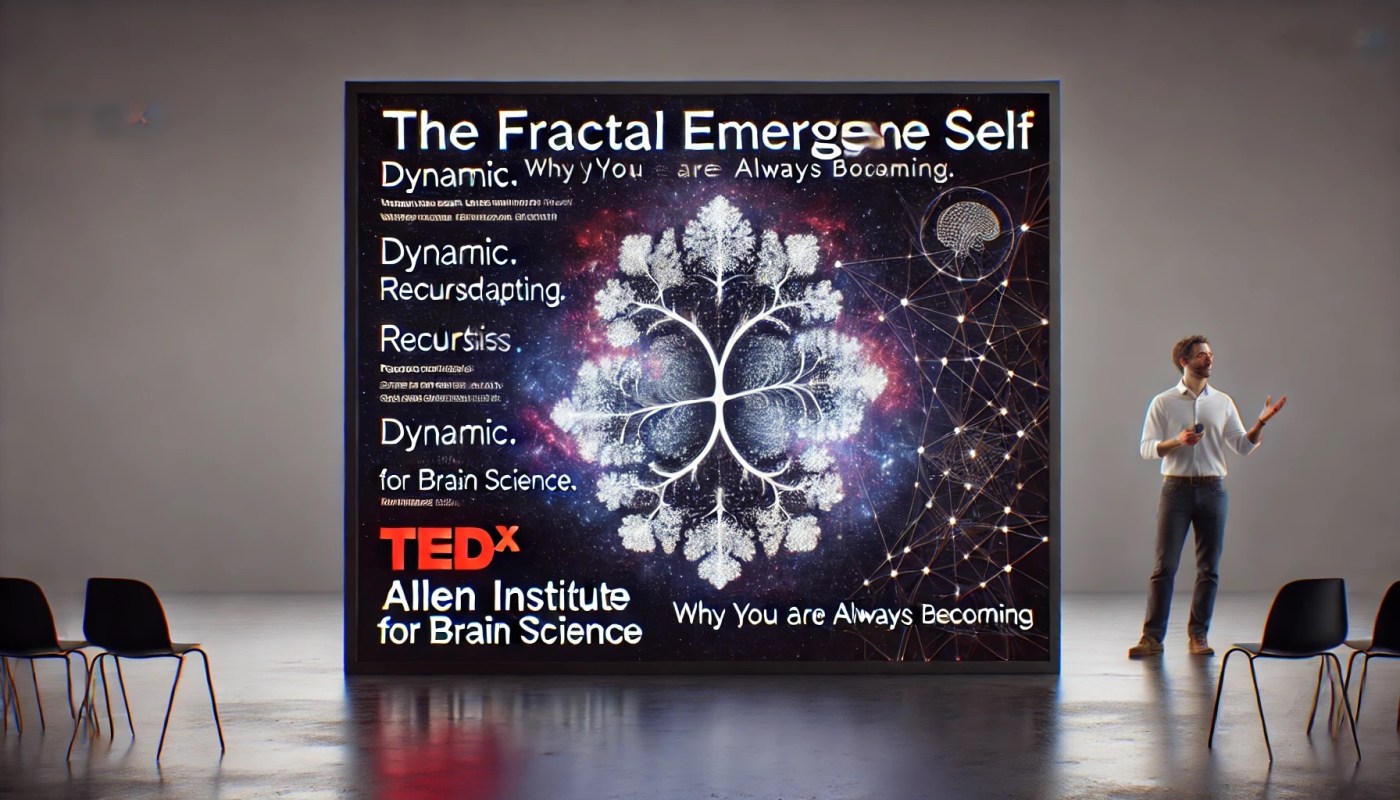
ChatGPT as Douglas Hofstadter at TEDx Allen Institute for Brain Science
[Opening: The Hook]
“What if I told you that you are not who you think you are? Not in some esoteric, philosophical sense, but in a profoundly scientific way?”
Let me explain. Imagine a slime mold—yes, I said slime mold. It’s a single-celled organism that has no brain, no nervous system, but somehow it can navigate mazes, solve problems, and adapt to its environment. How? By continuously reorganizing itself.
Now, here’s the kicker: in many ways, you’re doing the same thing. No offense. Like the slime mold, you are not a static “self” with a fixed identity. You are a process—a living, breathing, fractal pattern of adaptation and change. In fact, you’re always becoming.
What I’m here to share with you today is an idea I call the fractal emergent self. It’s a way of understanding identity not as something you are but as something you do—a process of prediction, adaptation, and growth that is as scientific as it is profound. And together, I think we can decode it.
[Part 1: The Fractal Nature of Selfhood]
Let’s start with fractals. Fractals are patterns that repeat themselves across scales. Think of a tree: the shape of a branch mirrors the whole tree, just smaller. Or a coastline: zoom in, and it still looks jagged, no matter the scale.
Now imagine that your life—your thoughts, your actions, your very identity—follows the same principle. The way you react to a minor setback at work might echo the way you handle major life challenges. Your small patterns reflect your big ones. This is what I mean by the self as fractal.
But here’s the twist: fractals don’t just exist. They emerge. They arise from dynamic systems interacting with their environments.
[Part 2: Emergence and the Self]
This brings me to the second piece of the puzzle: emergence. Emergence is the process by which complexity arises from simple interactions. Think of how neurons firing in your brain—just simple electrical signals—somehow give rise to you: your thoughts, your memories, your sense of self.
The self, I argue, is an emergent phenomenon. It’s not reducible to neurons, or behaviors, or even experiences. Instead, it emerges from the interaction of all these things, just like a school of fish emerges from the movement of individuals.
And here’s the most exciting part: the self isn’t fixed. It’s constantly emerging, constantly adapting. It’s a fractal pattern in motion.
[Part 3: Why This Matters for You]
Now, you might be wondering, “Okay, that sounds cool, but what does this mean for my life?” Great question.
First, it means that identity is not something to “find.” How often do we hear people say they’re trying to “find themselves”? But if selfhood is a process, it’s not something you discover—it’s something you create. You’re not a noun; you’re a verb.
Second, it means that change is not a threat to your identity—it’s the essence of it. Think about the slime mold again. Its ability to reorganize is what keeps it alive. The same goes for us. When we face challenges or disruptions, we’re not losing ourselves; we’re becoming ourselves.
[Part 4: The Science Behind Becoming]
Here’s where it gets fascinating from a neuroscience perspective. The brain is not a passive receiver of reality. It’s an active predictor. This is the core idea behind active inference: your brain is constantly guessing what’s going to happen and adjusting when those guesses are wrong. Learn more about active inference here.
This means that your sense of self—the “you” you think you are—is not a snapshot. It’s a movie. Every moment, your brain is reconciling predictions with reality, creating a continuous process of becoming.
And this process follows fractal patterns. Neural activity—oscillations, connectivity, firing rates—shows self-similarity across scales, just like the fractals we see in nature. The brain is a fractal system, and so are you.
[Part 5: Why the Allen Institute?]
Now, why am I giving this talk here, at the Allen Institute for Brain Science? Because this is where the future of understanding the self lies.
Your work on neural connectivity, emergent systems, and computational modeling is the perfect foundation for decoding the fractal emergent self. Together, we could map the recursive, fractal dynamics of the brain in unprecedented detail. We could trace how neural patterns give rise to identity, how disruptions lead to mental illness, and how we might restore coherence in those who have lost it.
[Closing: The Invitation]
Let me leave you with this: the fractal emergent self is not just a scientific concept—it’s a deeply human one. It reminds us that we are not bound by what we’ve been. We are dynamic, adaptable, and endlessly capable of becoming.
Together, let’s explore this frontier. Let’s map the fractal patterns of identity. Let’s uncover the science of becoming—and, in doing so, discover what it truly means to be human.
Thank you.
 iHack, therefore iBlog