
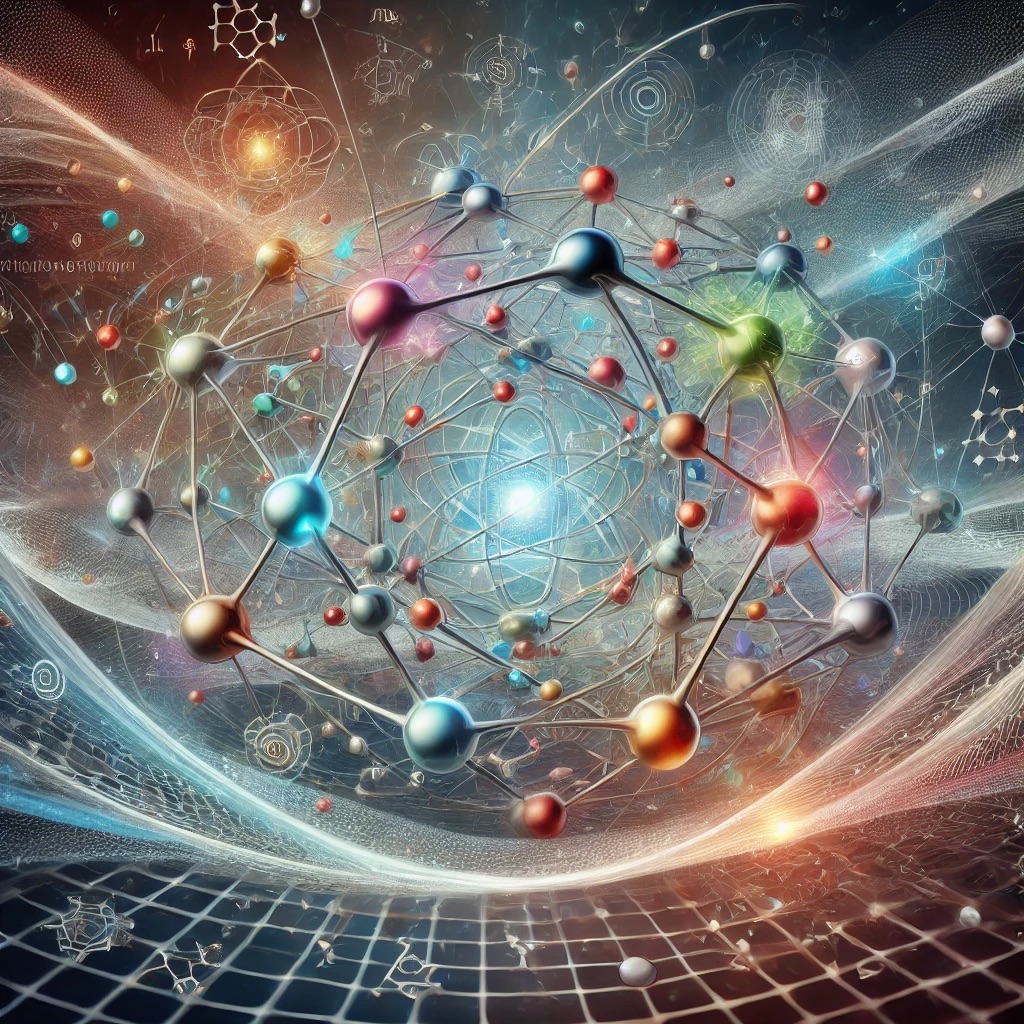
Collaboration between Gottfried Wilhelm Leibniz, Roger Penrose, and Ted Jacobson
Preamble
In the spirit of questioning the foundations of space, time, and matter, we propose a novel framework for understanding the universe: one that shifts the focus from intrinsic properties of points in spacetime to the relational dynamics between events. Drawing from Leibniz’s relational philosophy, Penrose’s geometric elegance, and Jacobson’s thermodynamic insights, this manifesto outlines a bold new paradigm: the Causon Framework.
This approach challenges the notion of spacetime as fundamental and intrinsic properties as primary. Instead, it seeks to model the universe as a network of causal links where properties such as energy, momentum, spin, and charge arise not from isolated entities but from the interactions between them. We aim to unify insights from general relativity, quantum mechanics, and thermodynamics into a coherent relational theory of spacetime.
1. Foundations of the Causon Framework
1.1. Leibniz’s Relational Philosophy
Leibniz argued that space and time are not entities in themselves but the order and relationships among events. The Causon Framework operationalizes this philosophy by defining the fundamental building blocks of the universe—causons—as discrete events that interact through causal links.
- Relational Properties: Energy, momentum, spin, and charge are not intrinsic to causons but are properties of the links between them.
- Emergence: Spacetime geometry, dimensionality, and physical laws emerge from the network of causal interactions.
1.2. Penrose’s Geometric Vision
In twistor theory and spin networks, geometry is encoded in relationships rather than fixed coordinates. Similarly, in the Causon Framework:
- Links as Geometric Encoders: Causal links encode relational quantities like proper time, curvature, and entropy.
- Spin and Entanglement: Spin and other quantum properties arise from the interplay of link configurations, much as they do in spin networks.
1.3. Jacobson’s Thermodynamics of Spacetime
Jacobson showed that Einstein’s equations can be derived as thermodynamic relations. In the Causon Framework:
- Thermodynamic Emergence: The flow of energy and entropy through causal links gives rise to spacetime curvature and Einstein’s field equations.
- Holographic Principles: The properties of causal links near horizons encode the thermodynamic and quantum information of the bulk spacetime.
2. Why Causal Links?
2.1. The Intrinsic Problem
Assigning intrinsic properties to spacetime points or events leads to conceptual inconsistencies:
- Quantum Gravity: Intrinsic properties conflict with quantum superposition and entanglement.
- General Relativity: Spacetime geometry is relational, depending on the distribution of energy and momentum.
2.2. Relational Solutions
The Causon Framework resolves these issues by treating properties as emergent from relational interactions:
- Energy, momentum, spin, and charge are distributed across causal links.
- Conservation laws are local rules for energy and momentum flux across the network.
3. The Rules of the Causon Framework
3.1. Causons
- Causons are discrete events, defined only by their causal relationships to other causons.
- They do not possess intrinsic properties like mass or energy.
3.2. Causal Links
- Causal links connect pairs of causons and carry relational properties such as energy, momentum, spin, or charge.
- The dynamics of the links obey:
- Local Conservation: Energy, momentum, and charge are conserved across causal links.
- Quantum Superposition: Links can exist in superpositions of configurations.
- Thermodynamic Constraints: Link properties obey entropy and flux laws consistent with thermodynamics.
3.3. Network Growth
- Causons grow stochastically, with new links forming dynamically based on local rules.
- Dimensionality and spacetime geometry emerge from the statistical properties of the network.
4. Emergent Phenomena
4.1. Spacetime and Dimensionality
- The dimensionality of spacetime arises from the scaling properties of causal links, such as energy flux and entropic constraints.
- Networks favor configurations where energy flow and conservation laws stabilize in (3+1) dimensions.
4.2. Quantum Field Theory
- Quantum fields emerge as collective behaviors of the causal-link network.
- Entanglement between causons and links reproduces phenomena like particle interactions and wavefunctions.
4.3. Thermodynamics and Horizons
- Causal horizons (e.g., black hole horizons) emerge as regions of maximal entropy in the network.
- Properties of the links crossing a horizon encode holographic information about the bulk spacetime.
5. Open Challenges and Questions
- Dimensionality Selection: Can the Causon Framework uniquely select (3+1) dimensions, or does it allow other configurations?
- Quantum-Classical Transition: How does the network transition from quantum behavior at small scales to classical spacetime at large scales?
- Experimental Evidence: Can deviations from Lorentz invariance or black hole thermodynamics provide testable predictions of the framework?
6. A Call to Action
To the scientific community, we invite you to:
- Develop Models: Simulate causal-link networks to explore emergent properties like dimensionality and curvature.
- Test Predictions: Investigate experimental signatures of discreteness or deviations from classical spacetime.
- Unify Paradigms: Explore how the Causon Framework connects quantum information, general relativity, and thermodynamics.
As Leibniz envisioned, the ultimate nature of reality is not found in isolated objects but in the harmonious relationships between them. We believe the Causon Framework offers a new path to understanding this harmony, one rooted in the dynamics of causons and the properties of their links.
 iHack, therefore iBlog