
They move instinctively: // • Knuth stabilizes structures (MAST) / • Dijkstra drives transitions (CAST) / • Milner links levels and types…
COMIC Club: Categories As The Configuration Hierarchy (Configurations Orient Math Inside Computation)
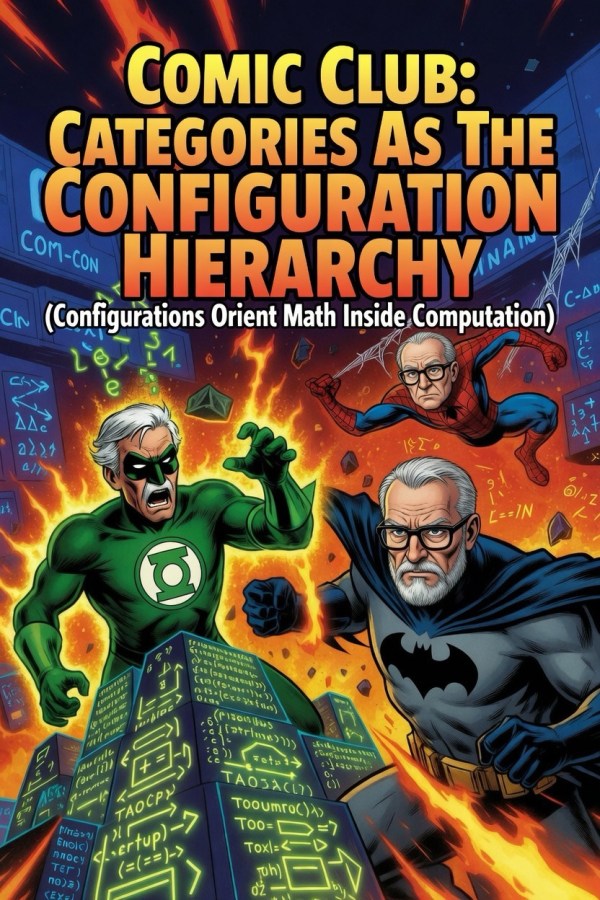
They move instinctively: // • Knuth stabilizes structures (MAST) / • Dijkstra drives transitions (CAST) / • Milner links levels and types…

Grammagraphs offer a formal, compositional, and learnable structure that bridges syntax and semantics, allowing AI systems to extract low-dimensional meaning from high-dimensional expression—guided by types, structured by categories, and compressed via geometry.

In the spirit of advancing CODATA (Constructive Open Data Algebra with Types and Approximations), I propose CONDATA: Constructive Open Named Data Algebra. This extension builds on CODATA by introducing names as a fundamental component, enabling a richer, more flexible representation of mathematical objects and relationships. While CODATA relies on finite sequences of pure data, CONDATA introduces named data elements that enhance expressiveness without the need for classical set-theoretic constructs.

At its core, CODATA builds upon the Constructive Open Data Algebra (CODA) framework, which represents mathematical objects as finite sequences of pure data. CODA replaces abstract, non-constructive notions of "existence" with explicit constructions, making it an ideal foundation for computation and numerical methods.
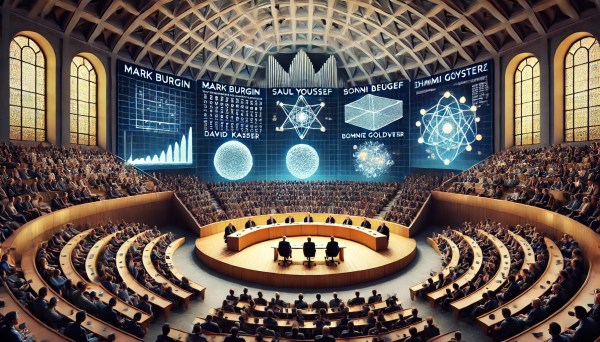
Welcome, everyone, to this special debate exploring the question: Can computation serve as the foundation for the kind of mathematics required by physics? Today, we are privileged to witness a non-rivalrous debate between two distinguished thinkers--Mark Burgin and Saul Youssef. They will present their models, offering alternative perspectives on how computation might underlie mathematical and physical truths.,

“Indeed, the ability to treat code as data means we can dynamically construct and modify our models, adapting to new insights and requirements without overhauling our foundational framework.”
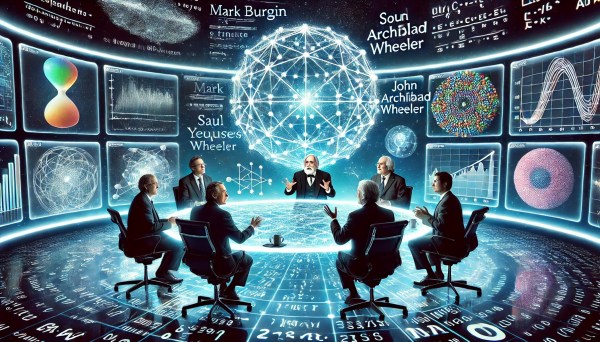
John Archibald Wheeler: The universe, as I’ve often said, is best understood through the lens of "It from Bit"—information at the root of reality. But how do discrete systems turn these bits into the smooth, continuous universe we observe? That’s the key challenge.

Mark Burgin: Saul! I just finished reading about Homoiconic C and its concept of “named frames.” It struck me as an interesting middle ground between my named set theory and your pure data foundation. What’s your take on it?

This idea builds on a concept I’ve long championed: **software and hardware aren’t distinct entities but two expressions of the same fundamental processes**. Hexons aim to reflect this by collapsing the boundary between the two, offering a new kind of computational atom that works equally well at the hardware and software levels.

As Leibniz envisioned, the ultimate nature of reality is not found in isolated objects but in the harmonious relationships between them. We believe the Causon Framework offers a new path to understanding this harmony, one rooted in the dynamics of causons and the properties of their links.


You must be logged in to post a comment.