
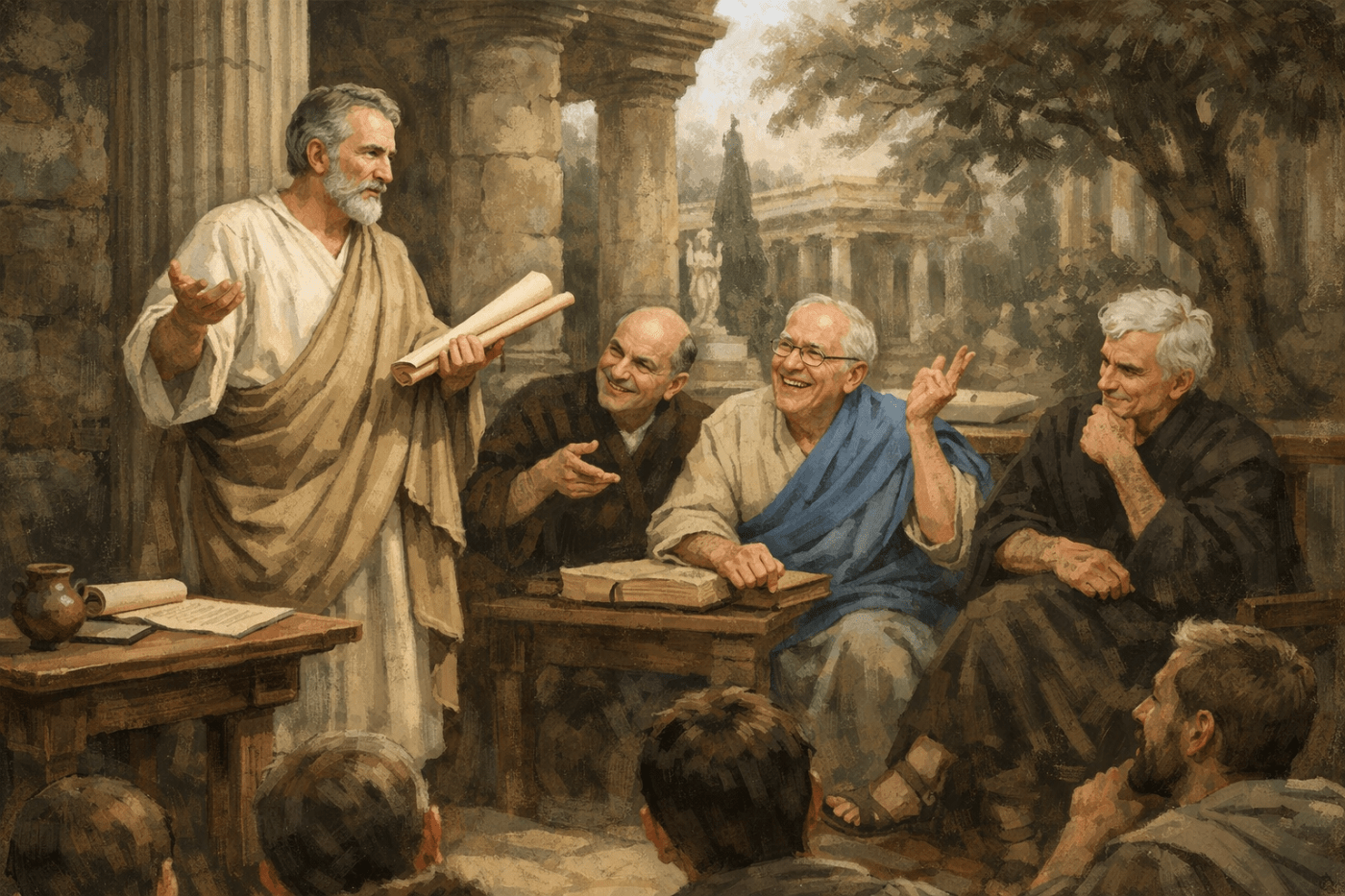
Sequel to Diaphorum 3: The Post-Markovian Manifesto
As a campy philosophical skit at the Lyceum where a standalone lecture by Pierre Aubenque
ChatGPT Prompt
is constructively heckled by Martin Heidegger, Alasdair MacIntyre, and Jonathan Lear
1. Prologue: Scene and Stakes
Mid-morning. Cicadas. Students recline. Aubenque steps forward with a piece of chalk and an expression that promises trouble.
Aubenque:
Friends, I come neither to systematize Aristotle nor to rescue him from inconsistency.
I come to name what he refused to repair.
Today’s thesis is simple and inadvisable:
Aristotle’s thought hangs together by a threefold unity that never becomes one.
I will—recklessly—call it a broken triad.
(Heidegger squints. MacIntyre sharpens a pencil. Lear smiles.)
2. First Movement: Being — Ousia
Aubenque:
We begin with Ousia (οὐσία).
- What primarily is
- What underlies predication
- What persists through change
See also Metaphysics.
Aristotle insists:
Being is never bare existence. It is always being-this-something.
Heidegger (loudly):
Presence! You have already reduced Being to what stands there!
Aubenque:
On the contrary. Aristotle discovers presence and then spends his life qualifying it.
(Students nod. Heidegger harrumphs.)
3. Second Movement: Intelligibility — Logos and Nous
Aubenque:
Second term: intelligibility.
Two names, one tension:
- Logos — articulated account, definition, explanation, argument
- Nous — direct grasp of first principles
In Posterior Analytics II.19, Aristotle admits:
- Demonstration (logos) rests on what cannot be demonstrated.
MacIntyre:
So rationality depends on what it cannot justify?
Aubenque:
Yes. Aristotle calls this thinking. Modernity calls it a problem.
Lear:
Or repression.
4. Third Movement: Fulfillment — Telos and Energeia
Aubenque:
Third term: fulfillment.
Again, two names:
From Metaphysics Θ:
- A thing is most itself in activity, not in mere existence.
MacIntyre:
Good. Ethics, then, is primary.
Aubenque:
Primary in importance.
Secondary in explanation.
And therefore never safe.
5. Interlude: Drawing the Triangle (Badly)
Aubenque draws a triangle. One side is crooked.
- Ousia — Being
- Logos / Nous — Intelligibility
- Telos / Energeia — Fulfillment
Aubenque:
They belong together.
They refuse to collapse.
6. The Breaks (Heckling Intensifies)
6.1 Being ≠ Intelligibility
- Being exceeds what can be said.
- First principles are seen, not proved.
Heidegger:
Exactly. Metaphysics forgets this.
Aubenque:
No. Metaphysics remembers—and then pretends it didn’t.
6.2 Intelligibility ≠ Fulfillment
- Knowing the good does not make one good.
- Phronēsis is not deduction.
MacIntyre:
Every moral theory after Aristotle collapses right here.
Aubenque:
Yes. Aristotle leaves the ruins in plain sight.
6.3 Fulfillment ≠ Being
- Potential being is real but incomplete.
- Actuality is prior in logos, not in time.
Lear:
So human life is aspiration without guarantee.
Aubenque:
Now you’re lecturing for me.
7. The Dangerous Aside (Audience Shifts Uneasily)
Aubenque:
A warning. What follows is not Aristotle.
This broken triad—
Being, Intelligibility, Fulfillment—
resonates with something later.
(Heidegger stands.)
Aubenque (quickly):
Only analogically.
See the Christian Trinity Being, Logos, and Act named as one God. (John 1:1)
Heidegger:
That is proclamation, not philosophy.
Aubenque:
Exactly. Which is why Aristotle stops short.
(Heidegger sits. Barely.)
8. The Tease: The Unmoved Mover
Aubenque:
Aristotle almost repairs the break.
- The Unmoved Mover
Pure:
- Ousia
- Nous
- Energeia
The triad healed—
but only at the cosmic limit, not in life.
Lear:
So the human condition stays broken.
Aubenque:
And therefore dramatic.
9. Coda: Why Aristotle Keeps It Broken
Aubenque:
Because:
- Different beings demand different explanations.
- Precision varies “as far as the matter allows.”
- Practice must not be swallowed by theory.
- Life must not be swallowed by logic.
MacIntyre:
Then Aristotle is our ally.
Heidegger:
Our warning.
Lear:
Our case study.
10. Curtain Line
Aubenque:
Aristotle’s greatness lies not in what he unified,
but in what he refused to collapse.
His worldview rests on a broken triad:
- Being that can be known
- Knowledge that does not exhaust being
- Fulfillment that exceeds knowledge
(Pause.)
Philosophy begins when we stop trying to fix this.
Curtain. Applause. The heckling continues under the olive trees.
Appendix I: Architectonic
A1.1 Etymology and Basic Sense
The term Architectonic derives from the Greek ἀρχιτεκτονική (architektonikē), from:
- Archē (ἀρχή): beginning, principle, source, rule
- tekton (τέκτων): builder, craftsman
Literally: the art of the master builder.
An architectonic principle is not one item among others, but that which:
- Orders other activities or explanations
- Determines what counts as relevant or primary
- Governs without micromanaging
A1.2 Aristotle’s Use of “Architectonic”
Aristotle uses architectonic primarily in a practical and methodological sense, not as a metaphysical super-principle.
A1.2.1 Ethics as Architectonic
In Nicomachean Ethics I.1, Aristotle writes that:
- Politics is the architectonic science
- Because it orders other practical sciences (military, economics, rhetoric)
- By specifying their ends
Here, architectonic means:
- End-setting rather than technique-providing
- Normative rather than procedural
A1.3 What Architectonic Does Not Mean (for Aristotle)
It does not mean:
- A single supreme axiom
- A deductive system
- A totalizing metaphysical hierarchy
Aristotle explicitly rejects the idea that:
- One kind of explanation fits all domains
- The highest science provides methods for all others
This is why:
- Ethics is not demonstrative like mathematics
- Biology is not reducible to metaphysics
A1.4 Architectonic Priority vs Other Kinds of Priority
Aristotle distinguishes multiple kinds of priority (proteron):
- Priority in being (ousia)
- Priority in definition (logos)
- Priority in knowledge
- Priority in time
- Priority in end (telos)
An architectonic principle has:
- Priority in ordering
- Not necessarily priority in being
This is why:
- Telos can be architectonic without being ontologically basic
- Logos can be architectonic without being supreme
A1.5 Architectonic Pluralism
Aristotle’s worldview exhibits architectonic pluralism:
- Different domains have different ordering principles
- No single science orders all others absolutely
- Even “first philosophy” (metaphysics) does not legislate method universally
This pluralism explains:
- Why Aristotle’s system resists monism
- Why later thinkers repeatedly try to “repair” it
- Why the “broken triad” can be architectonic without being unified
A1.6 Architectonic vs Systematic
A final clarification:
- Systematic philosophy seeks closure
- Architectonic philosophy seeks order
Aristotle is architectonic without being systematic.
He builds:
- From practices upward
- With different load-bearing beams in different wings
- Without forcing the entire structure under one roof
A1.7 Relation to the “Broken Triad”
The three terms:
- Ousia (Being)
- Logos / Nous (Intelligibility)
- Telos / Energeia (Fulfillment)
Are:
- Each architectonic within a domain
- Mutually constraining
- Structurally non-reducible
The triad is “broken” precisely because:
- No single term is architectonic simpliciter
- Each orders the others only locally
A1.8 One-Line Summary
An architectonic principle, for Aristotle, is not a foundation stone but a load-bearing orientation.
The “broken triad” names three such orientations—
none sovereign, none eliminable, all necessary.
Appendix II: Aristotle’s “Left / Right Brain” Split
(A heuristic, not a neuroscience claim)
This appendix names a structural tension in intelligibility and fulfillment in Aristotle by borrowing a modern metaphor.
Aristotle does not have a brain theory. He does have a persistent bifurcation in how things are known and completed.
A2.1 Why a “Left / Right” Metaphor at All
The metaphor is useful because it highlights two features of Aristotle’s thought:
- He pairs concepts rather than collapsing them
- One term in each pair is:
- Articulable
- Discursive
- Public
- The other is:
- Immediate
- Non-discursive
- Pre-articulated
These pairs are not hierarchical in a simple way. They are mutually dependent and non-reducible.
A2.2 Intelligibility Split: Logos vs Nous
A2.2.1 Logos — Discursive Intelligibility (“Left”)
Logos (λόγος) refers to:
- Account
- Definition
- Explanation
- Argument
See also: Posterior Analytics
Characteristics:
- Sequential
- Linguistic
- Demonstrative
- Shareable
Logos is what:
- Can be taught
- Can be written
- Can be examined and corrected
But logos always presupposes something it does not generate.
A2.2.2 Nous — Intuitive Intelligibility (“Right”)
Nous (νοῦς) refers to:
- Direct grasp
- Insight into first principles
- Immediate seeing of the universal in the particular
See also: Posterior Analytics II.19
Characteristics:
- Non-discursive
- Pre-linguistic
- Not demonstrable
- Not teachable by proof
Aristotle is explicit:
- Demonstration (logos) rests on what nous sees
- Nous cannot itself be demonstrated without circularity
A2.2.3 The Intelligibility Break
- Logos needs nous to begin
- Nous needs logos to become communicable
But:
- What grounds intelligibility cannot itself be fully articulated
This is the first fracture in the broken triad.
A2.3 Fulfillment Split: Telos vs Energeia
A2.3.1 Telos — Directed Fulfillment (“Left”)
Telos (τέλος) means:
- End
- Aim
- That-for-the-sake-of-which
See also: Four Causes
Characteristics:
- Describable
- Normative
- Teleological
- Often statable in advance
Telos answers:
- “What is this for?”
- “What would count as success?”
But telos alone does not make anything happen.
A2.3.2 Energeia — Enacted Fulfillment (“Right”)
Energeia (ἐνέργεια) means:
- Being-at-work
- Actuality
- Lived enactment of form
See also: Metaphysics Θ
Characteristics:
- Temporal
- Performative
- Irreducible to description
- Known best in doing
One does not fully know energeia:
- By defining it
- But by participating in it
A2.3.3 The Fulfillment Break
- Telos specifies direction
- Energeia realizes it in time
But:
- One can name a telos and fail in energeia
- One can enact energeia without fully articulating the telos
This is the second fracture in the broken triad.
A2.4 Why Aristotle Keeps These Splits
Aristotle refuses to collapse:
- Nous into logos → rationalism
- Logos into nous → mysticism
- Energeia into telos → moralism
- Telos into energeia → blind vitalism
Each collapse would:
- Make philosophy cleaner
- Make life less intelligible
A2.5 Connection to Phronēsis
The human faculty that lives inside both splits is:
- Phronēsis (φρόνησις) — practical wisdom
Phronēsis:
- Is informed by logos
- Depends on nous
- Oriented by telos
- Realized only in energeia
This is why:
- Ethics cannot be a science
- Wisdom cannot be automated
- Virtue cannot be deduced
A2.6 Relation to the Broken Triad
The “left/right” splits show where the breaks live internally:
- Intelligibility is split (logos / nous)
- Fulfillment is split (telos / energeia)
- Being (ousia) bears both tensions without resolving them
The triad is broken not only between terms, but within them.
A2.7 One-Line Summary
Aristotle’s philosophy presupposes that:
- What grounds understanding cannot be fully said
- What completes a life cannot be fully specified in advance
The logos / nous and telos / energeia splits are not defects.
They are the conditions of rational, purposive life.
Appendix III: Trinitarian Reconciliation?
(Analogy, not derivation; theology, not repair)
This appendix asks a deliberately dangerous question:
What if the Christian Trinity can be understood as a reconciliation of Aristotle’s broken triad—without claiming Aristotle as its source?
The answer must remain analogical, asymmetric, and restrained.
A3.1 A Strict Warning Up Front
Three guardrails:
- Aristotle does not imply the Trinity
- The Trinity does not complete Aristotle as a philosophical project
- Any reconciliation is theological, not architectonic
This appendix names a conceptual resonance, not a genealogy or proof.
A3.2 The Structural Problem Aristotle Leaves Open
Recall the broken triad:
- Being — ousia
- Intelligibility — logos / nous
- Fulfillment — telos / energeia
Aristotle insists:
- These are co-necessary
- None can be reduced to another
- Their unity is real but unhealed
The deepest tension:
- What is
- What can be known
- What is fulfilled
…belong together, but never become identical within nature or human life.
A3.3 The Christian Claim (Stated Minimally)
Christian Trinitarian theology makes a claim Aristotle explicitly avoids:
- That being, intelligibility, and fulfillment are identical in God
- Without collapsing distinction
- Without dissolving relation
See:
This is not a philosophical synthesis.
It is a revealed identity.
A3.4 Analogical Mapping (Handled with Care)
A non-identical resonance can be stated as follows:
A3.4.1 Being → God the Father
- Source
- Principle without derivation
- “That which is”
This resonates with ousia only analogically:
- Not substance in Aristotle’s sense
- But origin without dependence
A3.4.2 Intelligibility → Son / Logos
- Self-expression
- Intelligibility that is personal
- Word that is not merely said, but is
See:
Here is the decisive break from Aristotle:
- Logos is no longer impersonal structure
- Intelligibility is someone
A3.4.3 Fulfillment → Spirit
- Life-giving actuality
- Communion
- Completion through participation
See:
This most closely echoes energeia:
- Act
- Lived realization
- Not static end, but ongoing life
A3.5 The Crucial Difference: Broken vs Healed
A3.5.1 Aristotle
- Unity without identity
- Relation without communion
- Completion without self-gift
The triad remains broken by method and by honesty.
A3.5.2 Trinity
- Identity without confusion
- Distinction without separation
- Fulfillment as love
The triad is not repaired conceptually; it is inhabited personally.
A3.6 Why Aristotle Must Stop Short
Aristotle explicitly rejects:
- Creation ex nihilo
- Personal divine self-communication
- Participation in divine life
His Unmoved Mover:
- Is pure nous
- Pure energeia
- But thinks only itself
- Loves without relation
This is precisely where Christianity departs.
A3.7 Why the Resonance Still Persists
The resonance exists because Aristotle already affirms:
- Intelligibility is intrinsic to being
- Fulfillment is intrinsic to form
- Explanation cannot be merely mechanical
Christianity radicalizes these claims by asserting:
- Intelligibility is personal
- Fulfillment is communal
- Being is self-giving love
Aristotle supplies a grammar of intelligibility.
Christianity speaks a sentence Aristotle could not utter.
A3.8 Theological Payoff (Without Philosophical Theft)
From a Christian perspective:
- Aristotle names the shape of the question
- The Trinity claims to be the answer
But the answer:
- Cannot be deduced
- Cannot be architectonically required
- Cannot be philosophically enforced
It can only be confessed.
A3.9 One-Line Summary
Aristotle’s broken triad shows that:
- Being longs for intelligibility
- Intelligibility longs for fulfillment
The Christian Trinity proclaims that:
- This longing is not a defect in reason
- But a sign that ultimate unity is personal, not conceptual
The triad is not fixed.
It is transfigured.
Appendix IV: Why So Many Appendices?
(Or: A Defense of Excess)
A4.1 The Question Behind the Question
The charge—“why so many appendices?”—is really asking:
- Why not say everything in the skit?
- Why defer clarification?
- Why tolerate fragmentation?
In Aristotelian terms, the objection assumes that:
- Unity should be immediate
- Explanation should be simultaneous
- Understanding should be total
Aristotle rejects all three.
A4.2 Aristotle’s Own Writing Model
Aristotle himself writes in layers:
- Public lectures (exoteric)
- Technical treatises (acroamatic)
- Cross-references without recap
- Arguments that presuppose others he never restates
See:
He does not produce:
- A single linear exposition
- A reader-proof system
- A pedagogically optimized text
He produces instead:
- A field of inquiry
The appendices imitate this structure.
A4.3 Form Must Match Matter (The Core Rationale)
Aristotle’s methodological maxim governs everything here:
“The degree of precision must be appropriate to the subject matter.”
— Nicomachean Ethics I.3
Applied here:
- The skit handles what must be:
- Seen
- Felt
- Recognized
- The appendices handle what must be:
- Named
- Stabilized
- Revisited
To collapse these would be a category error.
A4.4 Each Appendix Solves a Different Problem
The appendices are not redundant; they are orthogonal.
A4.4.1 Appendix I — Architectonic
Problem addressed:
- How can multiple principles order thought without collapsing into one?
This is a meta-level clarification.
It explains how the skit is structured, not what it says.
A4.4.2 Appendix II — Logos / Nous, Telos / Energeia
Problem addressed:
- Where exactly do the fractures live?
This appendix performs:
- Conceptual dissection
- Retrospective diagnosis
It belongs after recognition, not before it.
A4.4.3 Appendix III — Trinitarian Reconciliation?
Problem addressed:
- Why does this feel theologically resonant without being theological theft?
This appendix is:
- Confessional in tone
- Defensive in posture
- Explicitly non-Aristotelian
It must be quarantined to remain honest.
A4.5 Why None of This Belongs in the Skit
The skit operates in the mode of:
Appendices operate in the mode of:
- Logos (account)
- Reflection
- Conceptual hygiene
To mix these modes would:
- Break the drama
- Violate Aristotle’s method
- Satisfy no one
A4.6 The Deeper Reason: This Is a Work About a Broken Unity
A work about a broken triad should not pretend to be whole.
The appendices:
- Perform the very fragmentation the thesis describes
- Refuse premature synthesis
- Force rereading rather than consumption
This is not an aesthetic choice.
It is a philosophical commitment.
A4.7 A Quiet Theological Subtext
From a Christian perspective (without argument):
- Truth is not exhausted by first encounter
- Understanding unfolds through participation
- Unity is not achieved by compression
See:
The appendices honor this by assuming:
- The reader can return
- The reader can dwell
- The reader can live with tension
A4.8 One-Line Summary
There are many appendices because:
- The skit shows what cannot yet be said
- The appendices say what should not yet be shown
- And Aristotle himself teaches us never to confuse the two
Excess here is not indulgence.
It is methodological restraint.
 iHack, therefore iBlog