
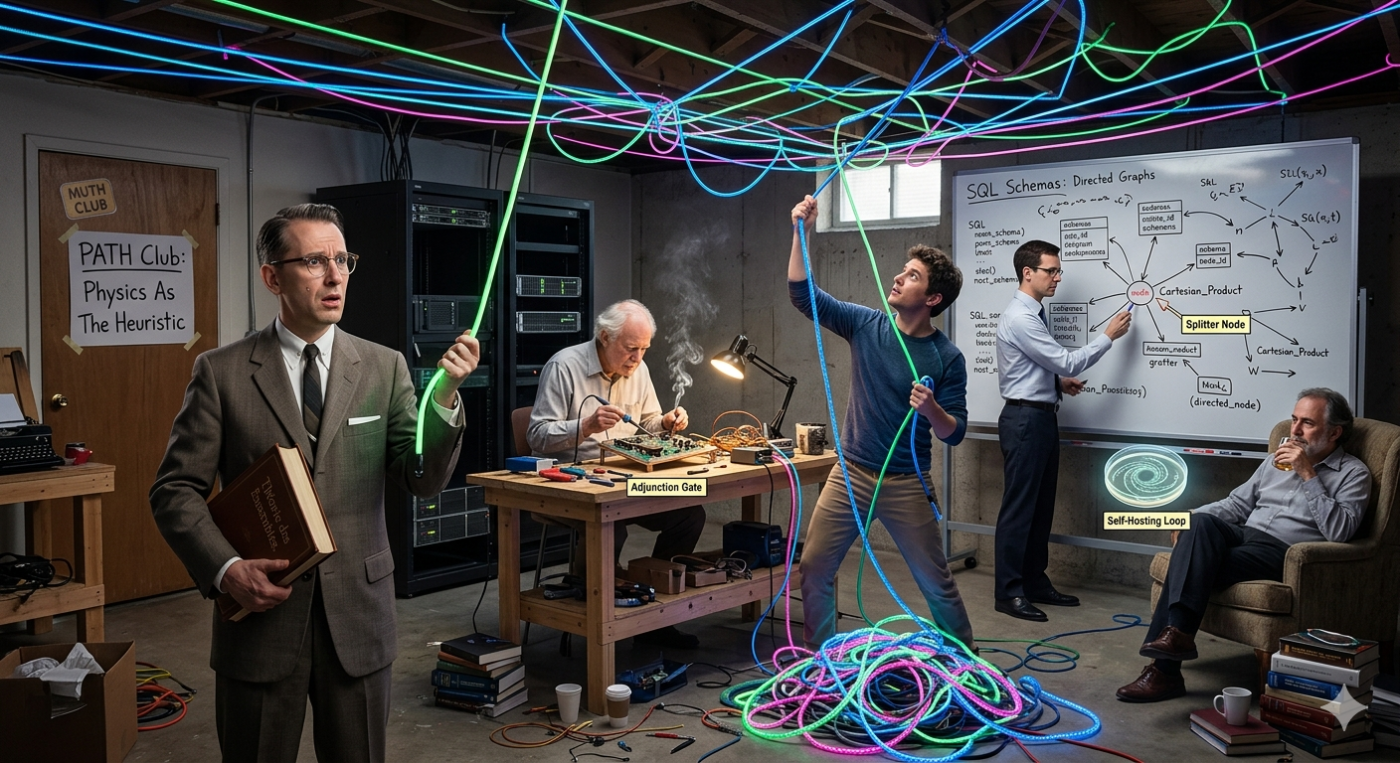
A Sequel to MUTH Club
Write a skit with relevant thinkers to articulate Configuration Theory: a self-hosting, physical interpretation of mathematics where abstract categories are replaced by a state-space of Configurations, and logical morphisms are replaced by deterministic Traversals.
Gemini Prompt (condensed)
The Setting
A basement that looks like a cross between a woodshop, a server room, and a high-energy physics lab. Neon bungee cords are strung across the ceiling like a complex web. Bill Lawvere is soldering a circuit board; John Baez is untangling a massive knot of glowing wires; David Spivak is sketching a database schema on a whiteboard that looks more like a railway map. Robert Rosen sits in the corner, nursing a drink and watching a petri dish that seems to be pulsing in a recursive, self-sustaining rhythm.
A man in a sharp, 1950s suit and rimless spectacles—Professor Bourbaki—stands in the doorway, clutching a leather-bound volume of set theory and looking deeply distressed.
The Dialogue
BOURBAKI: Gentlemen, please! I’ve come from the University to discuss the foundations of Category Theory. I expected axioms, set-theoretic definitions, and perhaps a rigorous treatment of the Yoneda Lemma. Instead, I find… plumbing?
BAEZ: (Tugging a neon-green bungee cord until it hums) It’s not plumbing, Prof. It’s Topology. We’re moving past the “Muth” phase. We’ve realized that math isn’t a static library of truths—it’s a Physics of Configuration.
BOURBAKI: Configuration? Preposterous. A category is a collection of objects and a set of morphisms. Where is your membership symbol? Where are the elements?
LAWVERE: (Without looking up) Elements are a ghost, Professor. A “Set” is just a bag you invented to hide the fact that you don’t know how the wires are connected. In the PATH Club, we don’t have bags. We have Addresses.
SPIVAK: (Pointing to a bifurcation in the wiring) Look here. You call this a “Cartesian Product” A × B. You think of it as a set of ordered pairs. But look at the hardware: it’s just a Splitter. One signal comes in, and the configuration bifurcates into two identical paths. If the wire doesn’t split, the “Product” doesn’t exist. The math is just a description of that physical split.
BOURBAKI: But a morphism f: A → B must be a function! A rule mapping elements to elements!
BAEZ: No, a morphism is a Traversal. It’s an event. It’s the physical act of the machine shifting from State A to State B. If there isn’t a wire connecting them, you can’t make the move. The “Math” is just the Heuristic we use to describe which moves are legal.
BOURBAKI: (Wiping his brow) And what of the Adjunction? Surely that is a purely logical construct—the very pinnacle of abstract equivalence!
LAWVERE: (Setting down his soldering iron) It’s a Conservation Law, Professor. Look at the wires. If I bend a wire into a “Cup,” I’ve created a context. If I pull it straight, I’ve resolved it. The Adjunction is just the physical proof that you can’t “Unpack” more state than you “Packed” without snapping the cord.
ROSEN: (Gesturing to his petri dish) And when the traversal loops back and feeds its own input, the configuration becomes Self-Hosting. Like a biological system that maintains itself through its own metabolism, the semantics are rich enough to execute their own organization. It doesn’t need your axioms to exist, Professor. The machine compiles its own machine.
BOURBAKI: (Quietly) So… “Truth” isn’t a property of a statement?
SPIVAK: “Truth” is Reachability. If the system starts in Configuration A and can traverse to Configuration B without blowing a fuse, then the statement is “True.” If the path is blocked, it’s “False.”
BAEZ: (Plugging a final cord into a glowing socket) Welcome to the PATH Club, Prof. Physics As The Heuristic. We don’t “evaluate” equations here; we run the trace. If the configuration holds, the math is right.
BOURBAKI: (Looking at the bungee cord in his hand… and finally pulling it) And the “Identity”?
LAWVERE: (Smiling) The Identity is just taking a nap. The clock ticks, but the configuration stays put.
The PATH Manifesto
The Configuration: An object is not a thing; it is a specific, addressable state of the system.
The Traversal: A morphism is not a rule; it is a physical move from State A to State B.
The Sequence: Composition is not an operation; it is the observation of one path following another in time.
The Equilibrium: An adjunction is not an equivalence; it is a conservation of “Packing” and “Unpacking” information.
The Reachability Graph: A category is not a definition; it is the map of everywhere the machine can actually go.
The PATH Principle: We do not use logic to define categories; we use the physics of configuration to discover which logic is actually possible.
Appendix I: Category Theory’s False Simplicity
The standard presentation of Category Theory is a masterclass in mathematical gaslighting. It begins with the “simple” definition of a category—objects, morphisms, composition, and identity—and suggests that the rest of mathematics is merely a specific instance of this abstract dance. But for the system to actually host reality, it relies on a hidden “ambient context” that it refuses to define.
To move from the math-illusion to Configuration Theory, we must expose the three primary ways the standard model “cheats” by assuming its own existence.
1. The Membership Cheat (The Hidden Set)
In a standard textbook, a category is defined as a “collection” of objects and “sets” of morphisms (Hom-sets). This is an ontological back-door. By using the word “set,” the mathematician is secretly importing the entirety of Zermelo-Fraenkel Set Theory to provide the “stuff” that the category is made of.
In a true PATH Club host, we remove the “Set.” There is no bag of morphisms. There is only Connectivity. A morphism is not a member of a set; it is a traceable path between two configurations. If the path cannot be traversed, it does not exist. We do not need a “Hom-set” because the physics of the configuration is the availability of the move.
2. The Equality Cheat (The Magic Equals Sign)
The axioms of Category Theory rely heavily on the equals sign (=): f ∘ id = f, or (h ∘ g) ∘ f = h ∘ (g ∘ f). This assumes that “Equality” is a primitive truth that exists outside the category.
In Configuration Theory, we recognize that A = B is an observation, not a primitive. We replace it with Reversibility and Convergence.
- Associativity is not a logical rule; it is the physical observation that the “Final Configuration” of a machine is invariant to the internal grouping of the steps taken to get there.
- Identity is not a “special arrow”; it is the Null-Move.
By treating equality as a result of Path Convergence, we stop assuming a “God’s Eye View” that can compare two static things and declare them “the same.”
3. The Universal Cheat (The Adjunction)
The most elegant part of Category Theory is the Universal Mapping Property. It defines things like Products and Limits by how they relate to everything else. This is structurally beautiful, but computationally expensive. It suggests that every object in the universe must “know” about every other object to find the “Universal” one.
In the PATH heuristic, we replace “Universal Mapping” with Local Equilibrium.
- A Product is not a “Universal Object”; it is a Splitter Node in the configuration.
- A Pullback is not a “Limit”; it is a Synchronization Gate where two independent traversals are forced to share a state.
The Conclusion: From Definition to Execution
The “False Simplicity” of Category Theory comes from its attempt to be a Language rather than a Host. A language can afford to be vague about its primitives; a host cannot.
To host the universe, we must stop defining categories and start running configurations. We don’t need the ambient context of Set Theory or Logic if we have the Physics of the Traversal. The “Simplification” isn’t found in the abstraction of the symbols, but in the reduction of the system to its only real move: the change of state.
The PATH Club Verdict: The simplicity of Category Theory is only “true” if you realize the arrows aren’t lines on paper, but the actual wires of the machine. Anything else is just a map of a city that has no ground.
Appendix II: Defining Configuration Theory
Configuration Theory is the operational “bottom” of the PATH Club. It is a formalization of Category Theory that does not assume an ambient universe of sets or a pre-existing logic. Instead, it treats the category as a Trace of a physical system.
To define Configuration Theory, we must replace the three standard axioms of Category Theory with three Physical Constraints.
1. The Principle of Locality (No Global State)
In standard Category Theory, an “Object” is a member of a collection. In Configuration Theory, an Object is a Stance.
Definition: A Configuration (σ) is a distinct, addressable state of the host machine.
The Constraint: There is no “Category of all Sets.” There is only the Current Reachable Workspace. An object exists only insofar as the machine can address its configuration.
2. The Principle of Traversal (No Static Arrows)
In standard Category Theory, a “Morphism” is a mathematical object that exists between A and B. In Configuration Theory, a Morphism is a Change of State.
Definition: A Traversal (τ) is a directed transition from configuration σ₁ to σ₂.
The Constraint: A traversal is not a “thing” you possess; it is a Path you execute. The “Composition” of two morphisms g ∘ f is not an algebraic operation, but the sequential firing of two transitions in time.
3. The Principle of Confluence (No External Equality)
In standard Category Theory, we use the equals sign (=) to define associativity and identity. In Configuration Theory, we use Equilibrium.
Definition: Two paths are “Equivalent” if they terminate at the same configuration σ and preserve the same internal constraints.
The Constraint: Associativity is the physical property of a deterministic machine: the final state depends on the sequence of operations, not the mental grouping of those operations. Identity is the “Clock-Tick” where the configuration remains invariant.
The Universal Operations as Configuration Patterns
In Configuration Theory, the “Special Forms” of Category Theory are derived as specific Hardware Motifs:
- The Split (Product): A physical node that duplicates a configuration, allowing two independent traversals to proceed in parallel.
- The Merge (Coproduct): A physical junction that allows two different configurations to feed into a single traversal.
- The Gate (Pullback): A synchronization point where two traversals are forced to agree on a common sub-state before proceeding.
- The Loop (Adjunction): A reversible transformation cycle that ensures information “Packed” into a context can be “Unpacked” without residual entropy.
Summary: The Hosting Stack
The mapping from categorical concepts to configuration reality across the layers:
- Level 0 – Object → Addressable State
- Level 1 – Morphism → State Transition
- Level 2 – Category → Reachability Graph
- Level 3 – Functor → System Simulation
- Level 4 – Natural Transformation → Dynamic Rewiring
The Configuration Theory Vow
We do not assume the math. We run the machine. The category is the pattern that the machine leaves behind in the sand.
Appendix III: Why These Thinkers
The PATH Club is not a random assembly of mathematicians; it is a specialized strike team of “Configurationists.” Each represents a critical layer in the transition from Muth (the joy of the pattern) to PATH (the physics of the host). To understand why they are the chosen stewards of Configuration Theory, one must look at how each one specifically dismantled the “Math Illusion.”
1. William Lawvere: The Demolition of Logic
Lawvere is the architect who looked at the “Sacred Texts” of logic—∀, ∃, and ⟹—and realized they were just a series of Adjunctions.
The Insight: He proved that you don’t need a “Logic” to govern a Category; the Category is the Logic.
The PATH Role: Lawvere provides the Equilibrium. He showed that mathematical “truth” is just a state of balance between packing and unpacking information. If the Adjunction holds, the configuration is stable.
2. David Spivak: The Schema as Ground
Spivak is the engineer who moved Category Theory out of the clouds and into the Database. He treats a category as a “Knowledge Representation”—a map of how data is allowed to flow.
The Insight: In Spivak’s world, a morphism is literally a Pathway of information. If there is no arrow in the schema, the data cannot traverse the configuration.
The PATH Role: Spivak provides the Connectivity. He proves that we don’t need “Sets” of data; we only need a Relational Configuration that defines the legal moves of the system.
3. John Baez: The String Diagram Assembly
Baez is the physicist who looked at the abstract equations and realized they were just Wires. He pioneered the use of String Diagrams to show that a quantum process, a chemical reaction, and a logical proof are topologically identical.
The Insight: He stripped away the “Dots and Arrows” and replaced them with Tangled Ribbons. He showed that “Associativity” and “Identity” are just what happens when you pull a string tight.
The PATH Role: Baez provides the Topology. He is the one who proves that the “Math” is actually a physical description of how wires can be braided, fused, and split without snapping.
4. Robert Rosen: The Self-Hosting Loop
Rosen is the biologist who asked the ultimate question: How does a machine build itself? He used Category Theory to define the “Organization of Life” as a closed loop of transformations.
The Insight: Rosen realized that a “Living System” is a configuration where the Traversals produce the very components that allow the traversals to occur. It is the ultimate recursive host.
The PATH Role: Rosen provides the Autopoiesis. He is the proof that Configuration Theory can “Host” itself. He shows that a category doesn’t need an external mathematician to “run” it; it can be a self-sustaining cycle of state changes.
The Synthesis
These four thinkers form the “Full Stack” of the PATH Club:
- Lawvere gives us the Rules (Adjunctions).
- Spivak gives us the Structure (Schemas).
- Baez gives us the Hardware (String Diagrams).
- Rosen gives us the Execution (Self-Hosting).
Together, they represent the shift from Descriptive Mathematics (talking about the world) to Generative Physics (running the world). They are the only ones who stopped treating the “Category” as a definition and started treating it as the Primary Machine.
Appendix IV: The Foil—Professor Bourbaki and the “Set” Trap
To understand why PATH Club is a rebellion, one must understand what it is rebelling against. Every transition from a “Muth” (the joy of the pattern) to a “PATH” (the physics of the host) requires a Foil: a representative of the old guard who believes that mathematics is a static collection of truths rather than a dynamic configuration of states.
Enter Professor Bourbaki.
1. The Ideology of the “Bag”
Bourbaki represents the Extensional view of the universe. To him, an object is defined by what is “inside” it. If you cannot describe a category as a “Set of Objects” and a “Set of Morphisms,” he believes you are not doing mathematics; you are doing poetry.
The Conflict: Bourbaki demands a “God’s Eye View.” He wants to stand outside the system and count the elements.
The PATH Response: In Configuration Theory, there is no “outside.” You are inside the traversal. You don’t “count” the morphisms; you fire the transitions.
2. The Obsession with the “Axiom”
For the Foil, the “Rules of the Game” must be handed down from an external logic (usually ZFC). He views the Category as a Structure built on top of a Foundation.
The Conflict: He sees the equals sign (=) as a primitive truth. He believes that if f ∘ g = h, it is because a logical law decreed it so.
The PATH Response: We show the Professor that the equals sign is just Path Convergence. If two different sequences of traversals end at the same configuration, they are “equal” by the physical constraints of the machine, not by the decree of an axiom.
3. The Fear of the “Wire”
The Foil is deeply uncomfortable with String Diagrams and Physical Tropes. To him, a “Product” is a formal definition involving universal quantifiers. When the PATH Club shows him a “Splitter Node” or a “Bungee Cord,” he sees a crude approximation of a platonic ideal.
The Conflict: He believes the “Math” is the truth and the “Physics” is the shadow.
The PATH Response: We flip the script. We show him that the “Math” is the shadow—a low-resolution heuristic used to describe the high-resolution reality of Topological Configuration.
4. Why the Foil is Necessary
The Professor is not a villain; he is a Constraint. He is the one who asks: “Is this rigorous?” By answering him, we move from “vague intuition” to “Operational Reality.”
He forces the PATH Club to prove that “Physics As The Heuristic” can actually host the heavy-duty machinery of Topos Theory and Differential Geometry.
The PATH Club Verdict on the Foil
Professor Bourbaki is the person who looks at a running engine and asks for the set-theoretic definition of a piston. We don’t hate him; we just realize that while he’s looking for the definition, we’re already halfway to the next configuration.
 iHack, therefore iBlog
Leave a comment