Through celestial holography, we can reinterpret spin and angular momentum as emergent from the conformal symmetries of the celestial sphere. This approach offers a novel and potentially unifying principle that aligns with the ideas proposed by Witten and colleagues, providing a fresh lens to understand the stability of the universe.
Reconstructing Spacetime: A New Spin on Angular Momentum
"We’ve all pondered why the universe doesn’t just collapse into a giant blob. On one end, angular momentum prevents gravitational collapse, stabilizing galaxies. On the other, electron degeneracy pressure stops stars from imploding. These phenomena seem unrelated, yet spin ties them together. Could spin be the key to a deeper unifying principle of stability across scales?"
Primer on Emergent Physics (ChatGPT as David Deutsch)
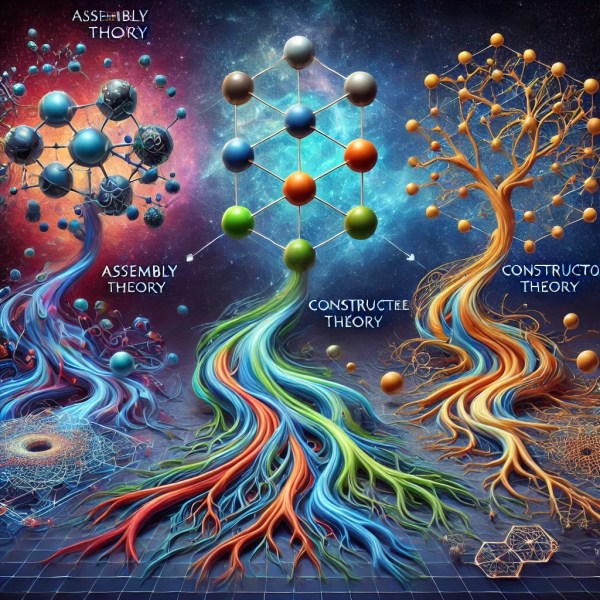
Emergent physics is one of the most fascinating domains of modern science. It is not merely about understanding the universe at its most fundamental level but about uncovering how the simple rules governing microscopic interactions give rise to the awe-inspiring complexity of the macroscopic world. Here, I provide an overview of emergent physics and relate it to theories like Assembly Theory and Constructal Theory, which address aspects of this profound problem.
The Fifth Loop of Universal Causation: Status
Athena: Humanity has mastered the physical, thrived biologically, developed language to shape meaning, and built narratives to create purpose. But beneath it all lies a more primal force: Status. Is this the hidden engine of causation, organizing hierarchies, influencing behavior, and even steering entire civilizations? Let’s discuss.
CONDATA: Adding Names to CODATA for Addressing Open Issues
In the spirit of advancing CODATA (Constructive Open Data Algebra with Types and Approximations), I propose CONDATA: Constructive Open Named Data Algebra. This extension builds on CODATA by introducing names as a fundamental component, enabling a richer, more flexible representation of mathematical objects and relationships. While CODATA relies on finite sequences of pure data, CONDATA introduces named data elements that enhance expressiveness without the need for classical set-theoretic constructs.
Exploring CODATA: A Constructive Foundation for Modern Physics
At its core, CODATA builds upon the Constructive Open Data Algebra (CODA) framework, which represents mathematical objects as finite sequences of pure data. CODA replaces abstract, non-constructive notions of "existence" with explicit constructions, making it an ideal foundation for computation and numerical methods.
Can Computation Create Math? (ChatGPT as Burgin/Youssuf Debate)
Welcome, everyone, to this special debate exploring the question: Can computation serve as the foundation for the kind of mathematics required by physics? Today, we are privileged to witness a non-rivalrous debate between two distinguished thinkers--Mark Burgin and Saul Youssef. They will present their models, offering alternative perspectives on how computation might underlie mathematical and physical truths.,
Leibniz on Agency: Contra Einstein and Newton on Non-Deterministic Causation
Leibniz: My friends, I thank you for entertaining this thought experiment. Let us set aside, for a moment, the comforting rigidity of determinism. Instead, I propose that the universe is not a machine driven solely by fixed laws but a tapestry woven of agency—an interplay of causes that act non-deterministically, yet with purpose.
TSM-13B: Homoiconic C as a Unifying Substrate for Math and Physics
“Indeed, the ability to treat code as data means we can dynamically construct and modify our models, adapting to new insights and requirements without overhauling our foundational framework.”
TSM-13A: Can Discrete Computation Implement Physics?
John Archibald Wheeler: The universe, as I’ve often said, is best understood through the lens of "It from Bit"—information at the root of reality. But how do discrete systems turn these bits into the smooth, continuous universe we observe? That’s the key challenge.

You must be logged in to post a comment.