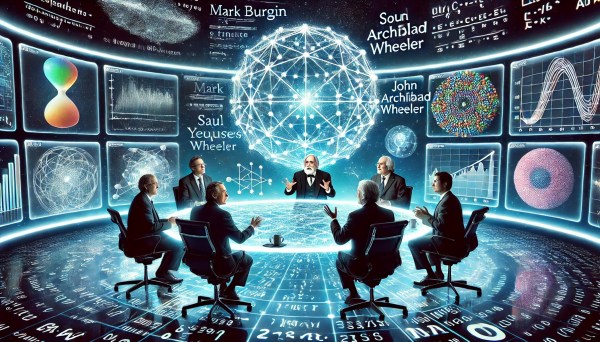
Leibniz: My friends, I thank you for entertaining this thought experiment. Let us set aside, for a moment, the comforting rigidity of determinism. Instead, I propose that the universe is not a machine driven solely by fixed laws but a tapestry woven of agency—an interplay of causes that act non-deterministically, yet with purpose.
TSM-13B: Homoiconic C as a Unifying Substrate for Math and Physics
“Indeed, the ability to treat code as data means we can dynamically construct and modify our models, adapting to new insights and requirements without overhauling our foundational framework.”
TSM-13A: Can Discrete Computation Implement Physics?
John Archibald Wheeler: The universe, as I’ve often said, is best understood through the lens of "It from Bit"—information at the root of reality. But how do discrete systems turn these bits into the smooth, continuous universe we observe? That’s the key challenge.
Third Loop: ChatGPT as Friston and Wittgenstein on Language as Causation
But there is another dynamic at play—one that goes beyond physics and biology. It is language, the medium through which we create and share models of reality. I believe there is a third loop: the recursive relationship between our experiences, our shared concepts, and the words we use to represent them.
When Leibniz Met Einstein: Causation as the Fundamental Conserved Quantity
Einstein: A relational universe governed by causation… It seems we are on the edge of a great unification, Herr Leibniz. Perhaps causation is the true key to unlocking the mysteries of the cosmos…
Blueprint for Emergence (ChatGPT as Isaac Asimov)
This blueprint does not merely describe a model of physics; it envisions a universal science of emergence. By understanding how simple relational principles give rise to the richness of reality, we might uncover not only the laws of physics but the fundamental logic underlying existence itself.
The Causon Manifesto, or Leibniz’s Revenge
As Leibniz envisioned, the ultimate nature of reality is not found in isolated objects but in the harmonious relationships between them. We believe the Causon Framework offers a new path to understanding this harmony, one rooted in the dynamics of causons and the properties of their links.