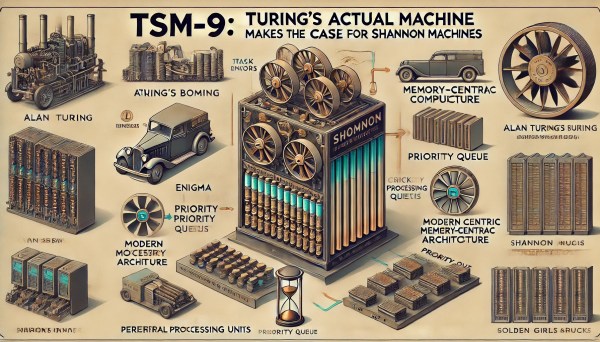
TSM-9: Turing’s Actual Machine Makes the Case for Shannon Machines

In a sense, the Bombe makes the case for Shannon Machines by showing how computation in the real world is defined by constraints—bounded memory, time-sensitive tasks, cooperative components, and structured data access. Turing’s actual machine, the Bombe, reminds us that effective computation is often about meeting specific needs within specific limits. Rather than the theoretical purity of infinite tape, Turing’s Bombe—and by extension, Shannon Machines and Golden Girls Architecture—illustrate how real computation can be collaborative, memory-centric, and bounded by design.

The Quilt Platform: Version Zero of the Littoral Toolbox

The Quilt Platform serves as a robust starting point for building the Littoral Toolbox, aligning closely with the goals of Littoral Science—collaborative, AI-powered, interdisciplinary research. With features like data versioning, cloud integration, verifiable data packaging, and metadata management, Quilt provides the essential building blocks for the Littoral Toolbox’s v0.

Introducing IDO: The Future of Identity Delegation in an AI-Driven World (with ChatGPT)

This is where IDO—Identity Delegation and Orchestration—comes into play. Imagine having a secure and user-friendly way to delegate specific tasks, permissions, and even parts of your identity to AI bots that can handle the heavy lifting for you. Whether it's managing your calendar, handling customer service inquiries, or even planning an event, IDO allows you to extend your identity safely and efficiently to the AI agents and services you trust.

TSM-7: From Aristotle to Newton — Towards a Scientific Theory of Computation

Since the dawn of computer science, our understanding of computation has been shaped by mathematical theories, from Aristotle's logic to Turing's formalization of algorithms. Turing Machines, with their elegant abstraction of computation into discrete steps on an infinite tape, have become a cornerstone of computational theory. However, this mathematical approach, while powerful, lacks a crucial element: empirical testability.

TSM-5: Homoiconic C (HC) Syntax Cheat Sheet

Homoiconic C ("HC") is a minimalist and highly expressive alternative to traditional programming languages. It eschews traditional grammar, keywords, and reserved words, focusing instead on a single type of object called a Frame. HC's syntax is a thin veneer over its robust semantics, which are centered around ubiquitous scope, consistent evaluation, and homoiconicity (symmetry between code and data). This cheat sheet provides an overview of HC's key syntactical elements.

TSM-3: Sigma Calculus and the PEACE Monad

The Sigma Calculus is a formal system for deterministic stateful computation, acting as both a generalization and simplification of the Lambda Calculus. It defines a system of Monads and Symbols for a computational framework closed under left-to-right evaluation.

Blog at WordPress.com.

Up ↑