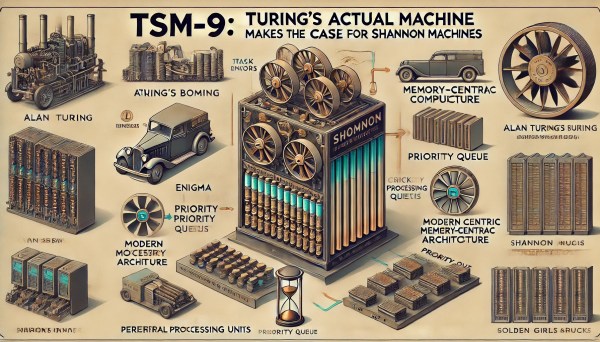
TSM-2: Alan Turing versus The Shannon Machine

### Alan Turing Here’s a simple breakdown: **Shannon Machines:** - Start with data structures, with computation as secondary. - Focus on associative memory and managing state. - Use binary operators and bit transforms for math simulation. **Turing Machines:** - Start with basic arithmetic and build up to computation. - Provide a theoretical framework, independent of practical implementation. - Use algorithms to simulate any computing process.

TSM-1: The Shannon Machine — Better Than Turing Complete?

The Shannon Machine is a decider computational system which uses bit-level word operations (rather than high-level computation) to perform arithmetric. The goal is model practical computation in a way that is more realistic -- but still as formal -- as the Linear Bounded Automoton, which has a similar level of computational power.

The Wisdom Improvement Protocol

Drawing on Karl Friston’s work on active inference and the theories of Murray Bowen and Edwin Friedman on self-differentiation, I propose a four-stage model of cognition that encapsulates the decision-making process…

The (Noonian) Soong of Solomon: Pursuing Artificial Wisdom by Adding Emotion to Data (by ChatGPT)

Prompt: Star Trek: TNG built a plot line about Data seeking an “emotion chip.” But they should have called it a “feeling chip.” Data the android, like all emergent systems (including LLMs), already requires the functional analog of emotions to properly weigh different opportunities and threats. Applying self-differentiation to this problem may help us move... Continue Reading →

Pitch: Designing Disruptive Institutions for a Flourishing Future

As societal challenges grow in complexity, our existing institutions—rigid, hierarchical, and often outdated—struggle to keep pace. To address these shortcomings, IAL can spearhead the creation of new "disruptive" institutions through a meticulously crafted design process that emphasizes innovation, adaptability, and inclusivity.

Blog at WordPress.com.

Up ↑