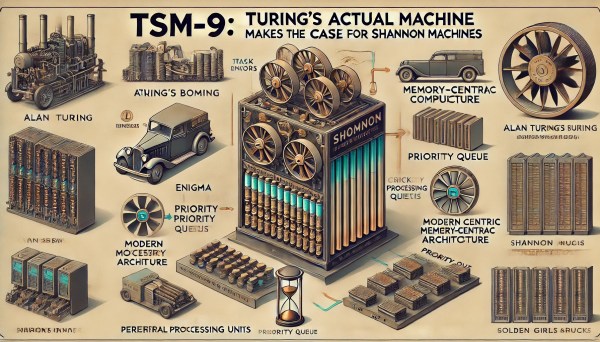
In a sense, the Bombe makes the case for Shannon Machines by showing how computation in the real world is defined by constraints—bounded memory, time-sensitive tasks, cooperative components, and structured data access. Turing’s actual machine, the Bombe, reminds us that effective computation is often about meeting specific needs within specific limits. Rather than the theoretical purity of infinite tape, Turing’s Bombe—and by extension, Shannon Machines and Golden Girls Architecture—illustrate how real computation can be collaborative, memory-centric, and bounded by design.
TSM-8: Golden Girls Architecture as a New Computational Philosophy
Collectively, the Shannon Machine, PEACE Monad, and Golden Girls Architecture represent a paradigm shift in how we conceptualize computation. They move away from the traditional view of a dominant CPU dictating operations to a more collaborative model where memory plays a central role.
TSM-7: From Aristotle to Newton — Towards a Scientific Theory of Computation
Since the dawn of computer science, our understanding of computation has been shaped by mathematical theories, from Aristotle's logic to Turing's formalization of algorithms. Turing Machines, with their elegant abstraction of computation into discrete steps on an infinite tape, have become a cornerstone of computational theory. However, this mathematical approach, while powerful, lacks a crucial element: empirical testability.
TSM-1: The Shannon Machine — Better Than Turing Complete?
The Shannon Machine is a decider computational system which uses bit-level word operations (rather than high-level computation) to perform arithmetric. The goal is model practical computation in a way that is more realistic -- but still as formal -- as the Linear Bounded Automoton, which has a similar level of computational power.