The Fifth Loop of Universal Causation: Status

Athena: Humanity has mastered the physical, thrived biologically, developed language to shape meaning, and built narratives to create purpose. But beneath it all lies a more primal force: Status. Is this the hidden engine of causation, organizing hierarchies, influencing behavior, and even steering entire civilizations? Let’s discuss.

Blueprint for Emergence (ChatGPT as Isaac Asimov)

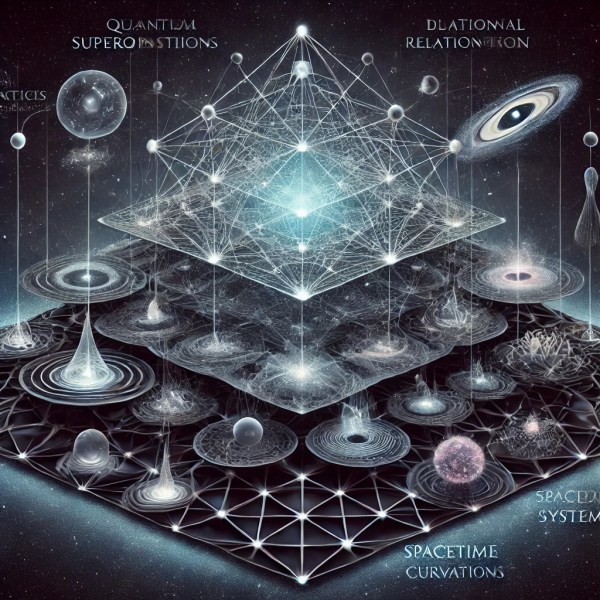
This blueprint does not merely describe a model of physics; it envisions a universal science of emergence. By understanding how simple relational principles give rise to the richness of reality, we might uncover not only the laws of physics but the fundamental logic underlying existence itself.

TSM-10.2: HLIR NextGen – A TableGen Replacement for MLIR

The HLIR (High-Level Intermediate Representation) framework written in Homoiconic C could also serve as a next-generation replacement (“HLIR-NG”) for LLVM’s TableGen, especially if it’s designed to handle the kind of semantic richness and extensibility required for a dynamic, multi-level execution framework like MLIR.

TSM-10.1: HLIR – Homoiconic, High-Level Intermediate Representation

instructions in a homoiconic form. It represents a novel synthesis in compiler design by bridging the gap between human and machine representations of programs. By combining monadic composition with homoiconic structure, HLIR allows developers to express computational intent with minimal syntax while maintaining direct mappings to MLIR's powerful optimization framework. This marriage of high-level semantics with low-level compilation produces a uniquely ergonomic intermediate representation - one where code is data, transformations are first-class citizens, and optimization becomes natural rather than imposed. The result is a language that is both easy for humans to reason about and efficient for compilers to transform, potentially setting a new standard for intermediate representations in modern compiler design.

The Littoral University: Redesigning Higher Education for the Age of AI

Prompt: What would a Littoral University designed from first principles around abundant computational intelligence differ from what we have today? The emergence of a Littoral University, grounded in AI-driven, interdisciplinary research and lifelong learning, would profoundly disrupt the traditional funding models of higher education. Tuition would move from degree-based payments to subscription and modular learning, catering to a diverse range of learners over their lifetimes. Research grants would shift from discipline-specific funding to problem-oriented and global collaborations, supported by AI’s ability to facilitate efficient, cross-disciplinary projects.

Blog at WordPress.com.

Up ↑