
When judgment retires upstream, enforcement gets simple, guards get happy, and Jerry gets the cookie
RAJEE vs IAM: The Petty Life of Secrets

When judgment retires upstream, enforcement gets simple, guards get happy, and Jerry gets the cookie
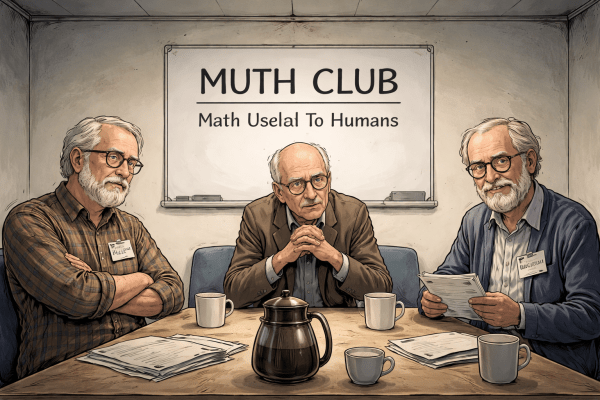
Arithmetic that doesn’t terminate is not mathematics. / It’s wishful thinking with symbols…

“What’s missing is the thing we had for structured data. But for… all of this.”

Deno wins only if Node becomes unsustainable in a specific context — untrusted, user-supplied code running in multi-tenant environments — before imitation arrives.

MSRP: Replace spacetime + Markov dynamics with something simpler that still predicts everything.

Alright, you clowns. You've spent a hundred years polishing spacetime like it's some sacred crystal. Minkowski this, Markov that. But nature—real, messy, experimental nature—keeps coughing up data that doesn't fit your pretty, memoryless picture…

Here we explore a hypothetical construct, the diaphorum, motivated by a playful challenge from theoretical physicists: can one imagine a structure so basic that geometry, causality, and quantum texture all emerge from it?

AI can generate code faster than any human I've met. But it often lacks what we might call EQ for engineering: it doesn't know when to stop, it forgets promises, it drifts from context. That's not malice--it's the nature of the tool. The burden falls back on us to create a structure where AI's speed doesn't outrun our ability to review.

This tutorial guides technically sophisticated Mac users (not necessarily developers) through setting up a fully open-source, non-crypto toolchain for decentralized collaboration using IPFS.

If AI is the next Hadestown—efficient, secure, but potentially dehumanizing—then Orpheus is the mythmaker, the artist, the remixer. A reminder that we are still here, and that meaning can emerge even inside the machine.


You must be logged in to post a comment.