For background, see TSM-5: Homoiconic C (HC) Syntax Cheat Sheet 1. Origins of TBC “To Be Continued” (TBC) was born from the desire to unify control flow and data processing in a simple, flexible language. It is inspired by Homoiconic C (HCLang), which introduced: Homoiconicity: Code is data. Programs can manipulate themselves naturally. Keywordless Design:... Continue Reading →
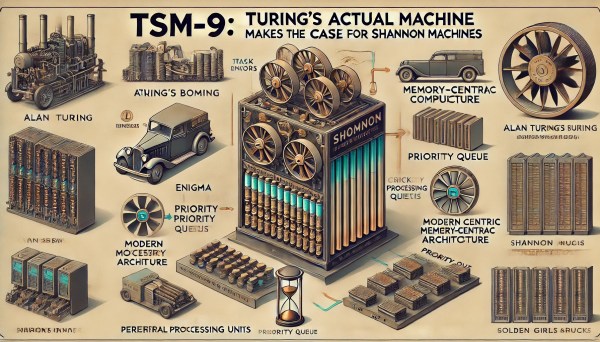
TSM-9: Turing’s Actual Machine Makes the Case for Shannon Machines
In a sense, the Bombe makes the case for Shannon Machines by showing how computation in the real world is defined by constraints—bounded memory, time-sensitive tasks, cooperative components, and structured data access. Turing’s actual machine, the Bombe, reminds us that effective computation is often about meeting specific needs within specific limits. Rather than the theoretical purity of infinite tape, Turing’s Bombe—and by extension, Shannon Machines and Golden Girls Architecture—illustrate how real computation can be collaborative, memory-centric, and bounded by design.
TSM-8: Golden Girls Architecture as a New Computational Philosophy
Collectively, the Shannon Machine, PEACE Monad, and Golden Girls Architecture represent a paradigm shift in how we conceptualize computation. They move away from the traditional view of a dominant CPU dictating operations to a more collaborative model where memory plays a central role.
TSM-6: Simplifying Lisp with Homoiconic C — All You Need is FOLD
Lisp has long been revered as the Platonic ideal of programming languages, its minimalist design where code and data share the same structure—lists—grants Lisp unmatched power and flexibility. But for all its elegance, Lisp’s strength also breeds complexity. Despite its simple syntax and aversion to assignment, Lisp still relies on a variety of special forms—like... Continue Reading →
TSM-5: Homoiconic C (HC) Syntax Cheat Sheet
Homoiconic C ("HC") is a minimalist and highly expressive alternative to traditional programming languages. It eschews traditional grammar, keywords, and reserved words, focusing instead on a single type of object called a Frame. HC's syntax is a thin veneer over its robust semantics, which are centered around ubiquitous scope, consistent evaluation, and homoiconicity (symmetry between code and data). This cheat sheet provides an overview of HC's key syntactical elements.
TSM-4: Total Computing with Pres — The Future of Safe, Expressive Software
For decades, Turing-complete computing has been the bedrock of modern programming. While this has empowered developers to create powerful, general-purpose systems, it has also forced us to accept a troubling reality: bugs, crashes, and unpredictable behavior are often seen as inevitable. These issues are typically viewed as the price we pay for the flexibility and... Continue Reading →
Solutions to Three of the World’s Hardest Problems
The Problems (Drawn from the list identified by Social Capital on December 15, 2018) Disrupting Programming Can we enable people who don’t know programming to build applications? Is there a way to structure, pipe, and manage data better? Disrupting Education Can we educate humans in interesting ways so that they learn to think in multi-disciplinary ways?... Continue Reading →
Leaving Apple after 17 years to launch a startup
After arguably the most amazing 17 years in computing history — seeing UNIX spread from iMac to the Apple Watch — I've decided it is time to leave Apple and strike out on my own. I'll be taking a few months off to play with some ideas I've been working on for making programming more... Continue Reading →