
The MCG integrates data trust, intent modeling, and semantic negotiation into a shared cognitive substrate. It supports not just interoperability—but mutual understanding.
The Meta-Cognitive Grid: Where Human and AI Agents Learn to Work Together.

The MCG integrates data trust, intent modeling, and semantic negotiation into a shared cognitive substrate. It supports not just interoperability—but mutual understanding.

At its core, CODATA builds upon the Constructive Open Data Algebra (CODA) framework, which represents mathematical objects as finite sequences of pure data. CODA replaces abstract, non-constructive notions of "existence" with explicit constructions, making it an ideal foundation for computation and numerical methods.
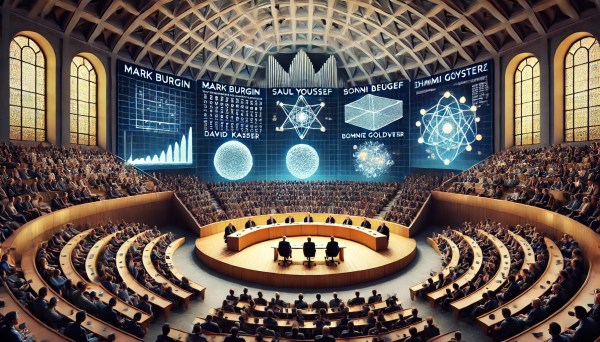
Welcome, everyone, to this special debate exploring the question: Can computation serve as the foundation for the kind of mathematics required by physics? Today, we are privileged to witness a non-rivalrous debate between two distinguished thinkers--Mark Burgin and Saul Youssef. They will present their models, offering alternative perspectives on how computation might underlie mathematical and physical truths.,
[These are my initial musings. It may take weeks or months to turn these into a coherent analysis, so I figured I should publish them as-is to get them out into the world. Merry Christmas!] Challenge Question: What is the minimum number of bits necessary to meaningfully simulate some aspect of an emotion? One Bit... Continue Reading →
Premise We hold certain positions because of what we: A. Experience -> B. Encode -> C. Evaluate -> D. Emphasize -> E. Express Corollary If someone disagrees with us, it is because they differ from us in one of those five areas, aka: A. Facts -> B. Definitions -> C. Reasoning -> D. Values - > E. Style Implications... Continue Reading →
 iHack, therefore iBlog