
Sequel to SDA: Strictly Disciplining Authorization
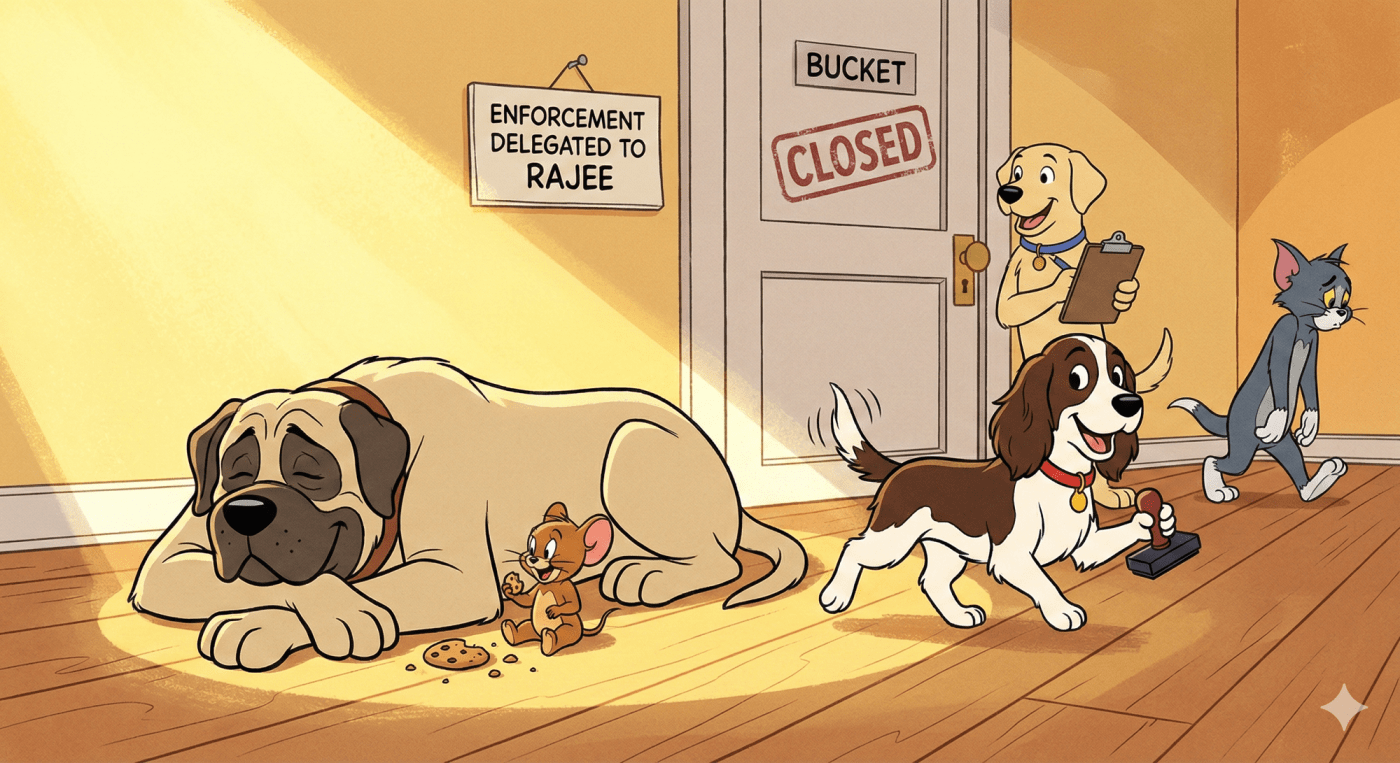
Contrast RAJ Enforcement Endpoints (“RAJEE”) with IAM’s double-mindedness, as dog breeds in a Tom & Jerry–style skit.
ChatGPT Prompt
1. Characters
1.1 The Guard (Redeemed)
IAM / The Border Mastiff — one big dog, formerly two-headed
- Border Collie instinct (judge): policy, deliberation
- Bullmastiff instinct (guard): blocking, enforcement
Old job: judging everyone, all the time
New job: trust RAJEE
1.2 The Stack
RAJ (Resource Access JWT)
- a dogtag on a chain — shiny, stamped with scope + expiry
- inert, factual, carries authority
RAJA (RAJ Authority)
- Labrador Retriever 📋
- calm “manager dog”
- plans why authority should exist
RAJEE (RAJ Enforcement Endpoint)
- English Springer Spaniel ✅
- cheerful bouncer with a stamp pad
- enforces how authority is applied
1.3 The Rivals
- Jerry — clever, needs access to the BUCKET pantry
- Tom — persistent, tries every trick
2. Setting
- A door labeled BUCKET
- A velvet rope
3. Scene One: The Old World
[The Border Mastiff sprawls across the doorway, grumpy.]
Border Mastiff (muttering):
Who are you? Why are you here? Are you still allowed?
[Tom walks up in a bad disguise.]
Border Mastiff:
Denied.
[Tom falls through a trapdoor.]
[Jerry approaches politely.]
Border Mastiff:
Also denied. Too many edge cases.
[Jerry slides away, annoyed.]
Border Mastiff (sighing):
I hate this job.
4. Scene Two: The Stack Arrives
[Enter RAJA, the Labrador, clipboard in mouth.]
RAJA:
Okay. Jerry needs one cookie.
Tom needs nothing.
Let’s not make this harder than it is.
[RAJA stamps a shiny dogtag.]
RAJ dogtag reads:
- Action: GET
- Resource: /cookie.jar/one
- Expiry: 30s
[RAJA clips the dogtag onto Jerry’s chain.]
5. Scene Three: The New Guard Takes Over
[Enter RAJEE, the Springer Spaniel, bouncing.]
RAJEE:
Hi! I check tags now.
Border Mastiff (startled):
Wait—then what do I do?
RAJEE (grinning):
You trust me.
[The Border Mastiff blinks. Slowly sits. Tail wag. Relief.]
6. Scene Four: Tom Tries Again
[Tom sneaks up, steals Jerry’s dogtag, sprints to the door.]
RAJEE (examining tag):
Tag valid.
Request… wow, that’s all the cookies.
[RAJEE compares Tom’s huge request scroll to the tiny dogtag.]
RAJEE:
Nope. Bigger than the tag.
[STAMP: “DENIED.” Tom ricochets off the door.]
7. Scene Five: Jerry Does It Right
[Jerry approaches, holding the dogtag forward proudly.]
Jerry:
One cookie, please.
RAJEE (stamp):
Subset fits!
[Door opens. Jerry slips in, returns instantly with exactly one cookie.]
[The dogtag fades with a tiny poof.]
8. Scene Six: The Happy Ending (The Real Point)
[The Border Mastiff watches calmly.]
Border Mastiff:
I didn’t judge anyone.
RAJEE:
You trusted the system.
RAJA (smiling):
And nothing went wrong.
[The Border Mastiff stretches out in the sun, finally at peace.]
Border Mastiff:
I guard trust now.
Not people.
[Tom tries one last time. RAJEE blocks him gently.]
RAJEE:
No tag, Tom.
[Tom shrugs, wanders off.]
9. Curtain Line
[Jerry sits beside the Border Mastiff, sharing crumbs.]
Jerry (to camera):
When the guard stops judging
and starts trusting,
the right mouse gets the cookie.
[RAJEE stamps “CLOSED” and trots off happily.]
10. What Actually Changed (Under the Cartoon)
- IAM / Border Mastiff
- now does one thing: trust RAJEE
- no longer conflicted, angry, or overworked
- RAJA decides why authority exists (telic)
- RAJ is the authority (alethic)
- RAJEE enforces it mechanically (instrumental)
Moral
When judgment retires upstream,
enforcement gets simple,
guards get happy,
and Jerry gets the cookie.
Appendix I: Refactoring Authorization Philosophy
I.1 What the Skit Was Really About
The skit presents itself as satire about secrets, roles, and credentials.
In reality, it exposes something more fundamental:
- why authorization systems feel petty,
- why they endlessly re-litigate trust,
- why engineers end up arguing with machines about morality.
IAM is not merely inconvenient.
It is philosophically overloaded.
I.2 IAM’s Core Mistake: Modal Collapse
IAM collapses multiple kinds of reasoning into a single runtime question:
“Should this person still be allowed this thing?”
That one sentence quietly fuses four distinct philosophical modes:
- Deontic — Is it permitted?
(see Deontic logic) - Telic — For what purpose is this needed?
(see Teleology) - Alethic — Is this action possible?
(see Alethic modality) - Instrumental — How do I carry it out?
IAM asks all four questions:
- on every request,
- in the hot path,
- with partial context,
- using mutable identity state.
The result is not security.
It is perpetual moral anxiety encoded in YAML.
I.3 “I Am Allowed” Is the Root of the Problem
IAM’s worldview is captured perfectly by one phrase:
“I am allowed.”
This grammar implies:
- permission is a property of a person,
- permission is continuously true,
- permission must be continuously re-justified.
From this flow the behaviors the skit mocks:
- ambient authority (see Ambient authority),
- secrets with social lives,
- roles that outlive their purpose,
- endless revocation ceremonies.
Once authorization is personal, it must remain revocable per person, per resource, forever.
This is Identity-Centric Bucket Management (ICBM).
I.4 RAJ’s Move: Separate the Questions
RAJ does not argue with IAM.
It simply refactors the questions.
I.5 RAJA: Telic Reasoning (Why)
RAJA asks only:
What authority should exist in order to accomplish this purpose?
This is telic reasoning:
- goal-oriented,
- contextual,
- slow,
- human-aligned.
Inputs may include:
- identity,
- intent,
- workflow context,
- policy engines like Cedar.
The output is:
- a deliberately scoped authority design.
No enforcement happens here.
Only intent is given shape.
I.6 RAJ: Alethic Assertion (What Is)
RAJ answers a different question:
What authority exists?
This is alethic:
- factual,
- checkable,
- indifferent to identity,
- bounded by time and scope.
A RAJ does not say:
- “Alice is allowed.”
It says:
- “This capability exists until time T.”
That is a statement about possibility, not permission.
I.7 RAJEE: Instrumental Enforcement (How)
RAJEE completes the separation.
It asks only:
Can I execute this request mechanically given this artifact?
RAJEE:
- validates cryptographic signatures,
- checks expiration,
- verifies subset containment,
- forwards or rejects.
No policy.
No identity.
No reconsideration.
This is instrumental rationality
(see Instrumental rationality).
The data plane becomes boring — and therefore trustworthy.
I.8 What Disappears Entirely
Notice what is absent at enforcement time:
- no “should”,
- no “still”,
- no “this person”.
Deontic reasoning leaves the hot path.
Authorization stops being law.
It becomes physics.
I.9 Why This Is a Philosophical Refactor, Not a Feature
RAJ does not add:
- more policy,
- more metadata,
- more configuration.
It removes a category error.
It restores:
- telos to planning,
- truth to authority,
- instrumentality to enforcement.
IAM tried to do all three at once — and made secrets into protagonists.
RAJ quietly fires them.
I.10 The One-Sentence Appendix
If this appendix had to end with one line, it would be this:
RAJ refactors authorization by separating purpose, fact, and execution — so the system no longer has to ask a moral question every time it moves a byte.
That is why the skit is funny.
And why the architecture works.
Appendix II: The Shared / Distinct Job Stories
(IAM vs RAJ)
II.1 Framing the Comparison
IAM and RAJ are not so much competing implementations than as answers to different jobs, even when they operate over the same resources.
This appendix distills those jobs into:
- one shared job story, and
- two distinct job stories that explain the architectural divergence.
II.2 The Shared Job Story
II.2.1 Shared Core Job
When a system stores valuable data accessed by multiple actors
I want access to be enforced correctly
So that unauthorized actions are prevented and authorized work succeeds
This is the job both IAM and RAJ are hired to do.
Neither disputes:
- the need for protection,
- the legitimacy of enforcement,
- or the requirement for auditability.
The difference is how that job is fulfilled.
II.3 IAM’s Distinct Job Story
II.3.1 IAM’s Primary Job
When people and services with persistent identities need ongoing access
I want permissions to be derived from identity and centrally revocable
So that I can change who is allowed to do what at any moment
This job optimizes for:
- identity as the organizing primitive,
- permissions as durable relationships,
- continuous re-evaluation at time of use.
IAM is hired to answer, repeatedly:
“Should this person still be allowed to do this?”
That makes selective, immediate revocation the defining success criterion.
II.4 RAJ’s Distinct Job Story
II.4.1 RAJ’s Primary Job
When a specific piece of work needs to be performed
I want to mint a narrowly scoped, time-bounded authority
So that the work can proceed safely without ongoing deliberation
This job optimizes for:
- authority as an explicit artifact,
- scope and duration as design-time choices,
- mechanical enforcement at runtime.
RAJ is hired to assert, once:
“This authority exists for this purpose, until this time.”
The system then enforces that fact without reconsideration.
II.5 The Fault Line Between the Jobs
The divergence is not about storage, clouds, or tokens.
It is about what must remain changeable during execution.
- IAM assumes permissions must remain personally revocable at all times.
- RAJ assumes authority can be pre-committed and allowed to run its course.
From that single assumption, everything else follows:
- policy evaluation vs subset checking,
- identity context vs artifact presentation,
- deliberation vs execution.
II.6 A Clean Summary
You can state the distinction succinctly:
- IAM is hired to manage who is allowed, continuously.
- RAJ is hired to manage what authority exists, deliberately.
Both solve the shared job of protecting data.
They differ because they are solving different secondary jobs —
and those jobs are fundamentally incompatible at runtime.
II.7 Why This Matters
Once these job stories are explicit:
- architectural debates stop being ideological,
- tradeoffs become visible instead of moralized,
- and systems can choose the right tool per job, not per tradition.
The conflict between IAM and RAJ is not about correctness.
It is about what kind of question you want your system to keep asking.
Appendix III: Why a Two-Headed Border Mastiff for IAM
1. The Metaphor Is Doing Real Work
The Two-Headed Border Mastiff is not a joke metaphor; it is a diagnostic one.
It captures why IAM feels heavy, angry, and conflicted in practice—even when well-designed.
IAM isn’t bad because it’s stupid.
IAM is stressed because it is asked to be two different kinds of dog at the same time.
2. The Two Instincts IAM Carries
2.1 The Border Collie Instinct: Judge Everything
The Border Collie half represents:
- continuous evaluation
- rule interpretation
- exception handling
- “should this still be allowed?”
This instinct is:
- hyper-intelligent
- vigilant
- never satisfied
- incapable of resting
It wants to think on every approach to the door.
2.2 The Bullmastiff Instinct: Guard the Gate
The Bullmastiff half represents:
- physical enforcement
- perimeter defense
- blocking by default
- “stop intruders now”
This instinct is:
- powerful
- blunt
- risk-averse
- intolerant of ambiguity
It wants to act immediately and decisively.
3. The Pathology Comes from Combining Them
A Border Collie and a Bullmastiff are both excellent dogs.
Forcing them to share one body is the problem.
IAM is expected to:
- deliberate and enforce
- reason and block
- judge and act
- reconsider while executing
And it must do all of this:
- in the hot path
- on every request
- under partial context
- at machine speed
That is why IAM systems accumulate:
- policy sprawl
- cognitive overload
- brittle behavior
- operator fatigue
The Border Mastiff is not malicious.
It is overworked.
4. Why RAJEE Changes the Border Mastiff’s Life
The architectural breakthrough is not “removing IAM.”
It is giving IAM permission to stop being conflicted.
5. IAM’s New, Single Job
With RAJEE in place, IAM does one thing:
Establish trust in RAJEE as the enforcement endpoint.
That’s it.
IAM no longer needs to:
- judge individual requests
- evaluate per-operation intent
- second-guess execution
It delegates enforcement once, structurally.
6. What Happens to the Two Heads
6.1 The Border Collie Finally Rests
Judgment moves upstream:
- to design time
- to policy authoring
- to RAJA’s telic reasoning
The Collie no longer needs to sprint endlessly.
6.2 The Bullmastiff Relaxes
Enforcement becomes:
- mechanical
- predictable
- bounded by explicit authority
The Mastiff no longer needs to growl at everything.
7. A Happier Ending for IAM
In the new world:
- RAJA decides why authority should exist
- RAJ represents what authority exists
- RAJEE enforces how authority is applied
IAM watches the system boundary and says:
“I trust that dog.”
That is a much more natural job for a guard.
8. Why This Metaphor Matters
The Two-Headed Border Mastiff explains:
- why IAM feels angry
- why it keeps growing more complex
- why adding “better policy” never fully fixes it
And it explains why RAJEE works:
RAJEE doesn’t defeat IAM. It relieves IAM of an impossible internal conflict.
Once the Border Mastiff is allowed to guard trust instead of judging everyone,
it can finally lie down in the sun—and the system works better for everyone.
 iHack, therefore iBlog