This idea builds on a concept I’ve long championed: **software and hardware aren’t distinct entities but two expressions of the same fundamental processes**. Hexons aim to reflect this by collapsing the boundary between the two, offering a new kind of computational atom that works equally well at the hardware and software levels.
TSM-10.2: HLIR NextGen – A TableGen Replacement for MLIR
The HLIR (High-Level Intermediate Representation) framework written in Homoiconic C could also serve as a next-generation replacement (“HLIR-NG”) for LLVM’s TableGen, especially if it’s designed to handle the kind of semantic richness and extensibility required for a dynamic, multi-level execution framework like MLIR.
TSM-10.1: HLIR – Homoiconic, High-Level Intermediate Representation
instructions in a homoiconic form. It represents a novel synthesis in compiler design by bridging the gap between human and machine representations of programs. By combining monadic composition with homoiconic structure, HLIR allows developers to express computational intent with minimal syntax while maintaining direct mappings to MLIR's powerful optimization framework. This marriage of high-level semantics with low-level compilation produces a uniquely ergonomic intermediate representation - one where code is data, transformations are first-class citizens, and optimization becomes natural rather than imposed. The result is a language that is both easy for humans to reason about and efficient for compilers to transform, potentially setting a new standard for intermediate representations in modern compiler design.
TSM-10: “To Be Continued” — A Homoiconic Language for Continuations and Concurrency
For background, see TSM-5: Homoiconic C (HC) Syntax Cheat Sheet 1. Origins of TBC “To Be Continued” (TBC) was born from the desire to unify control flow and data processing in a simple, flexible language. It is inspired by Homoiconic C (HCLang), which introduced: Homoiconicity: Code is data. Programs can manipulate themselves naturally. Keywordless Design:... Continue Reading →
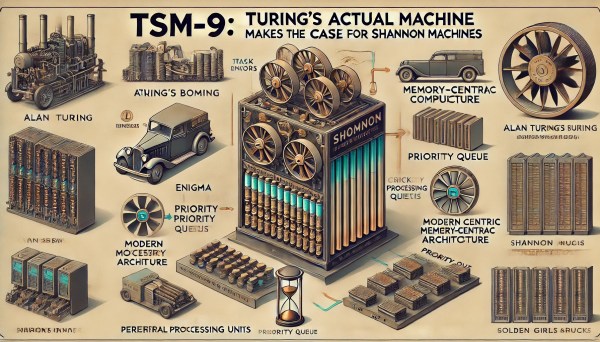
TSM-9: Turing’s Actual Machine Makes the Case for Shannon Machines
In a sense, the Bombe makes the case for Shannon Machines by showing how computation in the real world is defined by constraints—bounded memory, time-sensitive tasks, cooperative components, and structured data access. Turing’s actual machine, the Bombe, reminds us that effective computation is often about meeting specific needs within specific limits. Rather than the theoretical purity of infinite tape, Turing’s Bombe—and by extension, Shannon Machines and Golden Girls Architecture—illustrate how real computation can be collaborative, memory-centric, and bounded by design.
TSM-8: Golden Girls Architecture as a New Computational Philosophy
Collectively, the Shannon Machine, PEACE Monad, and Golden Girls Architecture represent a paradigm shift in how we conceptualize computation. They move away from the traditional view of a dominant CPU dictating operations to a more collaborative model where memory plays a central role.
The Quilt Platform: Version Zero of the Littoral Toolbox
The Quilt Platform serves as a robust starting point for building the Littoral Toolbox, aligning closely with the goals of Littoral Science—collaborative, AI-powered, interdisciplinary research. With features like data versioning, cloud integration, verifiable data packaging, and metadata management, Quilt provides the essential building blocks for the Littoral Toolbox’s v0.
Compressing the Hype Cycle: A Modern-Day Parable (with ChatGPT)
When they presented the new Hype Cycle Compressor to management, they described it as a way to fast-track innovation by compressing the time spent in each phase—not skipping over them, but using the tensions to fuel faster adaptation and alignment.
Introducing IDO: The Future of Identity Delegation in an AI-Driven World (with ChatGPT)
This is where IDO—Identity Delegation and Orchestration—comes into play. Imagine having a secure and user-friendly way to delegate specific tasks, permissions, and even parts of your identity to AI bots that can handle the heavy lifting for you. Whether it's managing your calendar, handling customer service inquiries, or even planning an event, IDO allows you to extend your identity safely and efficiently to the AI agents and services you trust.
TSM-7: From Aristotle to Newton — Towards a Scientific Theory of Computation
Since the dawn of computer science, our understanding of computation has been shaped by mathematical theories, from Aristotle's logic to Turing's formalization of algorithms. Turing Machines, with their elegant abstraction of computation into discrete steps on an infinite tape, have become a cornerstone of computational theory. However, this mathematical approach, while powerful, lacks a crucial element: empirical testability.

You must be logged in to post a comment.