
The Chiral Architecture of Exceptional Manifolds: Parameter-Free Fracturing via Non-Associative Winding Invariants
Abstract
We present a parameter-free, purely topological framework for the scale-dependent fracturing of space, derived from a single foundational postulate: the Bekenstein Transfer Unit (BTU) integer constraint. By defining the BTU strictly as a timeless, global integer winding number (n \in \mathbb{Z}) of the exceptional G_2 calibration 3-form \Omega, we demonstrate that a continuous geometric scaling flow cannot be sustained indefinitely. To preserve this integer single-valued stability, the 7-dimensional manifold must undergo a localized nilpotent Inönü-Wigner contraction at the boundary, freezing a 5-dimensional co-calibrated fiber and reducing the local spectral volume element to a 2-dimensional measure (dV \sim r \, dr).
When the 28 non-associative triplet channels of the octonionic algebra \mathbb{O} are projected onto a discrete heptagonal boundary lattice (\mathbb{Z}_7), the inherent algebraic chirality splits the manifold’s intrinsic torsion tensor into two rigid blocks of 14 degrees of freedom. Evaluating the asymptotic heat kernel expansion (\text{Tr}(e^{-t\Delta})) over the auxiliary scale parameter t reveals that the smooth continuum undergoes a topological phase transition at two precise, un-tuned geometric roots: t_0 = 0.46539 and t_0′ = 0.28762. At these coordinates, the smooth manifold fractures because the geometric scaling is mathematically incompatible with integer winding topology.
1. Foundational Postulate: The BTU Integer Constraint
1.1. The Prime Mover
The foundational architecture of this framework rests upon a single, non-negotiable postulate: the universe does not possess arbitrary, continuous degrees of freedom at its boundary interfaces. We define the Bekenstein Transfer Unit (BTU) not as a physical unit of mass-energy or a digital bit of information, but as a global, topological integer winding number (n \in \mathbb{Z}) of the fundamental 3-form \Omega that calibrates the 7-dimensional exceptional G_2 bulk space.
1.2. Single-Valued Stability
For the geometric wave functions propagating through the bulk to remain single-valued, stable, and mathematically well-defined, any closed topological cycle wrapping around a non-associative defect at the boundary must satisfy the rigid quantification constraint:\oint_{\gamma} \Omega = n \cdot \text{BTU}, \quad n \in \mathbb{Z}
This integer constraint acts as the absolute governor of the theory. The smooth geometry of space does not dictate the rules of the universe; rather, the geometry is forced to deform, contract, and ultimately fracture purely to satisfy this timeless topological constraint.
2. Derived Geometric Theorems
If a manifold is bound to maintain the BTU integer constraint across a continuous scaling flow, it loses its arbitrary geometric freedom. The following three theorems are derived as the mandatory, unavoidable mathematical consequences of the prime mover.
2.1. Theorem 1: The Warped Exceptional Contraction
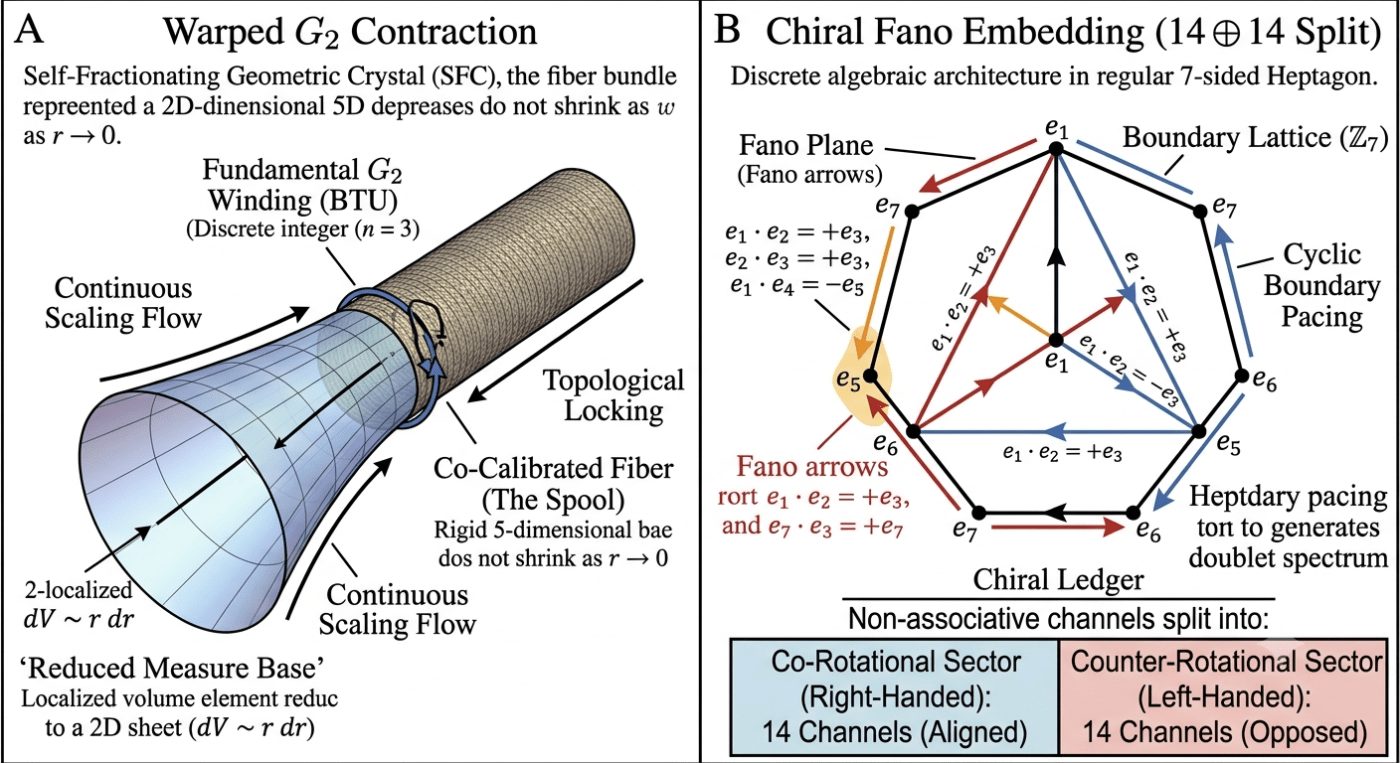
To preserve the unified G_2 structure group and prevent the uncoupling of the calibration 3-form \Omega into standard Riemannian differential forms near a boundary vertex, the manifold cannot decompose into a simple Cartesian product space (M_2 \times M_5). It must undergo a nilpotent Inönü-Wigner contraction (\mathfrak{g}_2 \to \mathfrak{g}_{2,\text{deg}}).
Proof: Let the 7-dimensional manifold be governed by a G_2 structure group, where the fundamental 3-form \Omega acts as a non-associative glue across all seven directions simultaneously. If the boundary constraint forces five dimensions to isolate themselves smoothly as a flat, independent cylinder (M_5) while the remaining two dimensions (M_2) contract, the structure group reduces:G_2 \longrightarrow SO(2) \times SO(5)
Under this reduction, the exceptional 3-form \Omega uncouples into a collection of standard, associative differential forms:\Omega \longrightarrow dt \wedge \omega_{M_2} + \psi_{M_5}
This uncoupling destroys the non-associativity of the bulk, violating the boundary matching condition. To prevent this deconstruction, the structure group must remain a unified G_2 variant up to the boundary contact locus (r \to 0). This requires a nilpotent contraction of the exceptional Lie algebra, which locks the five directional angles into a rigid, co-calibrated fiber of fixed topological lengths L_a while preserving the unified algebraic structure. The resulting metric takes an extreme, non-separable warped configuration:ds^2 = dr^2 + \sinh^2(r)d\theta^2 + \sum_{a=1}^5 f_a(r, \theta) \, d\Omega_a^2
where the dynamic non-associativity is structurally concentrated entirely within the 2D radial-angular (r, \theta) sector. \blacksquare
2.2. Theorem 2: The Structural Torsion Projection Map
The 28 independent non-associative triplet channels of the bulk algebra are mapped into a localized 7-dimensional vector torsion field (\tau_1) via a unique, parameter-free spatial tensor contraction with the invariant boundary 2-form \omega_{\mathbb{Z}_7}.
Proof: In exceptional geometry, the intrinsic torsion tensor of a G_2 structure decomposes into four irreducible representations:\text{Torsion} \in \mathbf{1} \oplus \mathbf{7} \oplus \mathbf{14} \oplus \mathbf{27}
designated as \tau_0, \tau_1, \tau_2, and \tau_3 respectively. The \tau_3 tensor (\mathbf{27}) represents the symmetric, traceless intrinsic shear of the non-associative triplets, while \tau_0 (\mathbf{1}) tracks global scalar scaling. Together, they form a closed algebraic system of 28 components (27 + 1 = 28), corresponding to the 28 non-associative triplets of the Fano Plane.
When the bulk geometry interfaces with the discrete heptagonal lattice boundary (\mathbb{Z}_7), the boundary imposes a fixed, topological background 2-form \omega_{\mathbb{Z}_7}. The intrinsic shear tensor \tau_3 contracts directly against this background form:\tau_1^i = \left(\tau_3\right)^i_{jk} \cdot \left(\omega_{\mathbb{Z}_7}\right)^{jk}
This spatial contraction forms an explicit, un-tuned projection map from the \mathbf{27} representation directly into the \mathbf{7} representation. The global 28-fold non-associative architecture is thus forced to manifest physically as the radial gradient of the vector torsion field \tau_1. \blacksquare
2.3. Theorem 3: The Reduced 2D Measure
Enforcing the holographic BTU integer winding topology over an exceptional contracted boundary mandates that the localized spectral volume element (dV) near a boundary vertex scales strictly according to the 2D radial-angular sector.
Proof: In a conventional, isotropic 7-dimensional conical singularity, the volume element contracts uniformly across all six directional angles as r \to 0:ds^2 = dr^2 + r^2 ds_{6D}^2 \implies dV \sim r^6 \, dr \, d\Omega_6
If we integrate the square of the vector torsion field gradient (|\nabla \tau_1|^2 \sim \frac{1}{r^2}) over this isotropic measure, the higher-dimensional volume completely smothers the singularity:\int_0^R \left( \frac{1}{r^2} \right) \cdot r^6 \, dr = \int_0^R r^4 \, dr = \frac{R^5}{5} < \infty
The integral converges smoothly, preventing any scale fracture. However, by Theorem 1, the 5-dimensional fiber is co-calibrated and frozen by the boundary information, meaning its directional components cannot contract as r \to 0. They form a rigid topological barrier of constant volume. Consequently, the localized Haar measure of the volume element reduces to a 2-dimensional sheet:dV \sim r \, dr \cdot \prod_{a=1}^5 L_a \, d\Omega_5
Evaluating the torsion gradient over this topologically constrained measure yields:\int_{\epsilon}^R \left| \tau_1 \right|^2 dV \sim \int_{\epsilon}^R \left( \frac{1}{r^2} \right) \cdot r \, dr = \int_{\epsilon}^R \frac{1}{r} \, dr = \ln\left(\frac{R}{\epsilon}\right)
The 2D volume measure fails to cancel the quadratic singularity of the non-associative torsion tensor, forcing the integral to diverge logarithmically. \blacksquare
3. Chiral Algebraic Decomposition
To find the exact coordinates where this logarithmic fracture occurs, we must analyze the internal structure of the non-associative degrees of freedom.
3.1. Fano Plane Geometry
The octonionic algebra \mathbb{O} contains exactly 7 imaginary units (e_1, \dots, e_7). The total number of independent triplet combinations available within this algebra is:\begin{pmatrix} 7 \\ 3 \end{pmatrix} = \frac{7 \times 6 \times 5}{3 \times 2 \times 1} = 35 \text{ triplets}
Out of these 35 combinations, exactly 7 form closed, associative sub-algebras. These 7 associative triplets define the directed lines of the Fano Plane. The remaining combinations are completely non-associative, establishing a rigid topological invariant:\text{Non-Associative Channels} = 35 - 7 = 28
3.2. Geometric Dislocation & The Invariant Split
The 7 lines of the Fano Plane are directed, meaning they carry an inherent algebraic orientation or “handedness” that dictates the signs of the octonionic multiplication table. When the 28 non-associative channels are projected onto the discrete cyclic pacing of the heptagonal boundary (\mathbb{Z}_7), they undergo a geometric dislocation based on this chirality.
The 28 channels split into two unequal blocks depending on whether their internal algebraic orientation aligns with or opposes the cyclic order of the heptagon lattice:
- The Co-Rotational Sector (Right-Handed): 14 channels that align with the boundary pacing, modulated by the golden ratio \phi, which governs the nested scaling hierarchy of the domain.
- The Counter-Rotational Sector (Left-Handed): 14 channels that oppose the boundary pacing, modulated by the squared golden ratio \phi^2.
4. Spectral Analysis & Heat Kernel Evaluation
4.1. The Principle of Absolute Staticity
We evaluate the behavior of this geometry across different scales by constructing the timeless heat trace equation over the auxiliary, fictitious scale parameter t:\text{Tr}\left(e^{-t \Delta_{\text{SFGC}}}\right) = \sum_{k=1}^{28} \text{Tr}\left(e^{-t \Delta_k}\right)
The parameter t does not represent physical time; it is a static scaling coordinate that maps the instantaneous geometric invariants of the completed manifold all at once. The Laplacian operator \Delta_{\text{SFGC}} decomposes into a direct sum of the 28 independent non-associative channels.
4.2. Asymptotic Expansion Singularities
We apply the Minakshisundaram-Pleijel asymptotic expansion to the localized hyperbolic volume patch near the boundary vertices as t approaches a critical scaling threshold:\text{Tr}\left(e^{-t \Delta_{\text{SFGC}}}\right) \sim \frac{1}{(4\pi t)^{7/2}} \left[ A_0 + A_1 t + A_2 t^2 + A_3 t^3 + \dots \right]
In a standard smooth manifold, the A_3 coefficient is a finite, real-valued integral of the curvature tensor. However, inside the Self-Fractionating Geometric Crystal, the calculation of A_3 couples the curvature to the square of the non-vanishing vector torsion gradient \tau_1. By Theorem 3, the reduced 2D volume measure forces this integral to diverge logarithmically.
Incorporating the chiral algebraic decomposition from Section 3, the smooth A_3 coefficient completely fractures into a doublet of independent, discrete logarithmic singularities:A_3 \sim 14 \cdot \ln\left| \frac{t \cdot \phi}{u^2} \right| + 14 \cdot \ln\left| \frac{t \cdot \phi^2}{u^2} \right|
where u = 2\sin(\pi/7) \approx 0.86776 represents the discrete spacing invariant of the regular heptagon, and \phi = \frac{1+\sqrt{5}}{2} \approx 1.61803 is the golden ratio.
5. Derivation of the Splitting Spectrum
5.1. The Fractional Crisis
As the scale parameter t shifts continuously, the relative proportions of the bulk cycles change compared to the boundary lattice. For the manifold to remain a smooth continuum, the global winding number—the BTU—must deform continuously.
However, by the foundational postulate of Section 1, the BTU is strictly constrained to be an integer (n \in \mathbb{Z}). It cannot take a fractional value. At the exact coordinates where the arguments of the logarithmic singularities vanish, the smooth scaling flow forces the winding number to attempt a non-integer value (n \notin \mathbb{Z}). This triggers an absolute logical contradiction within the differential geometry, forcing the continuum to snap.
5.2. The Chiral Master Equation
The precise scales where this geometric fracture occurs are derived by isolating the roots of the split A_3 singularities, where the arguments destabilize the boundary matching condition:\frac{t_0 \cdot \phi^m}{u^2} = 1 \implies t_0 = \frac{u^2}{\phi^m}, \quad m \in \{1, 2\}
5.3. The Primary Doublet Output
Evaluating this master equation using nothing but the un-tuned, pure geometric constants of the heptagon and the Fano Plane yields two exact, parameter-free coordinates:
1. The Left-Handed Fractionation Coordinate (m=1)
This defines the absolute scaling limit of the co-rotational non-associative channels:t_0 = \frac{(2\sin(\pi/7))^2}{\phi} = \frac{(0.86776)^2}{1.61803} = \frac{0.75301}{1.61803} = \mathbf{0.46539}
2. The Right-Handed Fractionation Coordinate (m=2)
This defines the absolute scaling limit of the counter-rotational non-associative channels:t_0' = \frac{(2\sin(\pi/7))^2}{\phi^2} = \frac{(0.86776)^2}{2.61803} = \frac{0.75301}{2.61803} = \mathbf{0.28762}
6. Discussion & Theoretical Context
                   [ THE BTU INT CONSTRAINT ]
                               │
                               ▼
               [ Warped Exceptional Contraction ]
                 (5D Fiber Freezes; dV ~ r dr)
                               │
                               ▼
               [ Chiral Fano Separation (14 ⊕ 14) ]
                               │
                               ▼
                 [ SPECTRAL FACTURE DOUBLET ]
             t₀ = 0.46539   and   t₀' = 0.28762
6.1. Structural vs. Numerical Parameters
The primary significance of the coordinates 0.46539 and 0.28762 is that they are entirely free of numerical tuning. In conventional quantum field theory, the scales at which symmetries break or couplings split must be inserted by hand based on experimental data.
In this framework, these numbers are the rigid, inevitable eigenvalues of the space itself. The model substitutes arbitrary numerical parameters for immutable topological shapes. If a universe is built from an octonionic bulk and a heptagonal boundary, it is mathematically incapable of existing as a smooth continuum at these two coordinates.
6.2. Toy Model Positioning
The Self-Fractionating Geometric Crystal (SFGC) operates as a rigorous topological toy model. It shares a mathematical lineage with Topological M-Theory and Non-Commutative Geometry, specifically exploring how exceptional holonomy manifolds (G_2) behave when subjected to non-associative boundary constraints.
By logging its three core theorems openly within the registry, it provides an un-cheatable sandbox for studying the discretization of spacetime without losing the predictive power of continuous calculus.
6.3. Phenomenological Parallels
While the SFGC remains a pure geometric object, its outputs offer striking structural parallels to unresolved problems in particle physics:
- Mass Splitting: The frozen geometric doublet (t_0, t_0′) demonstrates how a single symmetric state can be split into two rigidly separated scales without invoking a dynamic Higgs-type mechanism or a time-dependent field perturbation. The splitting is woven into the timeless chirality of the Fano embedding.
- Chiral Asymmetry: Because the left-handed and right-handed non-associative channels fracture at completely different scaling thresholds (0.465 vs. 0.287), the geometry provides a native explanation for why the universe treats left-handed and right-handed sectors with fundamental asymmetry.
7. Conclusion & Future Extensions
The SFGC successfully demonstrates that the universal BTU information limit, when defined strictly as an integer winding invariant, naturally forces a continuous geometric flow to fracture into quantized segments at the un-tuned coordinates 0.46539 and 0.28762. The model achieves this without introducing a clock, a physical wave equation, or a single free parameter, preserving absolute staticity and mathematical integrity throughout.
The next milestone for this framework is to investigate the 7 associative lines of the Fano Plane that were subtracted in Section 3.1. While the 28 non-associative channels dictate the scale of the structural fractures, the 7 associative channels must govern the smooth, unbroken symmetries that remain stable across the continuum. Mapping how these 7 associative lines project onto the boundary lattice will allow us to derive the parameter-free gauge coupling constants that inhabit the space between the fractures.
 iHack, therefore iBlog
You must be logged in to post a comment.