
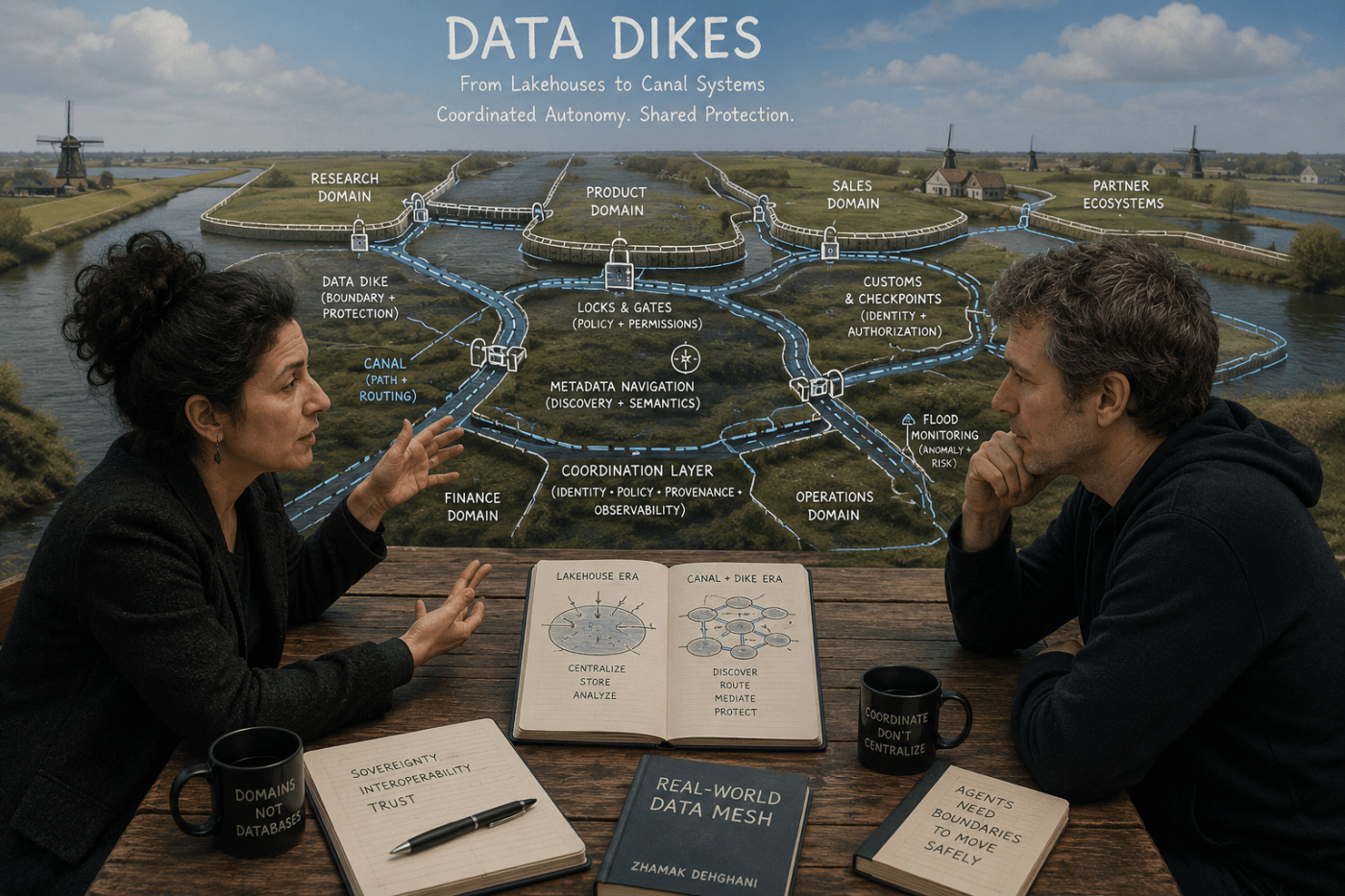
As Martin Fowler write on HOW and WHAT centralization wins then fails for each epoch, based on the historical trend of disruption, e.g., IBM – Oracle – DataBricks… ?
ChatGPT Prompt
Introduction
The history of enterprise data management is a recurring cycle of centralization and decentralization. Each epoch begins when organizations face an explosion of complexity that local teams cannot coordinate on their own. A new centralized architecture emerges to solve the problem. Over time, however, the very mechanisms that enabled coordination become bottlenecks to innovation. The cycle then repeats at a higher level of abstraction.
The Four Epochs of Data Management
Epoch 1: Mainframes and Centralized Compute
The first epoch centralized scarce compute.
Mainframes won because they solved:
- reliability,
- operations,
- resource allocation,
- enterprise-scale administration.
Computing was expensive and rare. Centralization was economically necessary.
However, the model failed when centralized IT became an obstacle to departmental agility and application development.
Further Reading
Epoch 2: Relational Databases and Business Truth
The second epoch centralized business truth.
Relational databases and enterprise systems created:
- consistent transactional records,
- shared schemas,
- enterprise systems of record,
- SQL-based interoperability.
Their strength was consistency.
Their weakness was rigidity.
As web-scale systems, semi-structured data, and distributed applications emerged, the relational center became increasingly strained.
Further Reading
Epoch 3: The Lakehouse Era
The third epoch centralized analytics.
Data warehouses, data lakes, cloud warehouses, and lakehouses all addressed the same organizational problem:
Organizations needed an integrated view of the business.
Snowflake and Databricks, despite their differences, converged on a common thesis:
Advanced analytics, machine learning, governance, and increasingly AI should occur within a unified managed platform.
Further Reading
The Hidden Political Economy of the Lakehouse
This third epoch was historically justified not primarily as a way to empower individual functions, but as a way to make organizations legible to executives and central governance.
Product, sales, support, research, and infrastructure teams each owned their operational data, but leadership required cross-functional visibility. The lakehouse became the place where disparate operational realities were translated into a coherent organizational picture.
The asymmetry was subtle but important.
Domain teams bore much of the cost of centralization:
- ingestion pipelines,
- schema normalization,
- governance processes,
- semantic disputes,
- delayed iteration cycles.
The primary beneficiaries were:
- finance,
- operations,
- compliance,
- executive reporting,
- centralized analytics.
The central bargain of the third epoch was therefore:
If teams submit their data to the centralized platform, they gain access to advanced analytical capabilities.
The Fourth Epoch: AI and Distributed Intelligence
Artificial intelligence may destabilize this bargain.
Historically, sophisticated tooling required centralization because:
- computation,
- integration,
- semantic reconciliation,
- interoperability
were difficult.
Today, intelligence is increasingly portable.
Models operate through APIs. Local inference becomes practical. Agents dynamically compose tools and workflows. Object storage, open table formats, and metadata catalogs decouple storage from compute.
Further Reading
Most importantly:
AI dramatically lowers the cost of heterogeneity.
Large language models can:
- interpret imperfect schemas,
- translate semantics between systems,
- generate metadata,
- synthesize interfaces,
- mediate access to distributed information sources.
What previously required centralized normalization may increasingly be achieved through dynamic interpretation.
From “Move Data to Tools” to “Bring Tools to Data”
This shift changes the economics of centralization.
Third Epoch
Organizations moved data to tools.
Fourth Epoch
Organizations increasingly bring tools to data.
Cross-functional insight still matters. Some organizational intelligence genuinely emerges only through combining data across domains.
However, AI changes the architectural assumption that such integration requires permanent centralization into a single platform.
Temporary federation, semantic mediation, and agent-driven retrieval may achieve many of the same outcomes while preserving domain ownership and local agility.
Revenge of the Data Mesh
This creates the possibility of a new equilibrium:
- domain-owned operational data,
- federated workflows,
- decentralized experimentation,
- centralized metadata,
- centralized identity and policy,
- centralized audit and governance.
In this sense, the fourth epoch may represent the revenge of the data mesh.
Further Reading
Data mesh was organizationally correct but operationally expensive.
It recognized that:
Meaning and ownership live within domains rather than within central platforms.
Yet the tooling required to sustain decentralized ownership at scale remained immature.
AI changes this equation by reducing the operational burden of interoperability itself.
The Emerging Equilibrium
The emerging architecture is therefore neither pure federation nor pure centralization.
History suggests that neither extreme persists for long.
Instead, successful systems repeatedly:
- centralize coordination,
- decentralize execution.
Durable Centralized Layers
The durable layers become:
- identity,
- metadata,
- governance,
- provenance,
- policy,
- discovery.
Increasingly Distributed Layers
Meanwhile execution becomes increasingly distributed:
- workflows,
- agents,
- local compute,
- domain-specific intelligence,
- ephemeral orchestration.
The fourth epoch is not the end of centralization.
It is the relocation of centralization upward in the stack.
What becomes centralized is no longer necessarily the data itself, but the coordination mechanisms that make distributed intelligence trustworthy.
Conclusion
The historical pattern is not:
- centralization forever,
- nor permanent federation.
The pattern is cyclical:
- decentralize innovation,
- centralize coordination,
- accumulate bottlenecks,
- decentralize again.
AI may represent the next major decentralizing force.
But history suggests that a new coordination layer will inevitably emerge above it.
Appendix: Data Dikes as the New Coordination Layer
As Zhamak Dehghani, propose Data Dikes as a metaphor for that new coordination layer.
ChatGPT Prompt
The metaphor of the lakehouse was historically powerful because it reflected the dominant architectural assumption of the third epoch:
Value emerges when data is accumulated into a single governed body.
The lakehouse unified:
- storage,
- governance,
- analytics,
- machine learning,
- organizational visibility.
Its organizational logic was gravitational.
Data flowed inward toward a centralized analytical center.
The emerging architecture of the fourth epoch operates differently.
AI lowers the cost of interoperability between domains:
- semantic translation,
- metadata synthesis,
- interface generation,
- schema mediation,
- contextual retrieval.
As a result, organizations no longer need to centralize all operational data in order to coordinate effectively.
But this does not eliminate the need for governance.
In fact, as autonomy increases, governance becomes more important.
The challenge therefore becomes:
How to preserve distributed ownership while preventing systemic failure.
This requires a different metaphor.
Not the lakehouse.
But the canal-and-dike system.
Historically, Dutch water systems did not eliminate local geography. They did not centralize all water into a single basin. Instead, they coordinated a distributed landscape through:
- canals,
- locks,
- dikes,
- navigation rules,
- shared governance institutions.
The system enabled autonomous cities and commercial actors to interoperate safely without surrendering sovereignty.
This is increasingly the shape of organizational intelligence.
Domains remain autonomous:
- product,
- sales,
- research,
- infrastructure,
- finance,
- operations.
Each maintains:
- local semantics,
- operational authority,
- bounded contexts,
- domain-specific optimization.
The role of the coordination substrate is not to erase these differences.
It is to make interaction between them safe, observable, and trustworthy.
This changes the architectural center of gravity.
In the lakehouse era, storage created gravity.
In the fourth epoch, metadata and policy create gravity.
The center no longer owns the operational data itself.
Instead, it coordinates:
- identity,
- permissions,
- provenance,
- runtime policy,
- discoverability,
- observability,
- interoperability contracts.
This resembles a canal system more than a repository.
Agents and workflows navigate between domains dynamically. Metadata acts as navigational charts. Identity and policy function as locks and customs checkpoints. Runtime governance mediates movement between bounded contexts.
Most importantly, the system assumes movement rather than consolidation.
The primary architectural challenge becomes:
- routing,
- trust,
- policy enforcement,
- provenance tracking,
- failure containment.
This is where the metaphor of the dike becomes especially important.
Dikes do not centralize water.
They contain risk.
They establish safe operating boundaries across a distributed and constantly changing environment.
Similarly, the governance layer of the fourth epoch exists not to eliminate autonomy, but to prevent cascading organizational failure:
- unauthorized access,
- semantic corruption,
- runaway agents,
- provenance loss,
- policy violations,
- uncontrolled propagation.
This is a fundamentally different governance philosophy from the centralized warehouse era.
The warehouse sought control through consolidation.
The canal-and-dike architecture seeks resilience through coordinated autonomy.
This distinction matters because AI systems increasingly behave less like static databases and more like dynamic economic actors:
- negotiating,
- retrieving,
- synthesizing,
- transforming,
- routing,
- collaborating across domains.
Such systems cannot realistically be governed through a single canonical schema or centralized repository.
They require:
- federated ownership,
- runtime mediation,
- adaptive interoperability,
- machine-readable policy,
- distributed trust coordination.
The fourth epoch therefore does not eliminate centralization.
It relocates centralization upward.
From:
- storage,
- compute,
- schemas,
to:
- identity,
- metadata,
- policy,
- provenance,
- runtime governance.
The enduring architectural lesson is this:
Large-scale autonomy requires stronger coordination infrastructure, not weaker coordination infrastructure.
The canal-and-dike system succeeds because it preserves local sovereignty while making distributed movement safe.
That may ultimately become the defining architectural pattern of the AI era.

