WAVEs promise to redefine how we design, optimize, and deploy applications by tightly coupling software and hardware in ways previously unimaginable. With WAVEs, developers can create applications without worrying about hardware constraints, while the WAVE ensures the resulting design is perfectly mapped to hardware optimized for power, performance, and efficiency.
TSM-10.1: HLIR – Homoiconic, High-Level Intermediate Representation
instructions in a homoiconic form. It represents a novel synthesis in compiler design by bridging the gap between human and machine representations of programs. By combining monadic composition with homoiconic structure, HLIR allows developers to express computational intent with minimal syntax while maintaining direct mappings to MLIR's powerful optimization framework. This marriage of high-level semantics with low-level compilation produces a uniquely ergonomic intermediate representation - one where code is data, transformations are first-class citizens, and optimization becomes natural rather than imposed. The result is a language that is both easy for humans to reason about and efficient for compilers to transform, potentially setting a new standard for intermediate representations in modern compiler design.
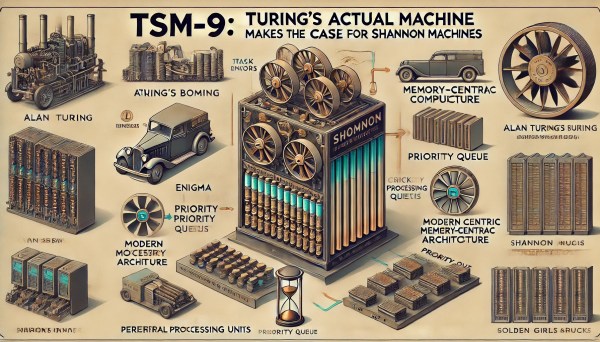
TSM-9: Turing’s Actual Machine Makes the Case for Shannon Machines
In a sense, the Bombe makes the case for Shannon Machines by showing how computation in the real world is defined by constraints—bounded memory, time-sensitive tasks, cooperative components, and structured data access. Turing’s actual machine, the Bombe, reminds us that effective computation is often about meeting specific needs within specific limits. Rather than the theoretical purity of infinite tape, Turing’s Bombe—and by extension, Shannon Machines and Golden Girls Architecture—illustrate how real computation can be collaborative, memory-centric, and bounded by design.
Littoral Governance: A New Politics for the Age of AI
Littoral Governance represents the next evolution in political systems—one that mirrors the co-evolution of AI and human systems in Littoral Science. It responds to the complexity and speed of the AI-driven world by embracing decentralization, distributed decision-making, and collaborative governance.
The Quilt Platform: Version Zero of the Littoral Toolbox
The Quilt Platform serves as a robust starting point for building the Littoral Toolbox, aligning closely with the goals of Littoral Science—collaborative, AI-powered, interdisciplinary research. With features like data versioning, cloud integration, verifiable data packaging, and metadata management, Quilt provides the essential building blocks for the Littoral Toolbox’s v0.
The Littoral Toolbox: A Distributed Platform for AI-Powered Science
The Littoral Toolbox will be a distributed data platform designed to enable the interdisciplinary, AI-powered research central to Littoral Science. By prioritizing verifiable datasets, the Toolbox will provide the foundation for trusted collaboration, both between human researchers and AI systems.
The Littoral University: Redesigning Higher Education for the Age of AI
Prompt: What would a Littoral University designed from first principles around abundant computational intelligence differ from what we have today? The emergence of a Littoral University, grounded in AI-driven, interdisciplinary research and lifelong learning, would profoundly disrupt the traditional funding models of higher education. Tuition would move from degree-based payments to subscription and modular learning, catering to a diverse range of learners over their lifetimes. Research grants would shift from discipline-specific funding to problem-oriented and global collaborations, supported by AI’s ability to facilitate efficient, cross-disciplinary projects.
Compressing the Hype Cycle: A Modern-Day Parable (with ChatGPT)
When they presented the new Hype Cycle Compressor to management, they described it as a way to fast-track innovation by compressing the time spent in each phase—not skipping over them, but using the tensions to fuel faster adaptation and alignment.
Pitch: Designing Disruptive Institutions for a Flourishing Future
As societal challenges grow in complexity, our existing institutions—rigid, hierarchical, and often outdated—struggle to keep pace. To address these shortcomings, IAL can spearhead the creation of new "disruptive" institutions through a meticulously crafted design process that emphasizes innovation, adaptability, and inclusivity.
AORTA Spiritual Entrepreneurship Practices
Ambition Openness Risk Thankfulness Awareness

You must be logged in to post a comment.