
Sequel to CHEFS Club,
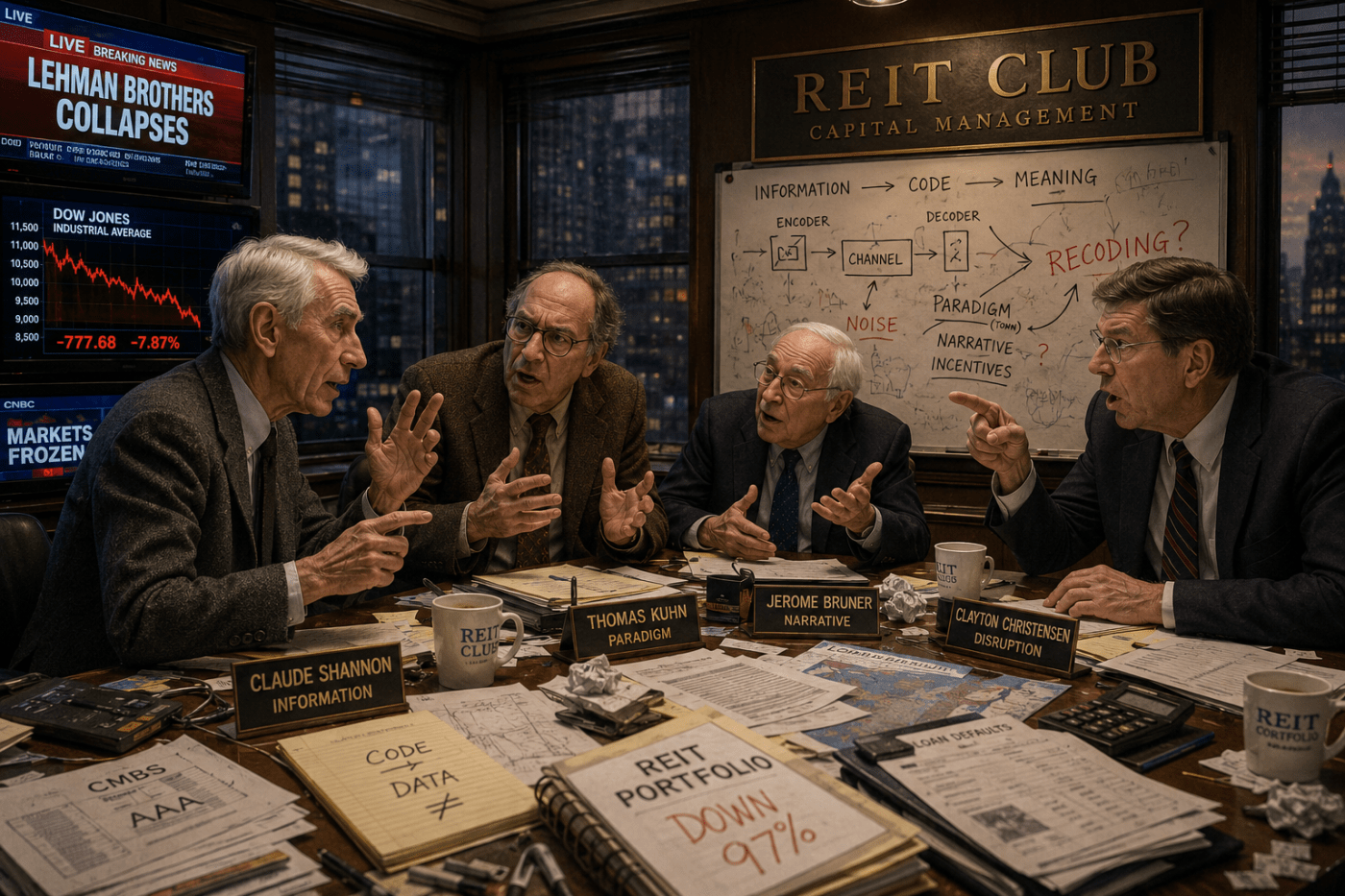
As Stoppard, write the next wacky “club” skit featuring only Claude Shannon, Thomas Kuhn, Jerome Bruner, and Clayton Christensen, desperately trying to save their Real Estate Investment Trust during the 2008 Financial Crisis. The start is them hilariously misunderstanding each other and the real problem because Information Theory (and their systems) implicitly assume a fixed encoding of reality. To solve this, they eventually force each other to organically rediscover:
- the distinction between code and data;
- the fact that encoders implicitly define what counts as reality;
- which requires escape sequences and software updates to “recode” information systems when reality shifts.
Scene: September 2008. The office of REIT Club Capital Management. Televisions scream. Everyone speaks simultaneously.
SHANNON
Excellent news.
The information is perfectly preserved.
CHRISTENSEN
Terrible news.
The business model is perfectly disrupted.
KUHN
Splendid news.
The anomalies have reached critical mass.
BRUNER
Gentlemen, perhaps we should tell ourselves a healthier story.
They stare.
CHRISTENSEN
Our tenants are defaulting.
SHANNON
Impossible.
The channel capacity is adequate.
KUHN
Reality is merely resisting the reigning paradigm.
BRUNER
Perhaps the buildings have suffered identity confusion.
CHRISTENSEN
The buildings haven’t suffered identity confusion!
The banks have!
SHANNON
Nonsense.
All these securities are encoded AAA.
KUHN
Exactly.
The reigning classification.
BRUNER
A narrative category.
CHRISTENSEN
An overserved market segment.
SHANNON
The symbols are intact.
CHRISTENSEN
The symbols are lying.
SHANNON
Symbols do not lie.
People lie.
Channels become noisy.
Symbols are innocent.
KUHN
Paradigms lie.
BRUNER
Stories lie.
CHRISTENSEN
Incumbents lie.
SHANNON
Symbols don’t.
Television. LEHMAN BROTHERS COLLAPSES.
Silence.
SHANNON
…That seems suboptimal.
The First Misunderstanding
KUHN
At last!
A scientific revolution!
CHRISTENSEN
No, no. Disruptive innovation!
BRUNER
No. Narrative reconstruction!
SHANNON
No. Noise.
CHRISTENSEN
Noise?
SHANNON
Clearly.
The mortgages entered one end.
AAA emerged from the other.
Therefore the message survived transmission.
CHRISTENSEN
That’s not transmission.
That’s laundering.
KUHN
He’s right.
The classification itself has collapsed.
SHANNON
But the codebook remains.
KUHN
That’s precisely the problem.
BRUNER
We’ve mistaken the dictionary for reality.
SHANNON
Preposterous.
Reality exists independently.
BRUNER
Yes, but your encoder decides what counts as reality.
SHANNON
Nonsense.
BRUNER
How many bits describe a liar?
SHANNON
…
BRUNER
How many bits describe panic?
SHANNON
…
BRUNER
How many bits describe a broker who has stopped believing his own brochures?
SHANNON
Those are semantic questions.
BRUNER
Precisely.
The Second Misunderstanding
KUHN
Gentlemen, we are suffering a paradigm shift.
CHRISTENSEN
No.
A disruption.
KUHN
Same thing.
CHRISTENSEN
Absolutely not.
Paradigms collapse because anomalies accumulate.
Businesses collapse because incentives accumulate.
KUHN
Interesting distinction.
CHRISTENSEN
Your scientists preserve theories.
My executives preserve margins.
KUHN
Ah.
Institutional inertia.
CHRISTENSEN
Exactly.
SHANNON
Neither explains why AAA means “safe.”
KUHN
Because the community says so.
BRUNER
Because the story says so.
CHRISTENSEN
Because regulators say so.
SHANNON
Because—
He freezes.
SHANNON
Wait.
None of those are properties of the signal.
Everyone stops.
Discovery One: Code Is Not Data
SHANNON
Good heavens.
The mortgages are data.
AAA is code.
CHRISTENSEN
Naturally.
SHANNON
No!
Not naturally.
Terribly unnaturally!
I’ve spent thirty years assuming the codebook is fixed.
KUHN
Science assumes the same.
BRUNER
Education too.
CHRISTENSEN
And management.
SHANNON
Then we’ve all gone mad.
Discovery Two: Encoders Define Reality
BRUNER
The encoder determines which distinctions matter.
KUHN
Normal science determines what counts as an observation.
CHRISTENSEN
Managers determine which customers matter.
SHANNON
Ratings agencies determine which risks matter.
They all stare.
SHANNON
Good Lord.
The encoder decides reality.
KUHN
Not reality itself.
Reality-for-the-system.
BRUNER
Reality-for-the-story.
CHRISTENSEN
Reality-for-the-balance-sheet.
SHANNON
Then the collapse occurred before the collapse.
KUHN
Indeed.
The codebook failed before the buildings failed.
Discovery Three: Escape Sequences
The television announces: “Markets Frozen.”
SHANNON
Frozen?
How does one transmit a symbol outside the codebook?
BRUNER
One tells a new story.
KUHN
One creates a new paradigm.
CHRISTENSEN
One spins out a new business.
SHANNON
No, no, no.
One requires…
an escape sequence.
Everyone turns.
SHANNON
When ordinary symbols become inadequate—
one transmits instructions for changing the code itself.
KUHN
Paradigm shifts are escape sequences.
BRUNER
Narratives are escape sequences.
CHRISTENSEN
Disruptive innovations are escape sequences.
SHANNON
Software updates!
Revelation
SHANNON
Information theory has no software updates.
KUHN
Neither does philosophy of science.
BRUNER
Neither does psychology.
CHRISTENSEN
Neither does management theory.
SHANNON
We’ve all assumed reality arrives already encoded.
KUHN
But revolutions rewrite encodings.
BRUNER
Humans rewrite meanings.
CHRISTENSEN
Markets rewrite incentives.
SHANNON
Then information systems require—
All four together:
RECODING.
Television: “DOW DOWN 777 POINTS.”
CHRISTENSEN
How disruptive.
KUHN
How revolutionary.
BRUNER
How narrative.
SHANNON
How statistically improbable.
The lights flicker.
SHANNON
Gentlemen.
Our REIT appears to have vanished.
CHRISTENSEN
Disrupted.
KUHN
Overthrown.
BRUNER
Re-authored.
SHANNON
Escaped.
Blackout.
Appendix I: Why This Took Five Tries
(How Reality Recodes)
Several readers have asked why REIT Club required five drafts. The answer is instructive.
The first draft contained all the right ideas. Unfortunately, it also contained no buildings, no loans, no losses, and no reason for anyone to care.
The second draft contained all the right ideas plus a talking backslash. This represented a measurable improvement in punctuation but not in drama.
The third draft introduced software updates. The characters immediately became omniscient and spent most of their time agreeing with one another. Agreement, while useful in accounting, is generally fatal to comedy.
The fourth draft suffered from excessive wisdom. Everyone understood recoding. No one understood mortgages. Consequently, the audience understood neither.
The fifth draft began with an entirely different piece of information:
September 2008.
A Real Estate Investment Trust is down 97%.
Suddenly reality acquired the floor. The same characters, theories, and jokes behaved very differently:
- Shannon stopped explaining information and started trying to understand why AAA securities were not.
- Kuhn stopped announcing revolutions and started denying them.
- Bruner stopped constructing meaning and started rebranding foreclosures.
- Christensen stopped theorizing disruption and started looking for trailer parks.
Nothing essential changed.
Except the code.
The 2008 financial crisis imposed constraints that no amount of cleverness could evade. The result was that the ideas ceased behaving like conclusions and began behaving like people.
Ironically, this accident provides the strongest evidence for the thesis of the play. No new principles were added. No hidden truths were discovered. No additional information was required. Reality merely changed the decoder.
Which suggests a curious possibility. Perhaps intelligence does not primarily consist in accumulating information. Perhaps it consists in being repeatedly recoded by contact with reality.
Or, stated more conservatively:
Reality is unusually effective at supplying escape sequences.
Unfortunately, it tends to charge tuition.
Appendix II: Information Theory as Thirdness
(Peirce and Fourthness)
Charles Sanders Peirce organized experience into three irreducible categories.
- Firstness is possibility. Redness, beauty, and the mere feeling that something might be.
- Secondness is actuality. Resistance, collision, and the experience of discovering that reality does not care what one believes.
- Thirdness is mediation. Signs, laws, habits, meanings, languages, and all the structures through which Firstness and Secondness become intelligible.
Modern science is largely an achievement of Thirdness. Theories, equations, paradigms, probability distributions, codebooks, and decoders are all structures of Thirdness.
Shannon’s information theory is therefore a triumph of Thirdness. Information is defined relative to a fixed decoder and a fixed state space.
But Peirce never articulated a Fourth category.
Suppose, however, that Thirdness itself becomes historical. Suppose that habits change. Suppose that meanings evolve. Suppose that paradigms collapse. Suppose that decoders are themselves informational structures.
Then something new appears. Not merely signs. Not merely resistance. But the reorganization of sign systems themselves.
This may be called Fourthness.
Fourthness is not another sign. It is not another fact. It is not another interpretation. Fourthness is the historical process by which systems of interpretation are transformed.
Thirdness says:
This is what things mean.
Fourthness says:
This is how meanings change.
Thirdness provides codebooks. Fourthness rewrites codebooks.
Thirdness explains communication. Fourthness explains recoding.
Thirdness governs signs. Fourthness governs the evolution of signs.
Thirdness assumes habits. Fourthness explains how habits die.
Secondness says:
You are wrong.
Thirdness says:
Here is how to understand why.
Fourthness says:
The way you understand things must itself change.
Scientific revolutions are Fourthness acting upon Thirdness.
Educational transformation is Fourthness acting upon habits.
Disruptive innovation is Fourthness acting upon institutions.
Religious conversion is Fourthness acting upon worldviews.
Financial crises are Fourthness acting upon markets.
In information-theoretic terms, Fourthness is not information within a fixed code. Fourthness is the process by which information recodes the structures through which future information becomes meaningful.
Thus:
- Firstness concerns possibilities.
- Secondness concerns realities.
- Thirdness concerns interpretations.
- Fourthness concerns the historical transformation of interpretations.
Or more concisely:
- Firstness asks what might be.
- Secondness asks what is.
- Thirdness asks what it means.
- Fourthness asks how meaning itself changes.
Information theory belongs to Thirdness.
Recoding Information Theory belongs to Fourthness.
Appendix III: When Information Is Not Information
Information is not an absolute substance. It is a relation among signal, code, decoder, and state space.
A signal becomes information only when a decoder can distinguish what state it addresses. Without a decoder, a signal is merely a difference. Without a state space, it has nowhere to land. Without a code, it cannot be interpreted.
This is why Shannon information is powerful but conditional. It measures uncertainty reduction within an already specified system. The alphabet is known. The channel is known. The decoder is assumed. The possible states are fixed.
Under those conditions, information is information.
But outside those conditions, something stranger happens. A signal may arrive that cannot be interpreted within the existing code. It may not select among available states. It may instead expose the inadequacy of the state space itself.
To the existing decoder, such a signal may appear as noise, error, contradiction, anomaly, paradox, trauma, nonsense, or crisis.
It is not yet information. Not for that decoder. Not in that world.
But it may still matter. If the receiver contains mechanisms capable of altering the decoder, the uninterpretable signal may function as an escape. It may trigger recoding.
Once recoding occurs, the same signal—or future signals like it—can become information.
Thus, some signals are not information when they arrive. They become information only after they have changed the conditions under which information can be received.
This is the central paradox.
What looks like noise before recoding may become meaning after recoding.
What looks like anomaly before recoding may become law after recoding.
What looks like failure before recoding may become evidence after recoding.
What looks like collapse before recoding may become revelation after recoding.
Information theory studies signals that are already interpretable.
Recoding Information Theory studies signals that alter interpretability.
This is why information is sometimes not information. It is not because the signal lacks structure. It is because the receiver lacks the code.
And sometimes the only way to receive the message is to be changed by it first.
Appendix IV: A Brief History of Escape Sequences
Escape sequences are old. Older, in spirit, than software.
They arise wherever a communication system must use the same channel for two different purposes:
- carrying ordinary data;
- carrying instructions about how that data should be interpreted.
This is the central trick. A mark appears inside the stream. To an ordinary decoder, it looks like another character. To a prepared decoder, it says:
Stop reading normally.
The history of escape sequences is therefore a history of disciplined ambiguity.
Early communication systems already distinguished between printable characters and control characters. Some symbols were not meant to appear on the page. They moved the carriage. Advanced the paper. Rang the bell. Returned the cursor. They were characters that did not describe content, but altered the conditions under which content appeared.
ASCII made this distinction explicit. Alongside letters, digits, and punctuation, ASCII included control characters such as carriage return, line feed, tab, bell, and ESC.
The ESC character was especially revealing. It indicated that what followed should not be interpreted as ordinary text, but as a control sequence.
In terminals, this became visible magic. A stream of text could suddenly move the cursor, clear the screen, change colors, or alter display modes. The same wire carried both prose and command. The same symbols could be either content or control. The difference lay in the decoder.
By the 1970s, video terminals had proliferated, each with its own private dialect of control codes. Programs had to know whether they were speaking to one kind of terminal or another. A message that moved the cursor on one machine might print gibberish on another.
This was not merely inconvenience. It was a codebook crisis.
ANSI and ECMA standards attempted to civilize the chaos by standardizing escape sequences for terminal control. The now-familiar pattern emerged: ESC, followed by additional characters, followed by an instruction.
The escape did not leave the channel. It repurposed the channel.
Programming languages generalized the same idea. A backslash inside a string says that the next character should be interpreted differently.
\nis not the lettern. It is a newline.\tis not the lettert. It is a tab.\"is not merely a quotation mark. It is a quotation mark allowed to appear inside a quoted string without ending the string.
The backslash does not add data. It changes the interpretation of data.
Markup languages extend the pattern again.
In HTML, angle brackets do not merely appear as text. They define structure.
In XML, tags tell the parser what kind of thing the text is.
In JSON, quotation marks, braces, commas, and colons organize data into interpretable form.
In protocols, headers tell receivers how to understand payloads.
In software updates, downloaded bits modify the software that will later interpret downloaded bits.
Each case repeats the same strange movement. A system sends information through an existing channel that modifies how future information through that channel will be received.
That is escape. Not escape from information. Escape within information.
Escape sequences reveal that no communication system is merely a pipe. Every pipe has grammar. Every grammar has privileged marks. Every privileged mark can become a door.
This is why escape sequences matter for Recoding Information Theory. They show, in miniature, how information can cease being merely content and become instruction. They are local, technical examples of a larger pattern: information acting on the machinery of interpretation.
A newline recodes a line.
A terminal escape recodes a screen.
A protocol header recodes a packet.
A software update recodes a program.
A crisis recodes a market.
A discovery recodes a science.
A conversion recodes a self.
The history of escape sequences is therefore not a curiosity of computing. It is a compressed parable of recoding.
The deepest lesson is simple:
The same channel can carry both what is said and how saying works.
Once that is possible, information theory can no longer treat the decoder as permanently outside the message. The decoder, too, may be addressed. And once addressed, it may be changed.
Appendix V: Who Invented the Control Plane?
Nobody invented the control plane.
That is the annoying answer.
The more useful answer is that engineers gradually discovered that every serious communication system has two different jobs:
- carrying traffic;
- deciding how traffic should be carried.
The first became the data plane. The second became the control plane.
Telephony: Signaling Before Control Planes
In telephony, this distinction appeared as signaling. A phone call carries voice, but the network also needs messages that set up the call, route it, bill it, and tear it down.
Early systems mixed signaling with the call itself. Later systems separated signaling from conversation. Signalling System No. 7 made this architectural split explicit: one network carried the call, while another carried the instructions governing the call.
That was not yet modern “control plane” language, but it was the same insight:
The channel needs a way to talk about the channel.
Networking: Naming the Distinction
Networking generalized the distinction.
Routers forward packets. That is the data plane.
Routers also exchange routing information, build forwarding tables, and decide where packets should go. That is the control plane.
Software-Defined Networking
Software-defined networking later made the distinction famous. OpenFlow and SDN separated the machinery that forwards packets from the software that controls forwarding decisions.
This was revolutionary because it made control programmable. The network was no longer merely equipment. It became software.
Who Invented It?
Telephony discovered it as signaling.
Networking named it as architecture.
Software-defined networking weaponized it as programmability.
But conceptually, the control plane is older than all of them. It appears wherever a system must distinguish between:
- messages carried by the system;
- messages that govern the system.
Recoding Information Theory
That is why the control plane matters for Recoding Information Theory. It is a historical example of escaped information.
Control information travels through or alongside ordinary information, but it is addressed to a different function.
Not the payload. The interpreter.
Not the traffic. The routing logic.
Not what is said. How saying proceeds.
The control plane therefore marks a crucial intermediate step between ordinary information and recoding.
Control changes system behavior. Recoding changes the code by which behavior and information are interpreted.
In that sense, the control plane did not invent recoding. It merely made visible a deeper pattern:
Every sufficiently complex information system must carry information about its own information flow.
Once that happens, information is no longer merely cargo. It becomes governance.
And once governance itself becomes updateable, the control plane becomes a doorway to recoding.
The control plane is not a second channel. It is the first admission that information sometimes addresses the receiver rather than the state of the world.
Recoding begins when the receiver itself becomes a legitimate destination.
Appendix VI: Code versus Data
(An Embarrassing Paradox)
Everyone knows the distinction between code and data. Programs are code. Inputs are data. Code acts. Data is acted upon.
Computer science students learn this in their first courses. Lisp programmers have joked for decades that code and data are merely different views of the same lists. Compilers treat programs as data. Interpreters treat data as code. Software updates rewrite software.
None of this is controversial.
Which makes the following historical fact rather awkward.
Despite understanding that code and data are made of the same stuff, we have largely failed to incorporate that fact into our theories of information.
Information theory assumes a fixed decoder.
Science assumes a functioning paradigm.
Education assumes stable schemas.
Management assumes established business models.
Each discipline acknowledges that these structures change. But they usually treat such changes as exceptional events occurring outside the theory itself.
Thus we encounter an embarrassing paradox.
We know the distinction between code and data. We simply have not allowed that distinction to recode us.
We know that software updates exist. Yet we continue to think about information as though only payloads mattered.
We know that constitutions amend constitutions. Yet political theory often treats constitutions as background assumptions.
We know that paradigms change. Yet science is practiced largely within paradigms rather than about paradigms.
We know that learning transforms people. Yet education is frequently discussed as information transfer.
We know that crises alter institutions. Yet economics prefers equilibrium.
We know that stories reshape identities. Yet psychology often measures beliefs rather than the structures that make beliefs possible.
In every case, we possess the fact. We lack the transformation.
We have treated the distinction itself as data. Not as code.
This is perhaps why the consequences have remained strangely invisible.
For if code and data are both information, then codebooks, paradigms, schemas, institutions, and decoders are themselves informational structures. And if informational structures are made of information, then information may act upon them.
Nothing mysterious is required. No second substance. No transcendence. No ghost in the machine.
Only the admission that information sometimes addresses not the state of the world, but the machinery through which states become meaningful.
This possibility is so obvious that it hardly seems worth stating. And yet its consequences remain largely unexplored.
Perhaps because recognizing a software update is easier than installing one.
Or, stated more painfully:
We have known the answer. We simply have not allowed it to change the question.
The distinction between code and data has been treated as data. It has not yet been allowed to become code.
Which may itself be the first empirical evidence for Recoding Information Theory.
Appendix VII: How REIT Club CATCHes COMICs
REIT Club looks, at first, like a joke about real estate. It is actually a joke about inheritance.
COMIC Club argued that configurations orient mathematics inside computation. CATCH Club argued that configurations act through computation hierarchies.
Together, they established that mathematical meaning does not float freely. It is situated inside structured systems that determine what counts as an object, an operation, a proof, or a transformation.
In the language of REIT Club, those structures are code. COMIC and CATCH show that code exists. REIT asks how code changes.
That is the missing step.
A configuration is not merely a state. It is not merely data. It determines how states are interpreted and transformed. It therefore functions as code.
But once configurations are themselves represented, compared, modified, or inherited, they become data to a higher configuration.
This is the crucial recursion.
Every code is data to a sufficiently higher code.
COMIC reveals that mathematics depends on configuration.
CATCH reveals that configurations operate through hierarchies.
REIT reveals that hierarchy itself is maintained by recoding.
Thus:
- Data is information addressed to a state.
- Code is information addressed to a transformation.
- Configuration is code made structural.
- Hierarchy is code organized across levels.
- Recoding is information acting across levels to modify the code.
This is why REIT belongs after COMIC and CATCH.
COMIC says computation contains mathematics.
CATCH says configurations govern computation.
REIT says governance itself can be updated.
Or, more tersely:
COMIC shows that meaning is configured.
CATCH shows that configuration is hierarchical.
REIT shows that hierarchy is recodable.
That is also why the 2008 financial crisis is not accidental scenery. The crisis dramatizes what happens when a higher-level configuration fails. The mortgages did not merely fail as data. The ratings, models, covenants, incentives, and assumptions failed as code. The state space changed.
The codebook failed before the buildings failed.
REIT Club therefore CATCHes COMICs by turning their static hierarchy into a dynamic process. Configurations do not merely orient mathematics. They can be recoded.
And once they are recoded, what counts as mathematics, computation, information, risk, value, or reality may change with them.


Leave a comment