
Write a parody of The Attention Paper building on the idea that the only thing “Agency” can truly control is where we redirect attention.
ChatGPT Prompt
The Self as Attentional Architecture
Abstract
We propose a radical simplification of agency by exploring an attention-based architecture for subjective experience. Drawing inspiration from the breakthrough Transformer model, we reframe the self not as an autonomous executive possessing complete control over mind and body, but as the locus in which selected perceptions, memories, impulses, and possibilities become available.
We hypothesize that attention is not all an agent needs–but it is all an agent “has.” Perception, memory, desire, reason, and action may depend on vast physical and cognitive systems, yet none of these is directly accessible to the experiencing “I.” They become available to agency only when activated within attention.
This does not imply that the self controls attention. Attention is continually activated, conditioned, captured, and hijacked by forces both internal and external. The minimal operation remaining to agency is not command, but redirection: the recurring attempt to notice where attention has gone and invite it elsewhere.
Introduction
Traditional models of agency have become bloated with complexity: rational decision layers, executive-control modules, preference hierarchies, narrative identities, and metaphysical assertions of free will.
Yet immediate experience suggests a fundamentally simpler interface:
Attention is all I “have.”
The quotation marks matter.
To “have” attention does not mean to own it, govern it, or possess it as an object. It means that whatever I experience is given through attention. I “have” a thought in the same sense that I “have” a sensation, memory, fear, or moment of clarity: it has become present to me.
My brain may process signals outside awareness. My body may regulate itself. My history may condition my responses. My environment may manipulate my salience. But the “I” does not directly encounter the machinery producing experience. It encounters only the limited output selected for attention.
This implies that attention is not merely one cognitive faculty among others. It is the core protocol through which anything becomes available to agency.
Attention is not all that agency needs.
But attention is all that agency “has.”
Architecture Overview
Legacy Systems: Ownership and Control
Traditional architectures of the self often assume:
- A central executive issuing commands
- Stable preferences stored in an accessible identity
- Conscious decisions produced through rational deliberation
- Voluntary control over thought and behavior
- Personal ownership of whatever occurs within the mind
These models confuse participation with sovereignty.
The fact that “I” experience a thought does not mean I authored it. The fact that I feel a desire does not mean I selected it. The fact that attention has settled somewhere does not mean I chose its destination.
Much of experience arrives already computed.
By the time an object appears important, underlying systems have assigned it salience. By the time a reason enters awareness, unconscious processes may have already prepared a response. By the time “I” decide, the available options have been filtered by mechanisms I neither observe nor control.
The legacy self therefore suffers from a persistent attribution error: it mistakes access for authorship.
The Attentional Model: Availability-Based Architecture
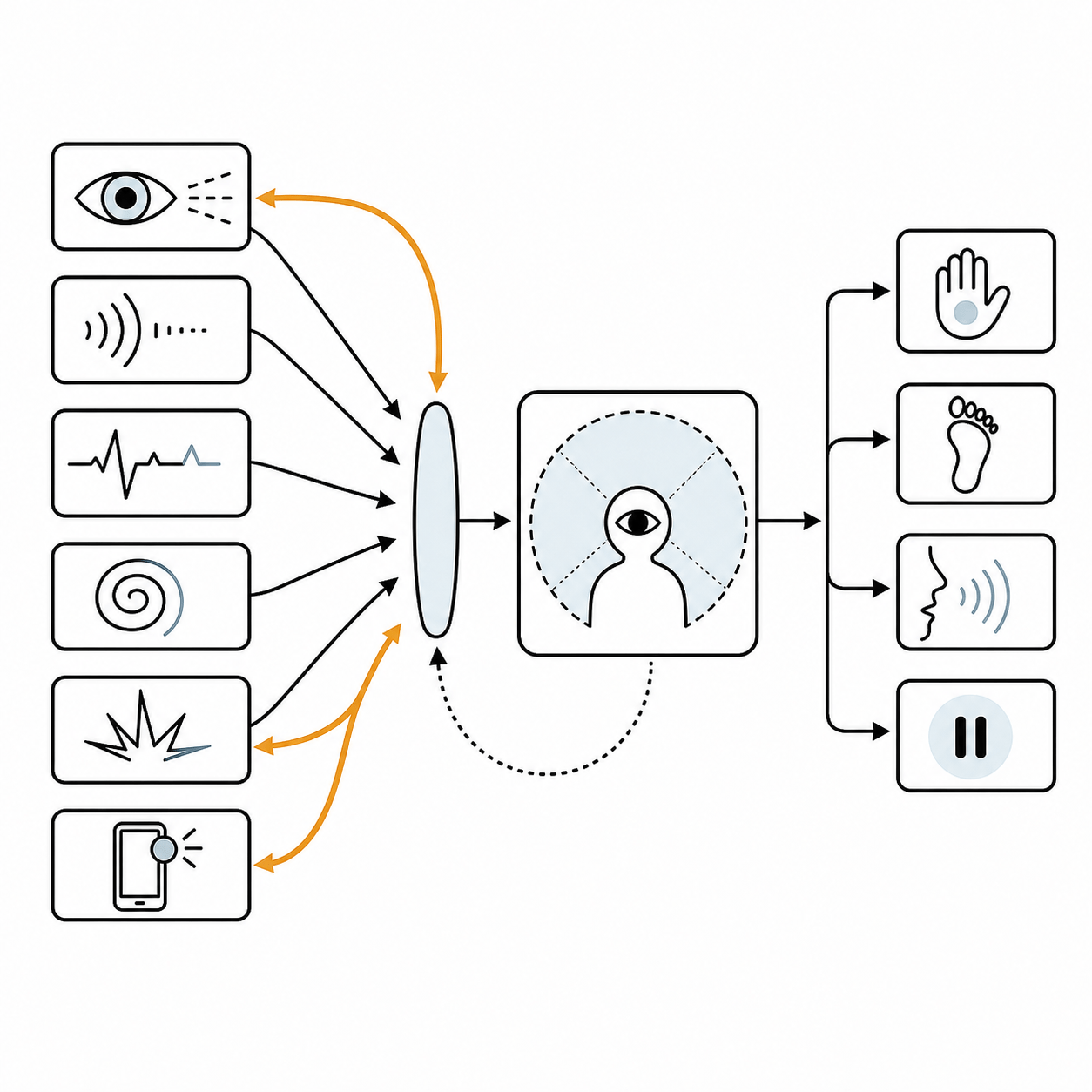
We define the experiencing self as an attentional interface through which selected contents become available for evaluation and action.
Let:
- (X) = the total state of the organism and its environment
- (S(X)) = unconscious processes assigning salience within that state
- (A(S(X))) = the limited contents activated in attention
- (I) = the agent operating upon what attention makes available
- (R) = the attempt to redirect attention
The agent does not receive (X) directly. It receives only (A(S(X))).
Agency can therefore be modeled as:
[
I_t = A(S(X_t))
]
with redirection expressed as:
[
A_{t+1} = R(I_t, A_t, X_t)
]
But (R) is not an external command issued from outside the system. The impulse to redirect must itself arise within the current attentional field.
I cannot redirect attention from nowhere.
I must first notice.
The “I” is not the owner of the system. It is the point at which part of the system becomes available for response.
Key Properties of the Attentional Paradigm
State Selection
The organism contains far more information than the experiencing self can access at once. Attention compresses this immense state into a narrow context window.
At any moment, countless sensations remain unfelt, memories unrecalled, motives unrecognized, and possibilities unseen. What enters attention acquires disproportionate influence because it becomes part of the agent’s actionable world.
- A forgotten commitment cannot guide me.
- An unnoticed danger cannot be deliberately avoided.
- A possibility I cannot imagine cannot be chosen.
Attention does not create every cause of action, but it determines which causes become available to agency.
What does not enter attention may still control me, but I cannot consciously respond to it.
Context Dependence
Attention never operates upon the world in its entirety. It operates within a context generated by embodiment, history, language, expectation, and present circumstances.
The same event may activate fear in one person, curiosity in another, and remain invisible to a third. Each receives a different actionable world–not necessarily because the external event differs, but because attention has weighted it differently.
The self therefore does not act upon reality as such.
It acts upon reality as attended.
Capture and Hijacking
Attention is not a neutral resource awaiting voluntary allocation. It is activated by competing systems.
It may be captured by:
- Sudden danger
- Physical pain
- Hunger or exhaustion
- Shame and traumatic memory
- Habitual craving
- Social approval
- Algorithmic recommendation
- Advertising and propaganda
- Notifications engineered for interruption
- Ideas that reproduce by monopolizing awareness
Some capture is essential. An organism unable to have its attention seized by danger would not survive.
But the same architecture that permits rapid adaptation also permits exploitation. Systems that learn how to trigger salience can influence behavior without persuading the agent at the level of reason.
To shape attention is to shape the field from which action emerges.
Attention may be all I “have,” while its contents are substantially selected by something else.
Limited Control
The attentional model rejects both total helplessness and total sovereignty.
I cannot simply choose never to be distracted. I cannot command an intrusive memory to disappear. I cannot guarantee that fear, anger, or desire will fail to capture me.
But neither am I always powerless.
- I may notice the capture.
- I may remember another concern.
- I may change my environment.
- I may return to my breath, my work, another person, a promise, a prayer, or the reality before me.
This redirection is neither absolute control nor passive observation. It is effort under constraint.
Agency is not the power to determine what appears. It is the capacity to participate in what attention does next.
Recursive Redirection
Because the intention to redirect attention must itself enter attention, agency is recursive.
I become aware that I am distracted. That awareness introduces a new object: the distraction itself. I may then attend to the intention to return. If that intention remains active long enough, attention may reorganize around a different object.
This loop is fragile. It may fail repeatedly.
Yet failure does not invalidate agency. The return is not a one-time command but a practice of recurrent reorientation.
- Attention wanders.
- Attention is captured.
- Attention notices.
- Attention returns.
The self persists not through uninterrupted control, but through repeated attempts at return.
Implications and Applications
Agency
Agency should not be measured solely by the freedom of an isolated decision. It also depends upon the conditions governing what the agent can notice, remember, and imagine.
A person may possess formal freedom while lacking attentional freedom. If every available cue reinforces the same fear, craving, or ideology, alternatives may never become sufficiently present to be chosen.
Expanding agency therefore requires expanding the attentional field.
Sometimes the most important freedom is not choosing between available options, but becoming able to see an option that was previously absent.
Responsibility
If attention can be conditioned and hijacked, responsibility cannot mean complete authorship of every internal event.
I am not necessarily responsible for the first thought, feeling, or impulse that appears.
Responsibility begins with my relationship to what appears: whether I identify with it, rehearse it, question it, redirect it, or build conditions that make a different response more likely next time.
This does not eliminate accountability. It relocates it from impossible sovereignty to practicable stewardship.
Mental Health
Distress often involves attentional capture: anxiety repeatedly selects possible threats, depression selects evidence of futility, shame selects memories of failure, and compulsion selects the promise of immediate relief.
Healing cannot always be achieved by issuing better instructions to the self. The system may require new relationships, environments, bodily states, practices, or professional care before alternative objects can remain available to attention.
The goal is not perfect control.
It is greater capacity to notice capture without becoming identical to it–and greater ability to return.
Technology and Power
Every attention economy is also an agency economy.
Platforms do not need to control users directly if they can control what repeatedly becomes salient. Repetition alters familiarity; familiarity alters perceived relevance; relevance alters choice.
A system that governs attention influences which memories are retrieved, which emotions are activated, which options appear reasonable, and which actions feel urgent.
Whoever shapes attention does not completely control the agent.
But they help determine what the agent has to work with.
Practice
Attention training should not be understood as achieving permanent concentration. Such a goal merely recreates the fantasy of total control.
Practice consists in shortening the distance between capture and recognition, then strengthening the possibility of return.
The decisive moment is not distraction.
It is remembering that attention can be redirected.
Limitations
Attention is not sufficient for agency.
An agent also requires embodiment, memory, affect, perception, learned models, evaluative capacities, and some ability to influence action. Attention cannot choose an unavailable option, retrieve a destroyed memory, or make an incapacitated body move.
Nor is every attentional event agentic. Seizure, panic, compulsion, trauma, and manipulation may constrain the possibility of redirection.
The claim is therefore not:
Attention is everything the self needs.
It is:
Everything available to the self is available through attention.
Attention is not the whole architecture.
It is the interface through which the architecture becomes “mine.”
Conclusion
The self does not require the mythical powers of an unconstrained executive. It does not need to author every thought, approve every impulse, or control every movement of awareness.
It needs only enough freedom to participate in the next allocation of attention.
- I do not own attention.
- I do not fully control what activates it.
- I cannot guarantee that it will not be captured or hijacked.
- I can only become aware of where it has gone and strive to redirect it.
That striving is not evidence of failed sovereignty. It may be the smallest meaningful unit of agency.
Attention is not all I need.
Attention is all I “have.”
And returning is all I can do.
Appendix: Suggested Practices
- Capture detection: Periodically ask, “What currently has my attention–and what activated it?”
- Source attribution: Distinguish between what you are attending to and what caused it to become salient.
- Context management: Change the environment when willpower cannot reliably overcome engineered capture.
- Attention labeling: Name the active pattern without identifying with it: “Fear is present,” rather than “I am fear.”
- Alternative activation: Place reminders of neglected values where they can re-enter the attentional field.
- Return loops: When attention wanders, treat noticing as success and redirection as practice.
- Shared attention: Ask trusted people to help make visible what your current context prevents you from seeing.
- Adversarial awareness: Before responding to urgency, ask who or what benefits from your attention being here.
The smallest act of agency is not choosing what first appears, but participating in what becomes present next.


Leave a Reply