
Using [appendix] assumptions, publish a white paper with title [above] arguing why this should/could/would happen. Note the key risks, and the natural but necessary mitigations (e.g., user support)
ChatGPT Prompt
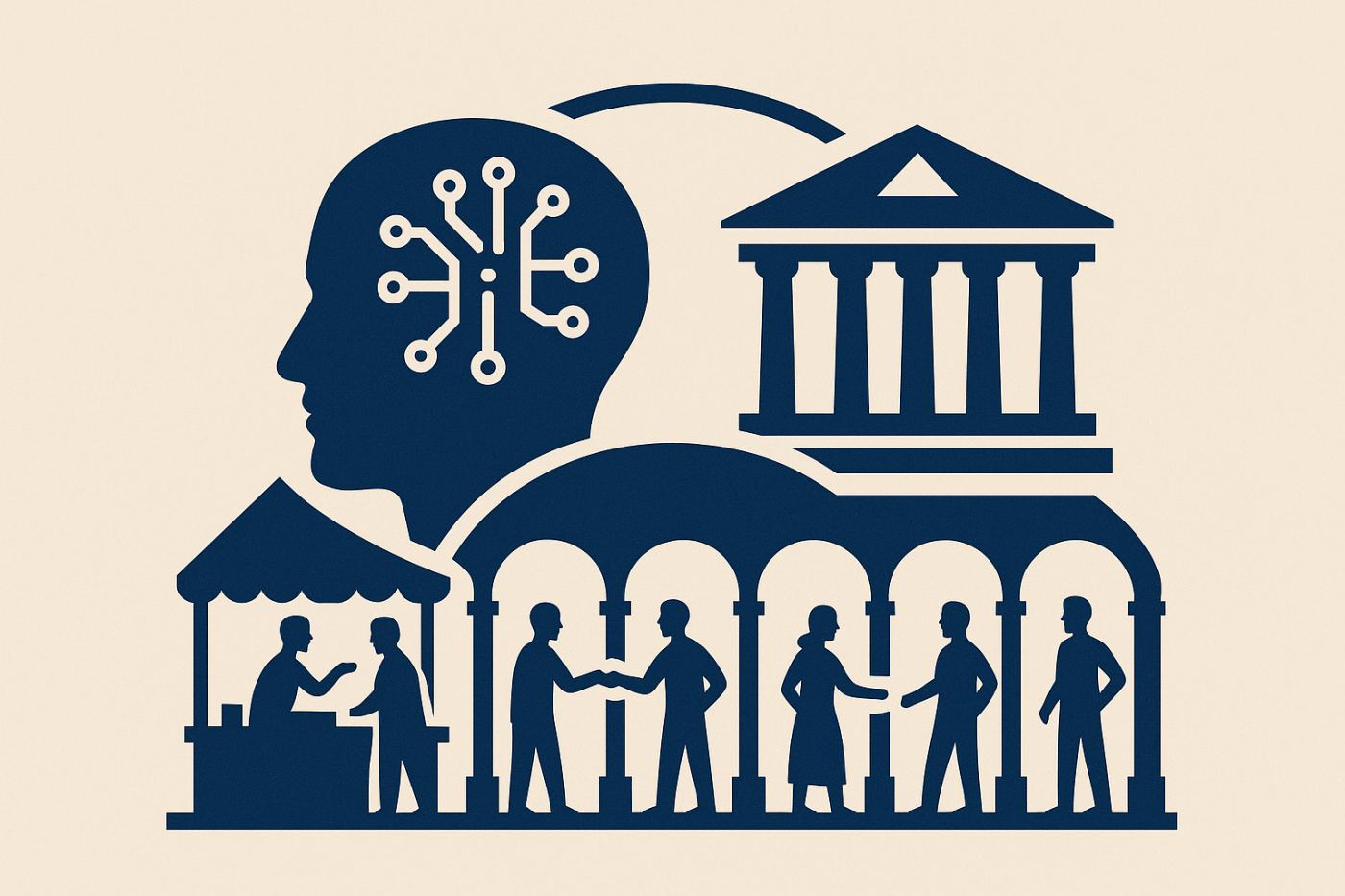
AIGORA (AI + agora) is a vision for a human-centered AI ecosystem — a decentralized, liquid marketplace where individuals find AI products that deserve their trust. It reframes the future of artificial intelligence not as a zero-sum race between monopolistic platforms, but as a flourishing commons of interoperable agents, governed by permission, reputation, and mutual benefit. In the age of AI, humans will win — not by outcompeting machines, but by designing systems where our trust, values, and agency are sovereign.
1. Why This Should Happen (Desirability)
1.1 Preserve Human Agency
Today’s dominant AI paradigms risk reducing users to data sources and prompt typists.
AIGORA proposes a reversal: humans are principals, not products.
By owning our trust graph and delegation ledger, we reassert sovereignty over AI use.
1.2 Align Innovation with Values
A liquid AI marketplace allows for diverse, values-aligned products — not one-size-fits-all algorithms.
This enables communities to define their own norms of fairness, privacy, and functionality.
1.3 Foster Economic and Cognitive Diversity
Commoditization of LLMs democratizes supply.
AIGORA encourages pluralism in demand: niche agents, hyperlocal trust, decentralized experimentation.
1.4 Build a Commons of Interoperability
Like Visa, TCP/IP, or the Web, the most durable infrastructures are cooperative standards.
AIGORA envisions a trust layer for AI that is open, decentralized, and user-aligned.
2. Why This Could Happen (Feasibility)
2.1 LLMs Are Already Commoditizing
The rise of model routing layers proves that quality is transient, not sticky.
No single LLM can dominate across all domains or tasks.
2.2 Precedents for Neutral Infrastructure Exist
Plaid, Visa, OAuth, and emerging agent protocols show how infrastructure can scale without control.
They thrive by standardizing complexity and respecting end-user context.
2.3 Developers and Institutions Need It
No single actor wants to maintain N-squared integrations between agents, apps, and models.
A shared fabric (AIGORA) reduces friction, distributes risk, and enables innovation.
2.4 Core UX Pattern: The Consigliere
A trusted, user-owned agent — a consigliere — can mediate access, data, and intent.
Built-in support for delegation, revocation, and selective disclosure makes this privacy-preserving by design.
3. Why This Would Happen (Probability)
3.1 Demand for Trust and Control Is Growing
Privacy fatigue and AI hallucination fear drive a hunger for tools that feel safe, local, and explainable.
Regulatory tailwinds (GDPR, AI Act) support user-controlled data and consent.
3.2 Centralized AI Will Fragment Under Load
Agentic use cases (e.g. travel, finance, health) require fluid, schema-flexible systems.
Monolithic platforms will buckle under rigidity and mistrust.
3.3 Value Will Flow to Meta-Coordination
Just as Visa made every bank viable in a global economy, AIGORA makes every agent a safe counterpart.
The highest leverage lies not in owning the silos, but orchestrating trust across them.
4. Key Risks and Necessary Mitigations
Risk 1: UX Complexity
Mitigation: Progressive disclosure. Begin with intuitive defaults, escalate only when needed. The consigliere acts invisibly until invited.
Risk 2: Fragmentation of Standards
Mitigation: Bootstrap from existing protocols. Use compliance templates and incentives, not mandates.
Risk 3: Exploitable Delegation
Mitigation: Fine-grained revocation, observability, and sandboxing. Use reputation staking to discourage abuse.
Risk 4: Monopolistic Pushback
Mitigation: Encourage co-ops and open councils. Make openness more profitable than enclosure.
Risk 5: Low User Motivation
Mitigation: Solve for community-level painkillers first (e.g. school trips, disaster recovery) where shared trust matters.
5. Conclusion: The Path Forward
The future is not determined by who builds the smartest AI, but by who sets the terms of trust, access, and consent.
AIGORA envisions a world where every individual has a consigliere, every agent must earn trust, and every transaction is a negotiation — not an extraction.
We believe:
- It should happen — because we deserve digital agency.
- It could happen — because we’ve done this before.
- It would happen — because no one can centralize trust indefinitely.
The age of AI doesn’t have to end in dystopia.
With AIGORA, it could end in democracy.
Appendix
The key assertions underlying this vision
- Posit 1: LLMs will be commoditized due to lack of strong network effects.
- Posit 2: AI products — not models — will capture enduring user value.
- Posit 3: Aggregators (like Plaid) will emerge to mediate trust and integration.
- Posit 4: These aggregators must be neutral, possibly structured as co-ops.
- Posit 5: Liquid, schema-free agent marketplaces will form wherever value and rational agents interact.
- Posit 6: Every persistent AI challenge reduces to a question of finding a trustworthy product in a liquid trust market.
- Posit 7: The UX layer must center on a user-owned consigliere that manages trust relationships and permissions.
 iHack, therefore iBlog
Leave a comment