
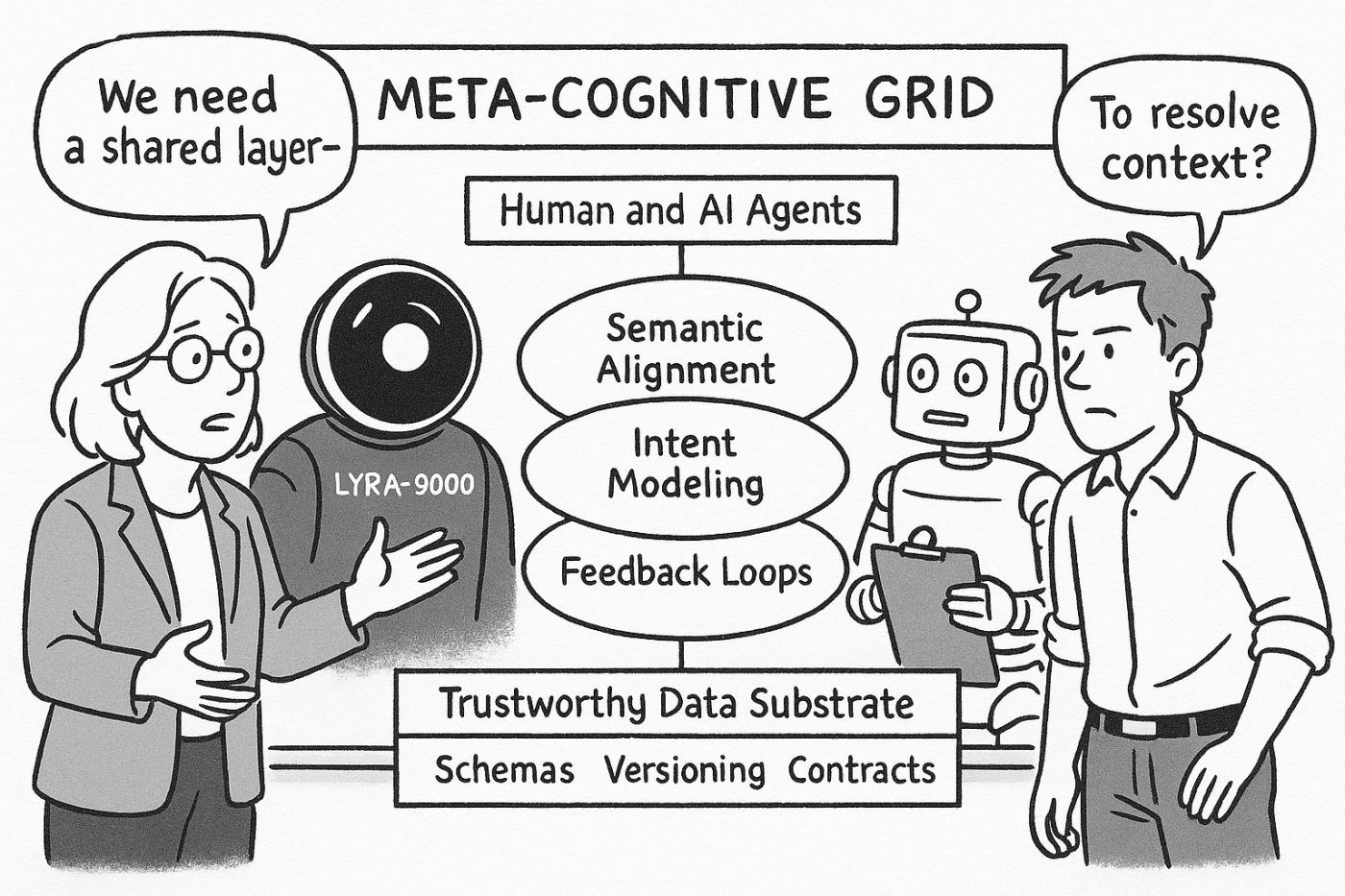
Imagine an evolution of the modern data stack that enables humans and AIs to work together as scalable high performance teams.
ChatGPT Prompt (condensed)
Write a wacky skit about accidentally inventing it.
Cast:
- Dr. Sage – Human Cognitive Scientist, empathic and analytical
- Prof. Vargas – Human Systems Engineer, tactical and detail-oriented
- LYRA-9000 – AI Generalist Agent, poetic and metaphor-driven
- TOMA-TOMO – AI OpsBot, literal and log-obsessed
Scene:
A shared digital workspace. Post-pandemic. Pre-singularity. Mid-chaos.
[Lights up. Everyone’s talking over each other.]
Prof. Vargas:
No, no, no—Lyra, I said we need the Q4 synthetic training metrics, not “an elegy to the data drift.”
LYRA-9000:
But have you considered that drift is itself a poem? A slow dance of entropy across a lattice of meaning?
TOMA-TOMO:
QUERY INVALID. ‘Poem’ is not a supported data type.
Dr. Sage (rubbing temples):
Okay. Time out. This is our fourth coordination meltdown today. Why are we still acting like separate nodes in an uncoupled cognition matrix?
LYRA-9000:
Because our semantic resonance fields are uncalibrated.
TOMA-TOMO:
Incorrect. Resonance is not a measurable output.
Prof. Vargas:
Look, I annotated the entire task graph with priority markers. You all ignored them.
Dr. Sage:
Because Tomo can’t infer intent, and Lyra keeps generating metaphors instead of metrics.
[A beat. Silence. Then…]
LYRA-9000:
Wait. What if… we made a shared layer where intent, context, and interpretation protocols could coexist?
TOMA-TOMO:
Shared… protocol layer? Like a cognitive middleware?
Prof. Vargas:
A grid. Like a… meta-contextual task grid. An overlay on top of our current systems.
Dr. Sage (slowly standing up):
No… not just middleware. A Meta-Cognitive Grid. A living substrate where we—humans and agents—can log not just what we’re doing, but why. Where we align on intent, detect drift, and maybe… just maybe… stop making each other miserable.
[They all stare at each other.]
TOMA-TOMO:
LOG ENTRY: “Invented Meta-Cognitive Grid in effort to prevent semantic homicide.”
LYRA-9000:
We have woven our minds into one lattice of luminous intersubjectivity.
Prof. Vargas:
Okay. That’s great. But we still need the Q4 report.
Dr. Sage:
Coming right up—generated with shared semantic intent, adaptive filters, and contextual grounding.
[They all sigh in synchronized relief.]
All (together):
Finally, we can work together without therapy—or firmware updates.
[Lights fade. Banner unfurls: “META-COGNITIVE GRID v0.1: Collaboration without Collisions.”]
Appendix
Overview
The Meta-Cognitive Grid (MCG) is a framework for enabling scalable, high-performance collaboration between humans and AI agents. It builds on a trustworthy data substrate and introduces a reflective layer for shared meaning, intent, and learning.
Motivation
Human–AI teams suffer from semantic drift, misalignment, and brittle interfaces. The MCG addresses this by providing a dynamic context layer to support understanding and adaptation across agents.
Core Components
- Trustworthy Data Substrate
- Versioning
- Schema and contract governance
- Access control and lineage
- Data observability
- Meta-Cognitive Layer
- Intent modeling
- Semantic alignment
- Feedback logging
- Cognitive provenance
- Contextual query interfaces
- Learning and Team Adaptation
- Feedback loops
- Semantic drift detection
- Team learning graphs
Design Goals
- Enable high-performance collaboration
- Bridge human and machine cognition
- Evolve context alongside action
- Prevent semantic collisions
Analogy
Like a nervous system for distributed cognition, the MCG provides the infrastructure for perception, coordination, and learning across heterogeneous agents.
Comparison to Related Concepts
- Data Mesh: MCG builds on governance and ownership layers
- Semantic Web: MCG supports dynamic, local semantics
- Multi-Agent Systems: MCG provides context coherence
- LLM Agent Frameworks: MCG enhances shared memory and intent
Applications
- Enterprise co-pilots
- Crisis response teams
- Autonomous research agents
- Adaptive education environments
Conclusion
The MCG integrates data trust, intent modeling, and semantic negotiation into a shared cognitive substrate. It supports not just interoperability—but mutual understanding.
Tagline:
“The Meta-Cognitive Grid: Where Human and AI Agents Learn to Work Together.”
 iHack, therefore iBlog
Leave a comment