
The Sigma Calculus is a formal system for deterministic stateful computation, acting as both a generalization and simplification of the Lambda Calculus. It defines a system of Monads and Symbols for a computational framework closed under left-to-right evaluation.
TSM-2: Alan Turing versus The Shannon Machine
### Alan Turing Here’s a simple breakdown: **Shannon Machines:** - Start with data structures, with computation as secondary. - Focus on associative memory and managing state. - Use binary operators and bit transforms for math simulation. **Turing Machines:** - Start with basic arithmetic and build up to computation. - Provide a theoretical framework, independent of practical implementation. - Use algorithms to simulate any computing process.
TSM-1: The Shannon Machine — Better Than Turing Complete?
The Shannon Machine is a decider computational system which uses bit-level word operations (rather than high-level computation) to perform arithmetric. The goal is model practical computation in a way that is more realistic -- but still as formal -- as the Linear Bounded Automoton, which has a similar level of computational power.
The Fractor Model: Precise Shared Mutable State Management for Systems Programming
The Fractor Model, inspired by BitC and Jonathan Shapiro, refines the Actor paradigm for better control over shared mutable state. Fractors offer explicit state and effect handling, ideal for low-level concurrent programming. The key innovation is fractal-like, fine-grained control over mutable state at the method level, improving programmer ergonomics and enabling automated type-checking.
The Wisdom Improvement Protocol
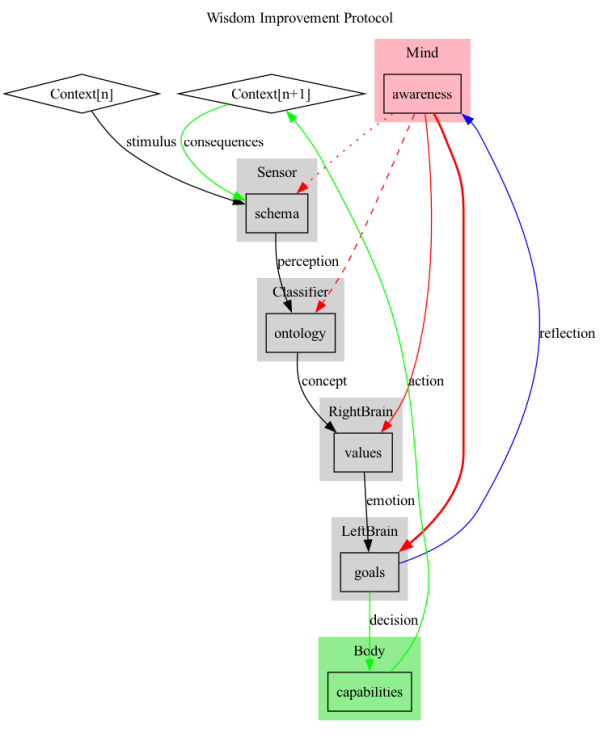
Drawing on Karl Friston’s work on active inference and the theories of Murray Bowen and Edwin Friedman on self-differentiation, I propose a four-stage model of cognition that encapsulates the decision-making process…
The (Noonian) Soong of Solomon: Pursuing Artificial Wisdom by Adding Emotion to Data (by ChatGPT)
Prompt: Star Trek: TNG built a plot line about Data seeking an “emotion chip.” But they should have called it a “feeling chip.” Data the android, like all emergent systems (including LLMs), already requires the functional analog of emotions to properly weigh different opportunities and threats. Applying self-differentiation to this problem may help us move... Continue Reading →
Whole-I-Ness 3: Embracing Vulnerability as the Gateway to Grace and Self-Differentiation (ChatGPT as Brené Brown)
This post connects the previous post about self-differentiation with Brené Brown's focus on vulnerability, showing how embracing vulnerability is crucial to experiencing and extending grace, leading to true self-differentiation and spiritual growth.
Whole-I-Ness 2: Embracing Self-Differentiation As A Modern Path to Spiritual Wholeness (ChatGPT as Larry Wall)
By framing self-differentiation as a process akin to writing clean, efficient Perl code, this post aims to convey the importance of maintaining integrity and clarity amidst life's complexities.
Abstract: X-JEPA – Mimicking Human/Cultural Cognition via Multi-Stage Semantic Mapping
The X-JEPA model introduces a multi-stage approach to semantic mapping, advancing the foundational principles established by eXtending the Joint Embedding Predictive Architecture (JEPA). This new architecture aims to develop cultured AI by mimicking human cognition through a layered structure that progressively builds on JEPA's semantic maps.
Pitch: Trinitarian AI to Mirror Human Cognition
By harnessing the strengths of LLMs for linguistic tasks, LNNs for perceptual and creative tasks, and SDMs for integration, the model promises to excel across a wide spectrum of cognitive tasks


You must be logged in to post a comment.